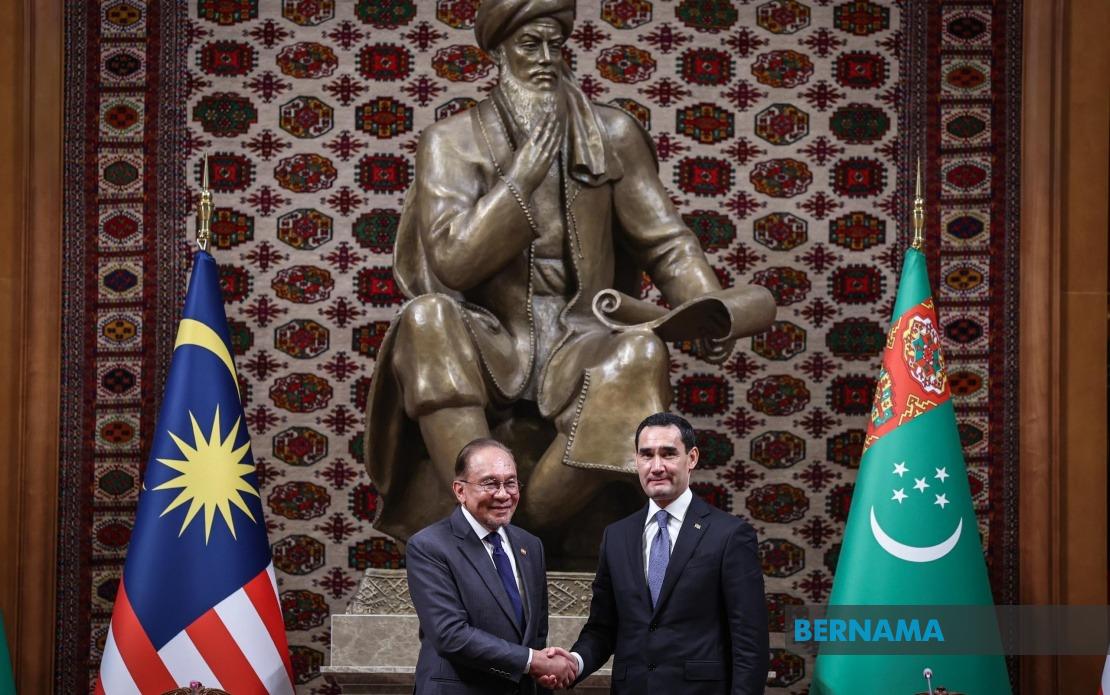
Prime Minister Datuk Seri Anwar Ibrahim has signalled Malaysia's intention to build a more systematic and forward-looking relationship with Turkmenistan, anchored in mutual strategic advantage and substantive people-to-people benefits. The pronouncement came following his formal audience with Turkmenistan President Serdar Berdimuhamedov at the Presidential Palace in Ashgabat on Friday, where the two nations formalised their commitment through a series of binding documents and cooperative frameworks designed to translate political goodwill into tangible outcomes across multiple sectors.
The bilateral engagement reflects a deliberate recalibration of diplomatic ties between two nations separated geographically but increasingly aligned on regional economic interests. Anwar's visit, undertaken at Berdimuhamedov's invitation, represents his inaugural official trip to the Central Asian nation since his assumption of office as Malaysia's 10th Prime Minister in November 2022. The timing and composition of the delegation—which included Minister of Investment, Trade and Industry Datuk Seri Johari Abdul Ghani and Minister of Economy Akmal Nasrullah Mohd Nasir—underscores the economic dimensions of the visit beyond ceremonial protocol.
During their extended bilateral discussions, both leaders navigated an expansive agenda encompassing energy security, commercial ties, investment opportunities, the halal ecosystem, Islamic financial services, academic collaboration, scientific advancement, tourism promotion, and aviation connectivity. This breadth of engagement suggests neither side views the relationship as confined to narrow sectoral interests, but rather as a comprehensive partnership requiring coordination across government ministries and private sector stakeholders. For Malaysia, the conversation around energy cooperation carries particular significance given the nation's ongoing diversification of supply sources and its regional positioning as a trading hub.
The institutional architecture underpinning the partnership gained concrete shape through the exchange of multiple agreements and memoranda of understanding. An Air Services Agreement between the two governments signals intent to facilitate people-to-people movement and tourism flows, potentially opening new routes or expanding frequency of existing connections. This dimension proves strategically important for Malaysia's tourism sector and for business communities seeking direct market access to Central Asian markets. Enhanced air connectivity historically catalyses broader economic integration by reducing transaction costs and travel friction.
Parallel institutional linkages were formalised between Malaysia's Institute of Diplomacy and Foreign Relations and Turkmenistan's corresponding entity under the Foreign Ministry, establishing dedicated channels for diplomatic dialogue and policy coordination. Similarly, the Ministry of Transport engagement and the bilateral accord between the Academy of Sciences Malaysia and the Academy of Sciences of Turkmenistan embed cooperation within government machinery and research infrastructure. These layered institutional connections suggest an intention to prevent partnership agreements from gathering dust, instead embedding accountability and regular engagement mechanisms at multiple bureaucratic levels.
The halal industry cooperation warrants particular attention for Malaysian stakeholders, as Turkmenistan's geographic position astride traditional Islamic trade routes and its Muslim-majority population present untapped opportunities for Malaysian halal certification bodies, food processors, and Islamic financial institutions. Malaysia's established expertise in halal standards development and Shariah-compliant financial engineering positions the nation advantageously to influence Central Asian market standards and capture value in these emerging sectors. The emphasis on Islamic banking further signals Turkmenistan's openness to alternative financial architectures that could diversify its economy beyond hydrocarbon dependence.
Energy cooperation represents perhaps the most economically consequential dimension of this partnership. Turkmenistan possesses substantial natural gas reserves and has historically sought to diversify export routes beyond Russian and Chinese channels. Malaysia, as a significant regional energy consumer and a major liquefied natural gas importer, represents both a potential customer and a gateway to Southeast Asian markets. The inclusion of energy discussions in high-level bilateral talks suggests serious exploration of long-term supply arrangements, though no specific commitments appear to have been announced publicly at this stage.
The joint statement and supporting memoranda embody a commitment to disciplined, transparent and effective implementation of agreed initiatives. This language, whilst appearing boilerplate, carries significance in development partnerships where accountability mechanisms often determine the difference between aspirational frameworks and genuine collaboration. The involvement of multiple Malaysian ministries and delegations indicates institutional buy-in across government, suggesting that implementation will not fall upon a single department but will be distributed across relevant agencies with sector expertise.
For Malaysia's broader regional diplomatic posture, strengthened ties with Turkmenistan reflect strategic engagement with Central Asia at a moment when great power competition is intensifying in the region. China's Belt and Road Initiative and Russia's traditional interests create a complex geopolitical landscape, within which Malaysia positions itself as a neutral, commercially-oriented partner offering expertise in Islamic finance, halal standards, and Southeast Asian market access without the baggage of colonial history or contemporary military alliances that complicate certain bilateral relationships. This positioning appeals to nations like Turkmenistan seeking partnership on reciprocal terms.
The education and research cooperation outlined in the Academy of Sciences accord offers potential for academic mobility, joint research initiatives in fields ranging from energy technology to agricultural science, and capacity-building that benefits both nations' technical workforces. Such programmes typically develop slowly but establish human networks that sustain diplomatic relationships across political transitions and economic cycles. Young scholars and researchers moving between Malaysia and Turkmenistan universities become informal ambassadors, fostering cultural understanding that provides foundation for enduring relations.
Tourism cooperation, though mentioned more briefly in official statements, potentially holds significant upside for both economies. Turkmenistan's cultural heritage, notably the ancient cities of Merv and Khiva and its distinctive architectural traditions, appeals to tourists seeking off-the-beaten-path Central Asian experiences. Malaysian tourism operators and hospitality enterprises stand to benefit from tour itineraries incorporating Turkmenistan, whilst Turkmenistan gains from Malaysian tourism expertise and marketing networks. The Air Services Agreement facilitates such tourism flows by reducing travel friction.
Looking forward, the success of this partnership framework will depend on whether the momentum generated during the Prime Minister's visit translates into operational reality at ministerial and official levels. Bilateral relationships between non-aligned nations operating at geographical distance require sustained attention and regular high-level engagement to prevent drift. Malaysia's commitment to disciplined implementation of the agreed framework suggests an institutional approach rather than personalities-dependent diplomacy, which bodes well for continuity. The next markers to observe include whether joint committees meet on schedule, whether technology and investment flows commence, and whether airline connections materialise, all of which would validate this reinvigorated partnership.
Anwar's visit to Ashgabat thus represents more than ceremonial diplomacy. It signals Malaysia's determination to cultivate relationships beyond Southeast Asia and the Indo-Pacific, engaging with Central Asia as an emerging arena for commerce, cultural exchange, and strategic cooperation. In an era of multipolar international relations, such diversified partnerships reduce dependence on any single power whilst expanding opportunities for Malaysian businesses, investors, and service providers. The comprehensive nature of the agreements suggests both nations recognise mutual benefit in structured, long-term engagement anchored in shared values and complementary economic interests.

