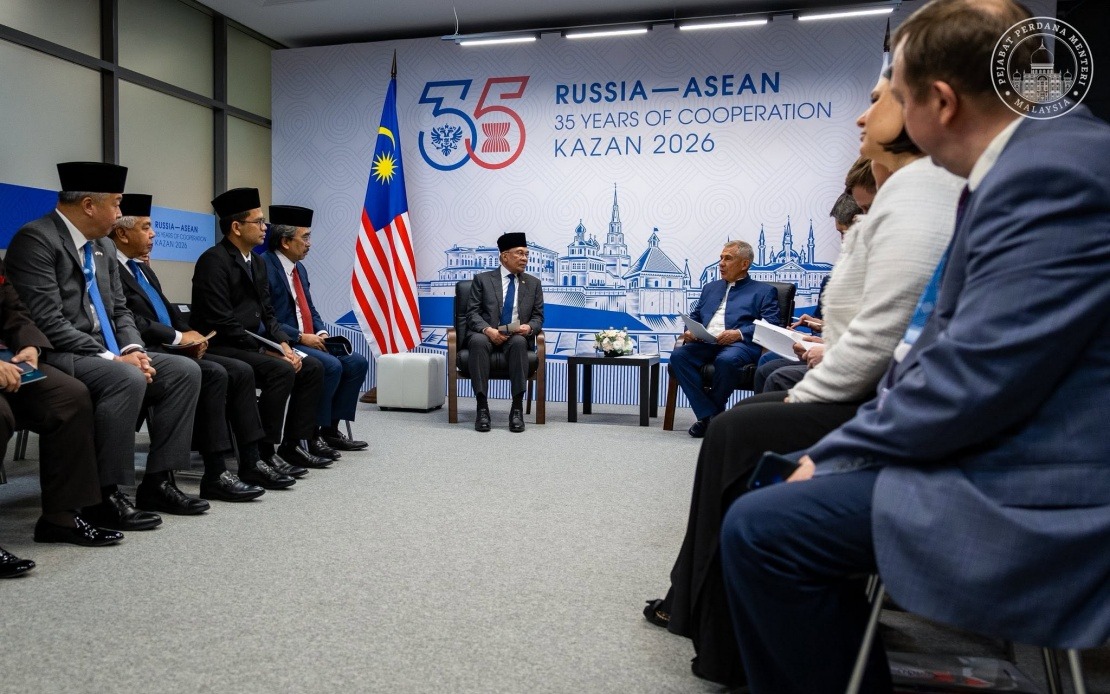
Prime Minister Datuk Seri Anwar Ibrahim has signalled Malaysia's intention to significantly broaden its engagement with the Republic of Tatarstan, identifying multiple avenues for mutual benefit spanning commerce, industrial development, cultural exchange and technological advancement. The announcement came following a bilateral meeting with Tatarstan's head Rustam Minnikhanov shortly after Anwar's arrival in Kazan on Tuesday, where the two leaders deliberated on concrete pathways to strengthen ties that could yield tangible returns for citizens and enterprises of both nations.
Energy cooperation stands as a cornerstone of the emerging partnership framework, given Tatarstan's prominence as one of Russia's principal petroleum-producing territories. During their discussion, Anwar and Minnikhanov explored the full spectrum of hydrocarbon sector possibilities, extending beyond crude extraction to encompassing downstream processing, refining capabilities and petrochemical manufacturing. This focus reflects Malaysia's strategic interest in diversifying its energy partnerships while leveraging Tatarstan's technical expertise and resource abundance to create shared commercial opportunities in advanced oil and gas ventures.
Beyond the energy domain, the bilateral agenda spans an impressively broad portfolio of cooperation areas. Trade and investment frameworks emerge as natural starting points for relationship deepening, given the complementary economic profiles of both regions. The discussions also factored in Malaysia's halal industry prominence, an area where Tatarstan's positioning within the Islamic world creates synergies for certification standards, product development and market access expansion. Educational partnerships, tourism development, and human capital strengthening initiatives were similarly flagged as fertile ground for institutional collaboration and people-to-people exchanges.
The Kazan Forum itself featured prominently in Anwar and Minnikhanov's conversations, with both leaders recognising its utility as a convening platform for business leaders and investors from both sides. The forum represents an institutional mechanism through which Malaysia and Tatarstan can facilitate commerce, explore innovation opportunities within the digital economy, and identify strategic investment corridors that bridge their respective markets and capabilities. This structured engagement model promises to move discussions beyond diplomatic pleasantries into concrete deal-making and partnership execution.
Anwar's visit to Kazan carries particular symbolic resonance given the city's recent designation as the Islamic World Cultural Capital 2026 by the Islamic World Educational, Scientific and Cultural Organisation. This recognition reflects Kazan's multifaceted role as a custodian of Islamic scholarship, a dynamic cultural hub and an innovation centre—attributes that align meaningfully with Malaysia's own positioning within the Muslim world and its aspirations to lead in halal industry standardisation and Islamic finance. The Prime Minister's acknowledgment of this designation underscores Malaysia's appreciation for Tatarstan's contributions to Islamic civilisation and his recognition of shared values within the broader Muslim community.
A particularly noteworthy element of Anwar's remarks centred on his commendation of President Vladimir Putin's establishment of the Strategic Vision Group, an initiative positioned as a critical bridge between Russia and Islamic-majority nations in fostering meaningful dialogue and constructive collaboration. This observation suggests that Malaysia views its relationship with Russia as embedded within a broader framework of civilisational engagement, where religious and cultural affinity can catalyse political and economic partnership. The Strategic Vision Group's existence provides institutional scaffolding for sustained engagement beyond temporary diplomatic cycles.
Anwar's two-day working visit to Kazan serves as his primary platform to represent Malaysia at the ASEAN-Russia Commemorative Summit, an engagement representing the pinnacle of dialogue between the 10-nation Southeast Asian bloc and the Russian Federation. This summit underscores the maturation of ASEAN-Russia relations since their establishment as dialogue partners in 1991 and their subsequent elevation to full Strategic Partnership status in 2018. The 2018 upgrade reflected shared commitment to expanding cooperation across political security dimensions, economic integration, and socio-cultural domains—precisely the areas where Malaysia and Tatarstan are now exploring deeper involvement.
The Prime Minister travelled to Kazan accompanied by a high-powered delegation reflecting the significance Malaysia attaches to this engagement. Investment, Trade and Industry Minister Datuk Seri Johari Abdul Ghani and Economy Minister Akmal Nasrullah Mohd Nasir participated in the visit alongside officials from the Prime Minister's Office and Foreign Ministry, suggesting that commercial negotiations and economic coordination will receive intensive attention beyond the ceremonial bilateral meeting. This ministerial composition signals Malaysia's readiness to translate partnership aspirations into bureaucratic action and regulatory frameworks.
Kazan itself possesses characteristics that render it a logical focal point for Malaysia's Russian engagement. Situated roughly 800 kilometres east of Moscow at the confluence of the Volga and Kazanka rivers, this city of approximately 1.3 million inhabitants holds the informal status of Russia's "third capital" following Moscow and Saint Petersburg. Beyond demographic significance, Kazan maintains a millennium-spanning history and occupies a singular position within Russia's landscape as a predominant centre of Islamic culture and heritage. This identity makes Kazan an exceptionally natural interlocutor for Malaysia on matters involving halal standards, Islamic education, and faith-based commerce.
The bilateral meeting between Anwar and Minnikhanov reflects a calculated Malaysian strategy to develop differentiated relationships within Russia beyond the central government in Moscow. Tatarstan's substantial autonomy within the Russian federation, combined with its economic weight and Islamic dimensions, makes it an exceptionally valuable partner for Malaysia's regional and global positioning. Engagement at the subnational level allows Malaysia to build resilient partnerships that transcend fluctuations in bilateral relations between Kuala Lumpur and Moscow, while simultaneously accessing Tatarstan's distinctive capabilities in petroleum production, Islamic governance, and cross-cultural bridge-building.
For Malaysian readers, the significance of this diplomatic initiative lies in its potential to create employment opportunities through joint ventures, investment flows into Malaysian enterprises with Tatar capital, and institutional partnerships within education and professional development. The emphasis on the halal industry carries particular resonance given Malaysia's aspirations to become the global standard-setter for halal certification and Islamic business practices. Similarly, technology and digital economy cooperation could facilitate knowledge transfer and innovation partnerships that strengthen Malaysia's competitive position within Southeast Asia and beyond.
The ASEAN-Russia Commemorative Summit represents a broader canvas within which Malaysia's bilateral engagement with Tatarstan operates. As a founding ASEAN member and current representative within the bloc's collective diplomacy, Malaysia's actions during this summit shape not only bilateral relations but also the strategic orientation of ASEAN-Russia cooperation as a whole. Malaysia's emphasis on diverse cooperation areas—from traditional sectors like energy to emerging domains like digital innovation—reflects a forward-looking approach to partnership architecture that transcends commodity-based relationships and contemplates knowledge-intensive collaboration.