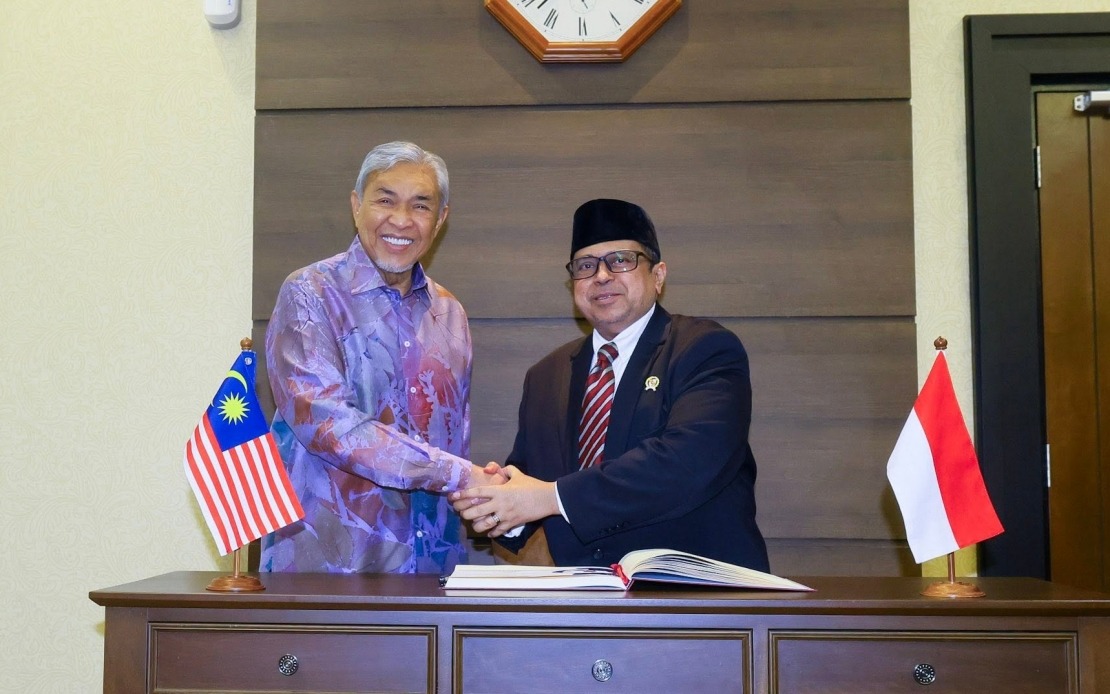
Malaysia and Indonesia are embarking on an ambitious programme to deepen their strategic partnership in the halal sector, signalling a shift towards greater regional integration in one of the world's fastest-growing certification and compliance markets. During a high-level meeting at Parliament, Deputy Prime Minister Datuk Seri Dr Ahmad Zahid Hamidi held discussions with Indonesia's Ambassador to Malaysia, Raden Datuk Mohammad Iman Hascarya Kusumo, and Dr Ahmad Haikal Hassan, who heads Indonesia's Halal Product Assurance Organising Body (BPJPH), to chart a collaborative roadmap spanning multiple dimensions of economic cooperation.
The discussions revealed a comprehensive agenda extending well beyond halal certification alone. Both nations identified rural development, human capital advancement, and broader trade expansion as complementary areas where bilateral synergies could unlock significant value. This multisectoral approach reflects recognition that halal standardisation cannot exist in isolation but must be embedded within a broader framework of economic complementarity. For Malaysia, which has long positioned itself as a global halal hub, the partnership represents an opportunity to leverage Indonesia's vast consumer base and production capacity. For Indonesia, collaboration with Malaysia offers access to established certification expertise and international market networks.
Central to the partnership framework are three proposed institutional platforms designed to reshape how halal governance operates across jurisdictional boundaries. The Malaysia-Indonesia Halal Council (MIHC) would serve as a bilateral mechanism for coordinating standards, resolving technical disputes, and facilitating business-to-business connections between certified producers in both countries. The proposed ASEAN Halal Council would escalate this cooperation to the regional level, creating opportunities for Vietnam, Thailand, the Philippines, and other member states to align their approaches and collectively strengthen Southeast Asia's position in global halal trade. A third pillar, the World Halal Development Council, signals ambition to reshape international discussions around halal standards, potentially challenging existing frameworks dominated by Middle Eastern certification bodies.
The establishment of these councils addresses a persistent challenge within the halal ecosystem: the proliferation of competing standards and certification bodies that create friction for international traders. Currently, manufacturers seeking to export halal products across borders often must navigate multiple certification requirements, each with different methodologies and approval timelines. A harmonised standard facilitated through formal councils would significantly reduce compliance costs for businesses, particularly small and medium enterprises that lack resources to manage parallel certification processes. This efficiency gain could catalyse expanded cross-border trade, benefiting Malaysian and Indonesian exporters who currently face fragmented regional markets.
Ahmad Zahid's leadership as chairman of the Malaysia Halal Industry Development Council positions him strategically to champion this agenda within government. His emphasis on leveraging the historical closeness between Malaysia and Indonesia underscores recognition that institutional frameworks alone cannot drive cooperation—genuine political commitment and interpersonal relationships remain essential. The mention of using bilateral ties as a catalyst acknowledges that Indonesia and Malaysia share linguistic, cultural, and religious commonalities that can facilitate smoother negotiation and implementation of complex agreements compared to partnerships with more distant nations.
For Malaysia's economy, the implications are substantial. The halal sector has evolved from a niche concern into a significant export driver, with certified halal products commanding premium prices in markets across the Middle East, North Africa, and Southeast Asia itself. By formalising cooperation with Indonesia, Malaysia can consolidate its market leadership whilst simultaneously expanding the addressable market through improved regional supply chains. Indonesian manufacturers, once integrated into a harmonised framework, become part of Malaysia's extended production ecosystem rather than competitors, allowing Malaysian companies to diversify sourcing and manage supply chain risks more effectively.
The regional dimension carries particular weight given ASEAN's broader integration agenda. A functioning ASEAN Halal Council would demonstrate that the bloc can create substantive institutional capacity in sectors where member states possess genuine comparative advantage. Unlike generic trade liberalisation, which often benefits countries unevenly, halal standardisation creates shared benefits because all ASEAN members have Muslim-majority or significant Muslim minority populations with genuine demand for certified products. This alignment of economic interest with cultural and religious values creates unusually durable political support for cooperation.
The proposed World Halal Development Council projects influence beyond Southeast Asia into global governance forums. Currently, organisations based in the Middle East dominate international halal discussions, and certification bodies in that region often set de facto global standards. Malaysia and Indonesia together represent over 500 million Muslims and significant halal production capacity, yet their voice in global standard-setting remains proportionally weak. A joint council could amplify their influence in international bodies, potentially reshaping certification methodologies to reflect Southeast Asian agricultural practices and manufacturing contexts rather than simply importing Middle Eastern approaches.
Industrial competitiveness also favours this cooperation model. Malaysia's established halal brand and certification expertise, combined with Indonesia's lower production costs and abundant raw materials, create a natural complementarity. Malaysian companies could establish production or assembly operations in Indonesia whilst maintaining Malaysian halal certification, capturing cost advantages without sacrificing brand positioning. Indonesian producers gain access to Malaysian distribution networks and certification credibility. This vertical integration, enabled by harmonised standards, would strengthen both countries against competition from other halal producers globally.
The sustainability of this partnership depends on several factors. Technical harmonisation requires resolving differences in inspection protocols, documentation requirements, and appeals processes—areas where bureaucratic inertia often impedes progress. Political support must endure across election cycles and potential changes in government priorities. Business community buy-in is essential; chambers of commerce and manufacturing associations in both countries must actively lobby for standards that reduce their compliance burdens. Additionally, other ASEAN members must be convinced that the framework serves their interests rather than advancing Malaysian-Indonesian dominance within the bloc.
For Malaysian readers and investors, this development signals expanding opportunity in halal-linked supply chains and certification services. Companies with existing halal certifications could leverage improved regional market access. Service providers specialising in compliance, logistics, and quality assurance face growing demand as cross-border halal trade accelerates. Investors in food manufacturing, cosmetics, pharmaceuticals, and related sectors should monitor progress on the council's establishment, as harmonised standards could significantly improve their export competitiveness and reduce regulatory uncertainty.
The timing of this initiative reflects broader regional economic currents. As global supply chains reconfigure following pandemic disruptions and geopolitical tensions, Southeast Asian countries are increasingly recognising the value of intra-regional cooperation as an alternative to dependence on distant suppliers. The halal sector, rooted in religious obligation and cultural identity, provides a foundation for cooperation less vulnerable to political shifts than generic trade arrangements. Malaysia and Indonesia are positioning themselves to shape this evolution rather than adapt to frameworks designed elsewhere.

