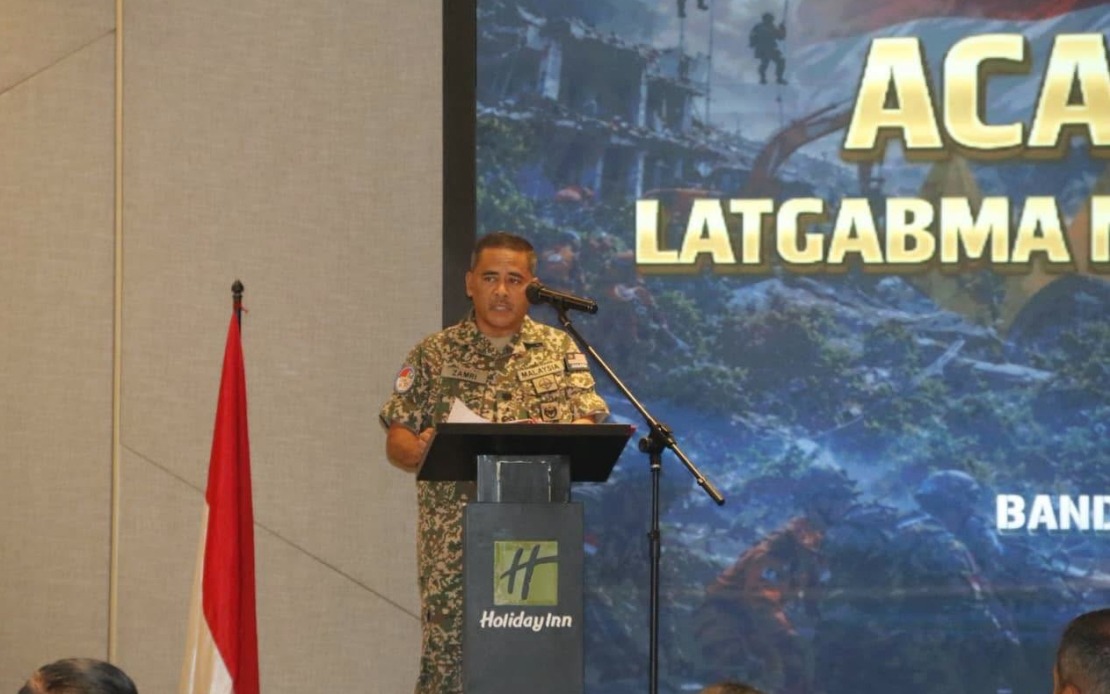
Malaysia and Indonesia have taken another significant step in their regional defence partnership, launching a comprehensive 13-day joint military exercise in Lampung, Sumatra. The LATGABMA MALINDO DARSASA 12AB/2026 exercise, coordinated between the Malaysian Armed Forces (MAF) and Indonesia's TNI (Tentara Nasional Indonesia), represents more than routine military coordination—it reflects a deepening strategic relationship between two of Southeast Asia's largest defence establishments and closest neighbours.
The exercise brings together 719 participants from various agencies across both nations, demonstrating the scale of commitment to bilateral defence cooperation. Operating from Al-Sultan Abdullah Camp, the Malaysian military's Joint Forces Headquarters oversaw the initiative alongside Indonesian counterparts. Brig Gen Datuk Zamri Othman, Commander of the 1st Infantry Brigade and head of the MAF Exercise Planning Group, characterised the deployment as a tangible expression of the fraternal bonds and mutual strategic confidence that underpin Malaysia-Indonesia relations. These words carry particular weight given the two countries' shared maritime borders, overlapping economic interests, and common security challenges.
The contemporary security landscape in Southeast Asia increasingly demands precisely the kind of integrated operational response this exercise practises. Non-traditional threats—ranging from piracy and transnational smuggling networks to the persistently evolving terrorism threat and sophisticated cyber warfare capabilities—do not respect borders and cannot be tackled by individual nations acting in isolation. The inclusion of cyber security components reflects recognition that modern threats operate across digital, physical, and maritime domains simultaneously. By training personnel across land, sea, and air capabilities, the exercise equips both militaries with shared operational languages and coordinated response protocols.
LatGabma Malindo Darsasa has operated as a vital institutional mechanism since 1984, conducted every three years on a rotating basis through the General Border Committee and the Malaysia-Indonesia Joint Training Committee. The decision to hold the 2023 edition in Pekan, Pahang with an anti-terrorism focus, followed by this year's iteration centred on humanitarian and disaster response, reflects pragmatic adaptability. The choice of Lampung province as host location demonstrates strategic thinking grounded in geographical reality. Situated at the convergence of three active tectonic plate systems, the region experiences recurring natural disasters—a reality that makes hypothetical scenarios immediately relevant and survival-focused.
The exercise architecture incorporates rigorous academic preparation through Staff Exercises focused on ten critical scenarios. Initial disaster response coordination, management of mass casualties, infrastructure collapse scenarios, medical emergencies, international assistance protocols, cyber attacks, information warfare, mass evacuation logistics, stabilisation phases, and transition planning form the foundational curriculum. This structured approach ensures that theoretical knowledge translates into practical competency during subsequent field operations. Rather than treating doctrine as abstract military theory, planners have rooted training scenarios in actual disaster experiences from Indonesia's southern Sumatra region, including historical earthquake and tsunami impacts that claimed lives and displaced populations across the archipelago.
The field training phase emphasises Force Integration Training involving MAF personnel, TNI soldiers, and diverse Indonesian civilian agencies including the National Search and Rescue Agency, disaster preparedness cadets, the Indonesian Red Cross, and regional disaster management authorities. This integration is crucial because real-world humanitarian disasters do not unfold within military hierarchies alone. Rope work, rappelling techniques, emergency response protocols, and field hospital establishment represent core competencies that transcend military-civilian distinctions. The deliberate inclusion of multiple agency types reflects understanding that effective disaster response requires seamless coordination between uniformed services and civilian relief organisations.
Beyond conventional military training, the exercise encompasses meaningful community engagement through engineering and medical civic action programmes. Two uninhabitable houses in Kampung Sukamaju are being repaired, whilst a concrete road is under construction in Kampung Keteguhan. These infrastructure improvements address genuine local needs and demonstrate to communities that bilateral military cooperation produces tangible benefits. Simultaneously, the medical programme—featuring general health screenings, spectacle distribution, and blood donation initiatives at the Community Health Centre—extends practical care to populations often underserved in rural Sumatran areas. Such programmes build grassroots goodwill and demonstrate that military institutions serve civilian populations, not merely strategic state interests.
The cyber security component represents increasingly critical modernisation of military cooperation. Training covers technical fundamentals from reconnaissance and enumeration through credential attacks, man-in-the-middle vulnerabilities, spoofing techniques, and feed manipulation. As both nations develop more sophisticated digital infrastructure and military systems become internet-connected, cyber resilience transforms from specialised concern into foundational security requirement. Joint training in these domains ensures compatibility of defensive systems and shared understanding of cyber threat landscapes that transcend geography.
The exercise composition reveals carefully calibrated participation: 463 TNI personnel, 150 MAF personnel, representatives from Malaysia's National Disaster Management Agency, Indonesian police contingents, and personnel from various Indonesian civilian agencies. This distribution reflects both nations' commitment whilst maintaining realistic force structures. For Malaysia, participation demonstrates continued investment in regional stability and bilateral relations despite resource constraints. For Indonesia, hosting the exercise underscores its role as a natural security leader within Southeast Asia and its commitment to cooperative rather than hegemonic regional approaches.
From a Malaysian perspective, this exercise carries particular significance. As a smaller nation sharing one of the world's longest maritime borders with a far larger neighbour, Malaysia's security architecture depends substantially on frameworks of institutional trust and procedural cooperation. Exercises like Latgabma Malindo Darsasa institutionalise regular engagement, create personal relationships between military professionals, and establish protocols that function smoothly during actual crises. When natural disasters strike—and in the region they inevitably do—these pre-existing relationships and trained coordination mechanisms save lives and accelerate relief delivery. The exercise also reinforces Malaysia's position within Southeast Asian security networks, demonstrating to regional peers that it maintains robust partnerships grounded in practical capability development rather than rhetorical posturing.
The rotational hosting arrangement, with exercises alternating between Malaysian and Indonesian territory every three years, embodies genuine partnership principles. Malaysia hosted the previous iteration; Indonesia hosts this one. This reciprocal arrangement ensures both militaries gain experience deploying in different geographical and operational contexts. For Malaysian planners, the Lampung setting offers opportunities to understand disaster response in volcanic regions with specific seismic characteristics, expanding the knowledge base applicable to Malaysian territory's own geological features.
Looking forward, this exercise establishes foundations for increasingly sophisticated bilateral cooperation. Cyber threats, maritime security, terrorism financing, human trafficking, and environmental degradation affect both nations. Military-to-military relationships grounded in regular realistic training create the institutional trust necessary for intelligence sharing, coordinated operations, and rapid crisis response. Whether responding to maritime accidents, addressing cross-border security incidents, or managing natural disasters, the relationships and procedures developed through exercises like Latgabma Malindo Darsasa transform theoretical cooperation into practical capability.