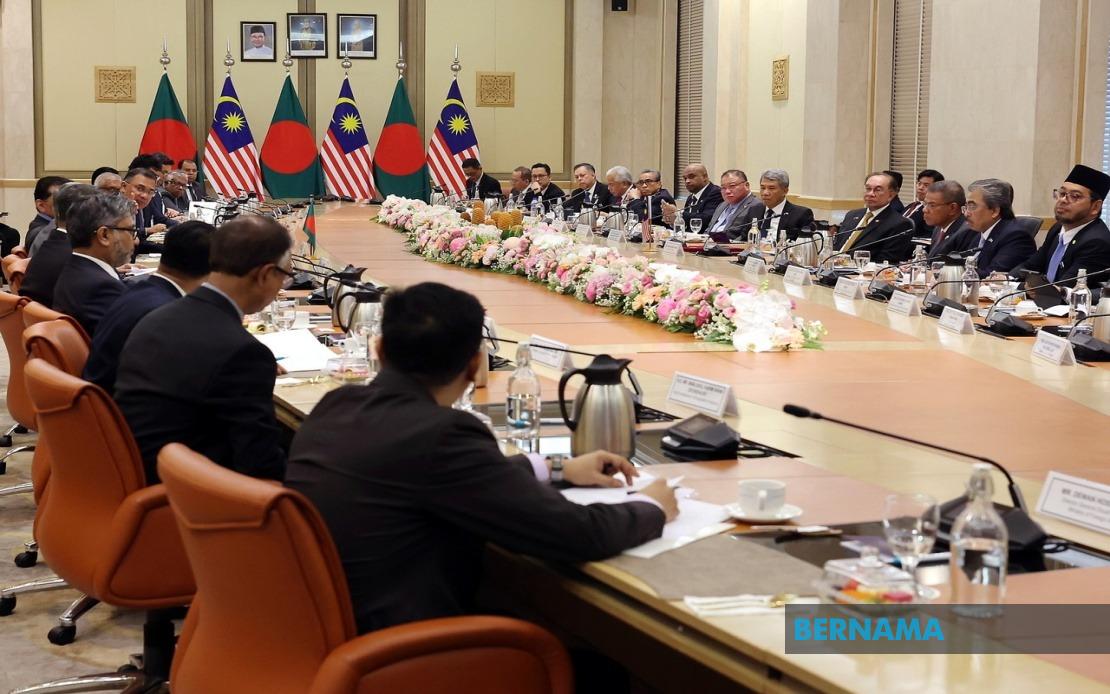
Prime Minister Datuk Seri Anwar Ibrahim has called for Malaysia and Bangladesh to substantially broaden their cooperative framework beyond conventional trade and investment channels, directing both nations toward emerging technological domains that will define regional competitiveness in the coming decades. Speaking during a joint press conference with visiting Bangladesh Prime Minister Tarique Rahman in Putrajaya on June 22, Anwar emphasised that artificial intelligence, energy solutions, and semiconductor development represent critical frontiers where the two countries can generate mutual prosperity and technological advancement.
The Malaysian premier's remarks underscore a strategic pivot in bilateral relations, reflecting broader regional recognition that Southeast Asia must invest heavily in future-oriented sectors to remain economically relevant. While agriculture has traditionally anchored Malaysia-Bangladesh trade relations, Anwar articulated a vision that encompasses digital economy infrastructure, advanced manufacturing capabilities, and renewable energy frameworks—domains where both nations possess complementary strengths and market opportunities. This reorientation aligns with Malaysia's own positioning as a semiconductor hub and growing artificial intelligence ecosystem, whilst Bangladesh's substantial population and manufacturing base offer attractive investment and partnership possibilities.
The emphasis on artificial intelligence collaboration carries particular significance given the technology's transformative impact on production efficiency, healthcare delivery, and financial services across Asia. Both nations face similar pressures to upgrade digital capabilities and develop local expertise in AI research and application, making coordinated development initiatives potentially advantageous. Malaysian companies and research institutions could share semiconductor manufacturing knowledge whilst benefiting from Bangladesh's lower-cost production capacity and emerging tech talent pool, creating a mutually reinforcing innovation corridor.
Energy cooperation represents another dimension where complementary interests converge. Bangladesh, like much of South Asia, grapples with energy demand pressures and climate imperatives, whilst Malaysia possesses established expertise in liquefied natural gas operations, renewable energy development, and energy efficiency technologies. Structured collaboration in clean energy transition could position both nations as sustainability leaders within the region whilst addressing individual energy security objectives. Joint ventures in solar and wind technologies, energy storage systems, and grid modernisation could attract international investment and technical expertise.
Semiconductor sector deepening holds particular strategic weight given global supply chain vulnerabilities exposed in recent years. Malaysia's established position as a leading semiconductor manufacturing hub, hosting operations by major multinational firms, creates natural pathways for Bangladesh to integrate into value chains through component production, assembly operations, or specialised manufacturing niches. Such collaboration would strengthen Southeast Asian semiconductor resilience whilst offering Bangladesh technology transfer and industrial development benefits that support broader economic advancement.
During the official engagement, both nations formalised three significant bilateral instruments. A Memorandum of Understanding on Cultural Cooperation establishes frameworks for educational exchanges, arts initiatives, and heritage conservation activities that deepen people-to-people connections beyond governmental channels. Concurrently, two Exchanges of Notes addressed Counter-Terrorism Research cooperation and Investment Promotion and Facilitation mechanisms, acknowledging that security coordination and streamlined investment procedures underpin successful economic partnerships. These formal agreements create institutional scaffolding upon which the technological and sectoral expansion can be constructed.
The Bangladesh Prime Minister's two-day official visit to Malaysia reflects the importance both governments assign to strengthening bilateral relations at a moment when regional geopolitical dynamics are shifting. Bangladesh's emergence as South Asia's fastest-growing economy and its strategic location alongside the Bay of Bengal render it an increasingly consequential partner for Malaysia's regional engagement strategy. Similarly, Malaysia's technological capabilities and established international business networks offer Bangladesh valuable pathways for industrial upgrading and technological absorption.
From a Malaysian perspective, expanded cooperation with Bangladesh addresses several strategic imperatives. First, it diversifies economic partnerships across Southeast Asia and South Asia, reducing overreliance on traditional developed-market relationships. Second, it positions Malaysian companies and research institutions as regional technology leaders capable of mentoring and collaborating with ambitious neighbouring economies. Third, it creates new export markets and investment opportunities precisely when global trade patterns remain fluid and unpredictable. Fourth, it supports ASEAN's broader integration agenda by strengthening bridges between Southeast and South Asia through Bangladesh's dual identity as both a major South Asian economy and a close regional partner.
The sectoral focus on emerging technologies also reflects recognition that traditional comparative advantages—agricultural production, low-cost manufacturing, resource extraction—increasingly depend upon technological sophistication and innovation capacity. By anchoring bilateral cooperation in AI, semiconductors, and advanced energy systems, both nations position themselves within global value chains offering higher margins, greater employment quality, and more resilient growth trajectories than commodity-dependent models. This strategic orientation mirrors Malaysia's own transition efforts and addresses Bangladesh's developmental aspirations for industrial sophistication.
Investment promotion mechanisms formalised through the Exchange of Notes become particularly consequential within this emerging technology context. Streamlined procedures for technology transfers, joint venture approvals, and research facility establishment can significantly accelerate practical implementation of bilateral agreements. Malaysian semiconductor firms seeking production cost optimisation or component sourcing diversification gain clearer pathways for Bangladesh operations, whilst Bangladeshi entities pursuing technology partnerships encounter fewer procedural impediments. Such facilitation mechanisms transform high-level political commitments into tangible commercial outcomes.
The counter-terrorism research cooperation dimension, though less prominently featured in discussions, addresses shared security challenges inherent in an increasingly interconnected region. Both nations face evolving terrorism and extremism threats, and collaborative research capacity—encompassing intelligence analysis, deradicalisation programmes, and security technology development—enhances regional stability whilst creating expertise-sharing opportunities. This security foundation strengthens the entire bilateral relationship by building confidence necessary for deeper economic and technological integration.
Looking forward, successful implementation of these expanded cooperation frameworks requires sustained governmental commitment, private sector engagement, and institutional development. Malaysian research universities and technology firms must actively pursue partnerships with Bengali counterparts, whilst Bangladesh must create enabling regulatory environments that attract Malaysian investment in semiconductor and AI ventures. Trade associations, chambers of commerce, and professional networks should facilitate business relationship development and knowledge exchange.
The Malaysia-Bangladesh partnership expansion into emerging sectors represents a microcosm of broader Southeast Asian strategies for positioning the region as a consequential technological player. As global powers compete for technological leadership and supply chain dominance, regional economies must leverage cooperative frameworks to build collective capacity. By mobilising complementary strengths in semiconductors, artificial intelligence, and energy innovation, Malaysia and Bangladesh demonstrate that South-Southeast Asian collaboration can generate prosperity benefits unavailable through purely national or traditional bilateral approaches.

