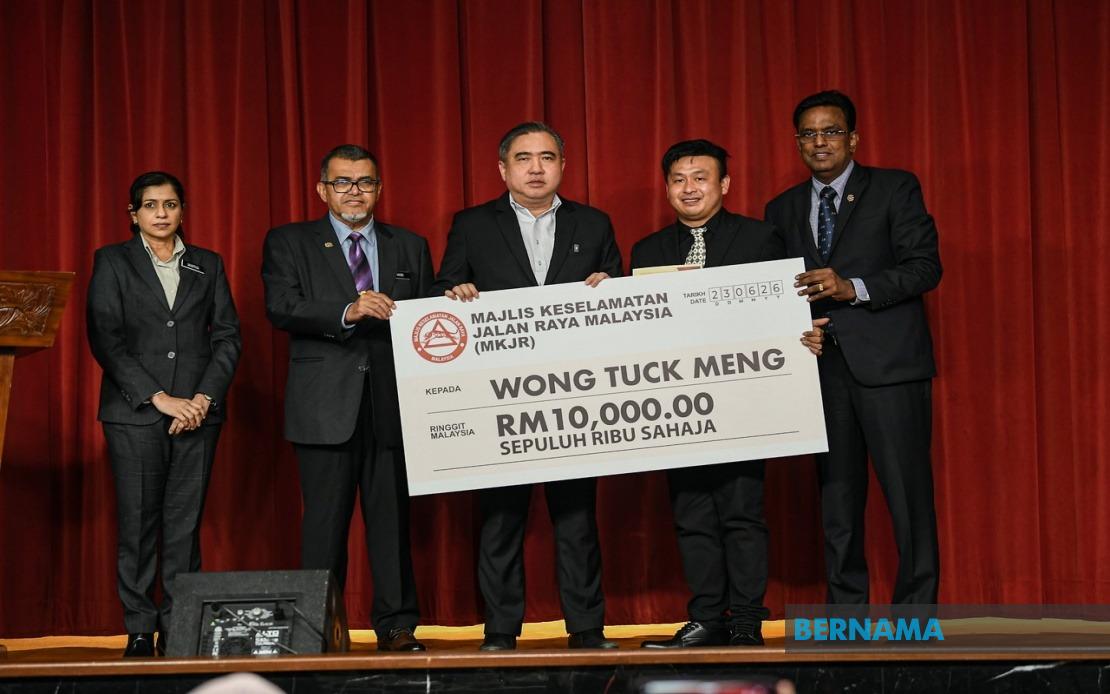
Wong Tak Ming, a lorry driver whose split-second decision-making prevented a potential disaster on a Perak expressway, has been honoured by the Malaysian government at a ceremony held at Parliament today. Transport Minister Anthony Loke presented Wong with a Special Certificate of Appreciation and RM10,000 in recognition of his actions during an incident on June 15, when he helped save 21 passengers travelling on an express bus. The award, funded by the Malaysian Road Safety Council (MKJR), underscores the government's commitment to recognising individuals who demonstrate exceptional bravery in preventing road tragedies.
The incident that prompted the award occurred when an express bus travelling from Kedah to Kuala Lumpur experienced a technical failure whilst negotiating a downhill section near the Menora Tunnel. The loss of control triggered a potentially catastrophic sequence of events, but Wong's immediate intervention altered the trajectory of what could have been a fatal collision. Rather than attempting to brake suddenly or veer away from the uncontrolled bus, Wong employed a calculated strategy that demonstrated both composure and tactical awareness. He positioned his lorry to make controlled contact with the rear of the runaway bus, effectively using the weight and momentum of his vehicle to assist in slowing the larger conveyance.
Following the initial contact, Wong executed a precise manoeuvre by steering his lorry closer to the guardrail whilst maintaining engagement with the bus. This positioning allowed both vehicles to come to a controlled halt without triggering a catastrophic collision or leaving the road surface entirely. The action required Wong to maintain focus despite the obvious danger to himself and his vehicle, as the combined momentum of two heavy vehicles presented significant risks. Transport Minister Loke characterised Wong's conduct as heroic, stating that his swift intervention prevented what could have devolved into a tragic accident and preserved the lives of more than twenty people.
In his address at the Parliament building ceremony, Loke emphasised the gravity of Wong's decision-making under extreme pressure. The minister noted that Wong's actions demonstrated not only physical quick reflexes but also the mental clarity required to assess the situation and respond appropriately within mere seconds. This distinction is particularly significant in road safety contexts, where many accidents result from drivers freezing under pressure or making panic decisions that worsen outcomes. Wong's behaviour represents a model for how professional drivers should respond to emergency situations on Malaysia's highways, where technical failures can occur at any moment regardless of vehicle maintenance standards.
When interviewed following the ceremony, Wong provided insight into his thought process during the incident, revealing a mentality focused entirely on casualty prevention rather than self-preservation. He explained that his immediate concern was to arrest the bus's momentum and simultaneously alert other motorists further ahead to the developing danger. The existence of distance between his lorry and the oncoming bus provided a crucial window of opportunity, which Wong used to sound his horn repeatedly, warning vehicles ahead to move out of the potential collision zone. This dual-action response—directly intervening to slow the bus whilst simultaneously warning downstream traffic—demonstrates the kind of comprehensive situational awareness that could serve as training material for professional driver development programmes.
The incident gained significant public attention when video footage circulated across social media platforms, generating widespread appreciation for Wong's selfless actions. The viral nature of the recording ensured that his heroism received recognition beyond official channels, with members of the public praising his courage and judgment. This grassroots appreciation likely contributed to the government's decision to formalise recognition through the special ceremony at Parliament, acknowledging that road safety is not merely a governmental responsibility but a shared social concern requiring acknowledgment of individual contributions.
Parliament itself formally recognised Wong's contribution to road safety when Deputy Speaker Datuk Dr Ramli Mohd Nor conveyed the Dewan Rakyat's gratitude following Transport Minister Loke's tabling of the Road Transport (Amendment) Bill 2025 for its second reading. This parliamentary acknowledgment elevates Wong's actions beyond individual heroism into the realm of national policy and legislative consideration. The timing suggests that the incident may have influenced discussions regarding bus safety standards, technical inspection protocols, or emergency response procedures that could subsequently be incorporated into revised road transport regulations.
The recognition of Wong's actions carries implications for Malaysia's broader road safety culture. Professional drivers constitute a critical component of the national transportation infrastructure, and their responses to emergency situations directly affect passenger safety across the country. By publicly honouring exceptional conduct, the government signals that proactive, safety-conscious driving practices will be recognised and rewarded. This approach potentially incentivises other professional drivers to maintain the highest standards of alertness and preparedness, knowing that their contributions to accident prevention may be formally acknowledged.
The incident near the Menora Tunnel also highlights the ongoing challenges associated with bus transportation safety in Malaysia. Technical failures on commercial vehicles, particularly on downhill stretches of expressway, represent recurring hazards that demand attention from both regulators and vehicle operators. The successful outcome in this case depended largely on fortunate circumstances—the presence of Wong's lorry immediately behind the bus, the existence of adequate spacing, and Wong's professional competence. Systemic improvements in vehicle inspection, maintenance scheduling, and safety features could reduce the reliance on chance interventions to prevent tragedies.
For Southeast Asian road safety practitioners, Wong's case provides valuable lessons regarding emergency response and inter-driver cooperation. In a region where traffic fatalities remain a significant public health concern, fostering a culture where drivers actively assist one another during emergencies could prevent countless accidents. The RM10,000 award and special certificate represent modest financial recognition for an intervention that preserved twenty-one lives, underlining the immense social value generated by individual acts of professional excellence under pressure.

