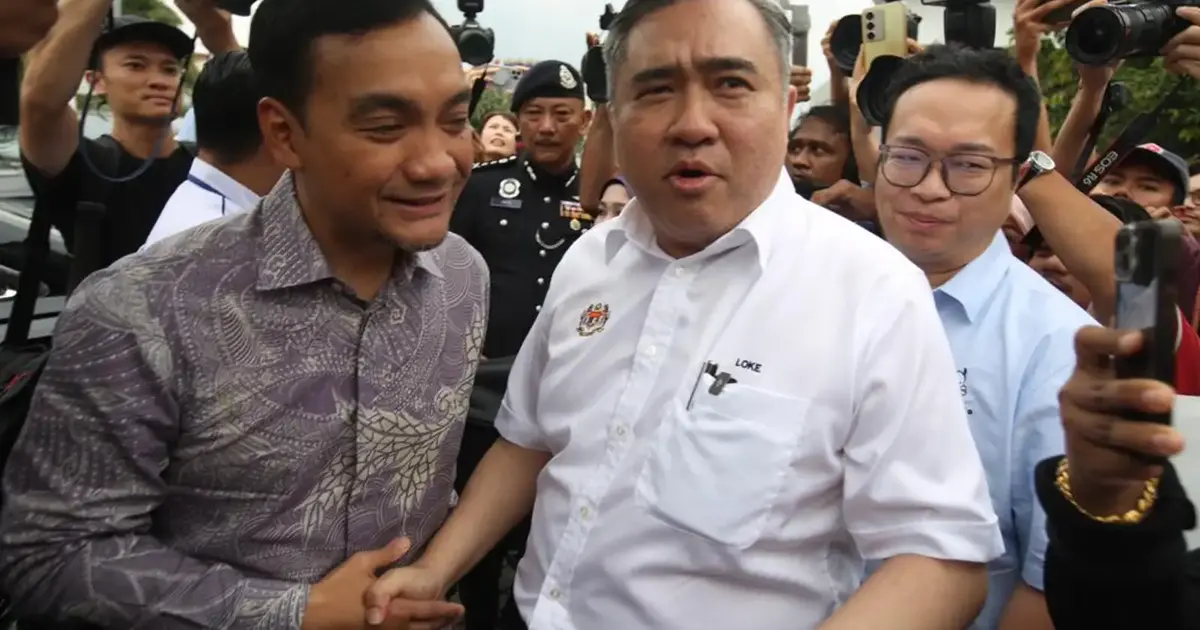
Transport Minister Anthony Loke and Johor Menteri Besar Onn Hafiz demonstrated the art of political civility when they met for the first time since their contentious exchange on social media, suggesting that despite personal friction, Malaysia's political establishment maintains channels of dialogue at official functions.
The encounter took place at an event organised by the transport ministry, where the two leaders managed to keep proceedings cordial and dignified. Their interaction marked a notable moment given the high-profile nature of their recent disagreement online, which had drawn attention from political observers and media commentators across the peninsula. The ability of both figures to move past public bickering and engage professionally underscores an unwritten code among Malaysian politicians that formal state business must proceed regardless of personal or party differences.
Onn Hafiz, despite maintaining outward cordiality, could not entirely resist a subtle jab at his counterpart during his remarks at the event. The Johor MB made reference to having to substantially reorganise his official schedule in order to accommodate the transport ministry function, implying that the invitation had arrived at the last moment with minimal notice. This pointed commentary, delivered with diplomatic restraint, suggested that beneath the surface pleasantries, some irritation persisted regarding the handling of the engagement.
The remark was characteristic of political communication in Malaysia, where direct criticism is often clothed in ostensible courtesy and veiled references rather than explicit confrontation. By framing his schedule adjustment as a matter of logistical inconvenience rather than a substantive political objection, Onn Hafiz maintained the appearance of collaboration while simultaneously signalling his displeasure. This form of rhetorical manoeuvre allows politicians to register discontent without escalating tensions to a level that would prove damaging to inter-governmental cooperation.
The encounter between the two leaders reflects the complex dynamics at play across Malaysia's federal and state governance structures. While the federal government and state administrations must work together on matters of mutual concern, including infrastructure development and transport planning, the political affiliations and ideological differences between coalition partners and opposition figures frequently create friction at both public and private levels. The transport portfolio is particularly significant as it touches upon issues affecting multiple states and constituencies.
Loke, as DAP secretary-general and a senior figure in the federal administration, carries considerable weight in national politics. Onn Hafiz, leading the state government in Malaysia's wealthiest state and representing UMNO-led governance, operates from a different political perspective. These structural differences mean that disagreements, whether expressed online or through official channels, carry implications beyond mere personality conflicts. They reflect broader tensions within Malaysia's political coalition and the ongoing negotiations between federal and state authorities over budgets, project implementation, and strategic direction.
The context of their social media dispute remains significant. Online platforms have become increasingly important spaces where Malaysian politicians engage in direct communication with the public, and missteps or confrontations in these spaces can quickly amplify into major political narratives. That both leaders opted to move past their digital disagreement and maintain professional relations at the subsequent official event suggests a recognition that allowing such disputes to metastasise would be counterproductive to governance objectives.
From the perspective of Malaysian stakeholders and regional observers, such developments illustrate how political systems function when multiple parties with different agendas must cooperate within existing structures. The ability to compartmentalise disagreements and maintain working relationships, even when cordial relations do not run deep, is essential for countries with coalition governments or federal systems where power is distributed across different levels of administration. Malaysia's experience in this regard offers lessons relevant to other developing democracies navigating similar configurations.
The transport sector particularly benefits from such cooperation, as major initiatives often span jurisdictional boundaries and require coordination between federal and state authorities. The Johor state government's role in facilitating infrastructure projects that connect to national transport networks means that any prolonged coolness between the transport ministry and the MB could translate into delays or complications for public users. The pragmatic approach demonstrated by both leaders in maintaining cordial relations despite their differences thus has tangible implications for service delivery and economic development.
Looking forward, the successful navigation of this first meeting post-dispute may set a template for how the two leaders manage their relationship going forward. If they can establish a pattern of separating personal or party-based disagreements from the business of governance, it could contribute to smoother operations across sectors where their respective portfolios intersect. The transport ministry's purview touches upon rail development, port operations, and highway management, many of which have direct relevance to Johor's economic interests and infrastructure aspirations.
The broader political lesson here extends beyond Loke and Onn Hafiz themselves. Malaysian politics frequently involves personalities and parties that find themselves in opposition on some matters while collaborating on others. The demonstration of political maturity in managing such relationships, even when public disagreements occur, reflects an understanding that governance requires pragmatism alongside principle. Whether this particular relationship continues to develop constructively or reverts to public tension will likely depend on how federal and state priorities align in the months ahead.