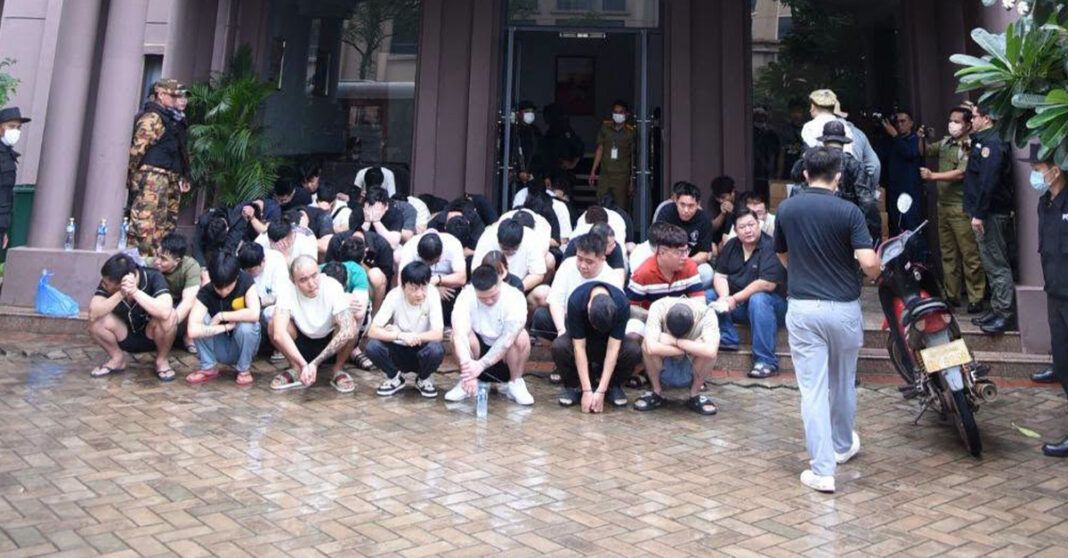
Vientiane's police have moved decisively against a sophisticated international fraud network, conducting a targeted operation on 8 August that resulted in the detention of 261 suspects engaged in telecommunications fraud and online gambling schemes within Vientiane's Thatluang Lake Special Economic Zone. The raid represents a significant escalation in Laos's fight against organised criminal enterprises that have increasingly leveraged the country's relatively permissive regulatory environment and geographic position in Southeast Asia to orchestrate cross-border scams.
The composition of those arrested underscores the transnational nature of contemporary fraud operations. Chinese nationals represented the dominant contingent at 153 individuals, reflecting both Beijing's large diaspora communities across Southeast Asia and the technical sophistication that Chinese-speaking criminal networks have developed in coordinating digital fraud schemes. Vietnamese suspects totalled 61, while Thai nationals comprised 36 of those detained. Smaller numbers included five Taiwanese, two Malaysian, two South Korean, and two Myanmar nationals, illustrating how these operations draw talent and capital from across the region to coordinate complex scams targeting victims globally.
The technical infrastructure seized during the operation reveals the considerable investment these criminal syndicates have made in their operations. Police confiscated nearly 500 desktop computers and laptops, devices essential for managing multiple fraud schemes simultaneously and maintaining the communication channels that bind dispersed teams together. The seizure of 2,355 mobile phones indicates the complexity of their operational structure, where individual handsets may be dedicated to specific fraudulent activities or customer management protocols. Such quantities of equipment suggest a well-organised enterprise rather than ad-hoc criminal activity, pointing to established hierarchies and significant financial resources.
Authorities have identified Lao Thatluang Investment Development Co., Ltd. as the entity controlling the building where the operation functioned, though investigators emphasise their investigation remains ongoing as they work to identify the masterminds orchestrating these schemes and their network of accomplices. This distinction between the corporate entity and the actual criminal apparatus illustrates a common challenge facing law enforcement across Southeast Asia: scam operations frequently exploit legitimate business structures as cover, complicating efforts to dismantle the networks completely.
The August 8 raid forms part of a sustained enforcement campaign that extends well beyond this single operation. On 10 August, Laotian authorities executed the deportation of 41 Thai suspects through the 1st Lao-Thai Friendship Bridge, transferring them to Thai custody. This followed an earlier handover of 32 Thai nationals across the same crossing on 6 August, bringing the total number of Thai nationals deported through this operation to at least 73 individuals. The coordinated international handovers underscore Laos's commitment to cooperating with regional partners in addressing scam networks, particularly given Thailand's significant presence among the detained suspects.
These recent operations built upon an even larger enforcement action conducted on 18 July targeting the ST Vegas complex in Dongphosy village, Hatsayfong district. That raid yielded 589 suspected scammers in total, predominantly Thai nationals alongside Lao, Vietnamese, and Cambodian suspects. The successive large-scale operations conducted within weeks suggest authorities have substantially disrupted at least one major criminal ecosystem, though questions persist regarding whether the networks could reconstitute or relocate operations to other SEZs or jurisdictions within Laos.
The concentration of these operations within Laos's special economic zones reflects a broader regional vulnerability. SEZs are designed to attract foreign investment through regulatory flexibility and tax incentives, yet their semi-autonomous status and borders can inadvertently create spaces where criminal organisations operate with reduced oversight. Laos hosts multiple SEZs, and while the Thatluang Lake zone has now experienced intensive enforcement, concerns remain about similar operations potentially functioning in other designated areas or emerging elsewhere along the Mekong.
For Malaysian observers, the presence of two Malaysian nationals among the 261 detained merits attention, as it indicates Malaysian citizens are being drawn into international scam operations despite the country's own enforcement efforts. This pattern reflects how regional connectivity and shared language capabilities can make Southeast Asian nationals attractive recruits for transnational criminal enterprises, even as their home governments intensify investigations and penalties. The integration of Malaysian nationals into such operations suggests these networks actively recruit across the region.
The broader crackdown signals Vientiane's acknowledgement that scam operations have become a serious governance challenge threatening Laos's international reputation and regional standing. Foreign investment and tourism depend partially on stability and security perceptions, and the revelation that sophisticated criminal networks operate within SEZs under government authority can deter legitimate business interest. By conducting these high-profile raids and coordinating international deportations, Laotian authorities demonstrate responsiveness to international concerns.
However, the fundamental structural vulnerabilities that enabled these operations remain partially unresolved. Whether authorities can establish sufficient regulatory oversight within SEZs to prevent criminal networks from re-establishing operations, and whether the masterminds behind these schemes can be identified and prosecuted rather than merely their lower-ranking operatives, will determine whether current enforcement represents a temporary disruption or a genuine shift in Laos's capacity to manage transnational organised crime. The coming weeks will reveal whether investigation proceeds toward prosecuting the architects of these schemes or whether the matter concludes with the deportation of operational staff.

