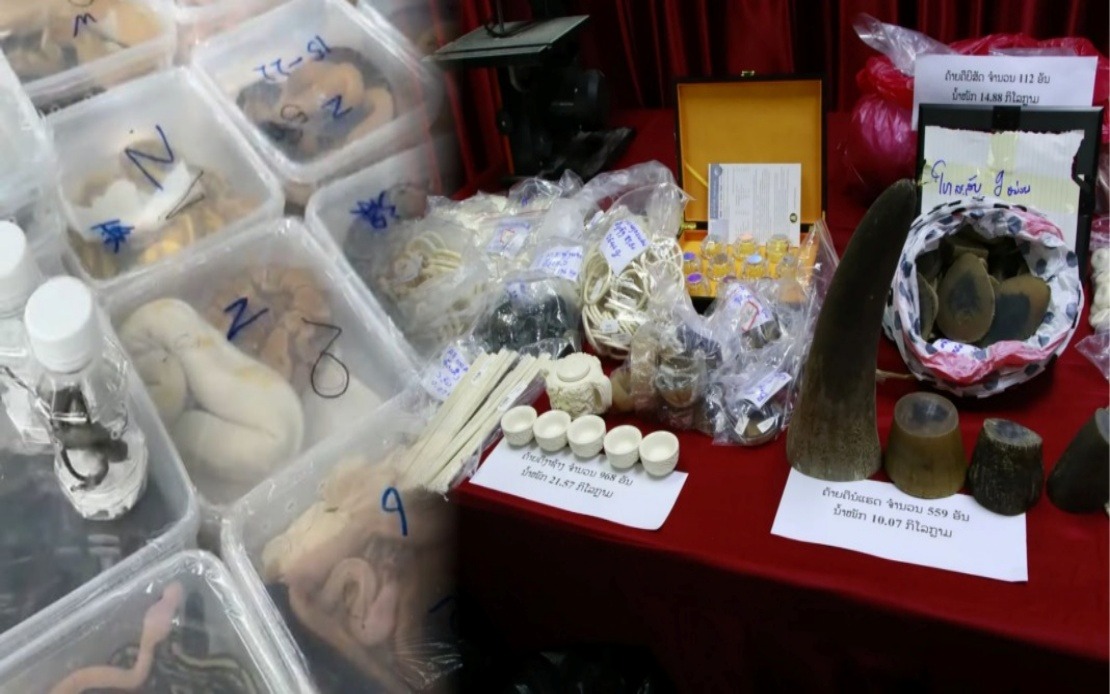
Coordinated enforcement operations across Laos have unravelled one of Southeast Asia's more active wildlife smuggling networks, with authorities rescuing nearly 300 animals and seizing substantial quantities of endangered species products along key trafficking corridors. The enforcement actions, conducted in Luang Prabang and Champasak provinces, reveal the sophisticated reach of criminal syndicates exploiting the region's porous borders and weak regulatory oversight.
The breakthrough came when wildlife enforcement teams intercepted a commercial passenger bus operating between Pakse and Bangkok carrying confiscated animals and contraband. This discovery underscored how traffickers have brazenly embedded illegal shipments within legitimate transport networks, moving endangered species across international borders with minimal detection. The animals found on the vehicle were identified as non-native to Laos, indicating they had been sourced from neighbouring countries and were destined for markets further afield, most likely Thailand or Vietnam where demand for traditional medicine and exotic pets remains robust.
In Luang Prabang, the Lao Wildlife Enforcement Network's seizure painted a troubling picture of the scale and diversity of the illegal trade. Officers confiscated 60 kilogrammes of contraband, including elephant skin powder, pangolin scales, ivory-like objects, and animal gallbladders—materials central to traditional medicine practices in Southeast Asia and China. The discovery of rhino horn fragments and bear gallbladder, alongside elaborate herbal medicine preparations suspected of containing wildlife ingredients, demonstrates how traffickers disguise illegal products within legitimate-appearing commercial goods. Such packaging strategies make detection at checkpoints exponentially more difficult and allow organised networks to move tonnes of contraband across borders annually.
Four days after the Luang Prabang operation, the enforcement response escalated significantly when wildlife rangers at the Vang Tao International Checkpoint in Champasak Province intercepted 294 live animals destined for Thailand. The shipment included turtles, pythons, green snakes, gold-ringed cat snakes, and various lizard species—creatures that command premium prices in black markets across Asia where they are sold as exotic pets, traditional medicine ingredients, or entertainment animals. The sheer number of individual animals recovered in a single operation illustrates the industrial scale at which traffickers operate, moving hundreds of creatures in coordinated shipments rather than small-scale smuggling attempts.
These enforcement successes are not isolated incidents but part of an accelerating crackdown on trafficking networks across the Mekong region. In late May, Thai authorities arrested a woman operating a traditional medicine and souvenir shop in Nakhon Phanom, confiscating more than 100 protected animal remains that had been smuggled from Laos. Similarly, in mid-May, collaborative enforcement disrupted an attempt to move 130 kilogrammes of cut elephant ivory and animal carcasses across the Thai-Lao border, preventing significant losses of one of the world's most threatened megafauna. These sequential operations suggest coordinated intelligence-sharing and enforcement coordination among regional agencies, though experts caution that such visible successes often represent only a fraction of the total illegal trade passing through.
Laos's geographic position makes it uniquely vulnerable to exploitation by trafficking networks. Bordered by Cambodia, China, Myanmar, Thailand, and Vietnam, the country serves as a critical transit hub where animals sourced across the broader region converge before redistribution to final markets. Wildlife originating from Cambodia's remaining forest reserves, Myanmar's remote regions, and Vietnam's declining wildlife populations flows through Laotian territory, where corruption, limited enforcement capacity, and porous borders provide ideal conditions for smugglers. This geographic centrality has transformed Laos into what wildlife experts describe as the region's principal trafficking thoroughfare.
The scale of the broader problem extends far beyond these recent seizures. According to the United Nations Office on Drugs and Crime's World Wildlife Crime Report 2024, illegal wildlife trade constitutes a global economic force rivalling human trafficking, narcotics smuggling, and conventional arms dealing, collectively worth nearly US$10 billion annually. This staggering valuation reflects the extraordinary profits available to criminal networks willing to exploit endangered species. The report identifies systemic corruption as the primary enabler, with officials at border checkpoints, ports, and regulatory agencies frequently compromised or insufficiently resourced to resist criminal inducements.
The persistence of trafficking despite international agreements and two decades of enforcement cooperation underscores the fundamental economic drivers sustaining these networks. Consumer demand in wealthy markets—particularly China and Vietnam, where traditional medicine practices continue despite bans on wildlife products—creates persistent profit incentives. Simultaneously, the desperate poverty in source communities throughout Southeast Asia ensures a steady supply of individuals willing to capture and transport animals for modest compensation. This structural dynamic means that enforcement alone, without addressing underlying demand and poverty, can only marginally disrupt the trade.
For Malaysia and other Southeast Asian nations, these Laotian operations carry significant implications. Malaysia serves simultaneously as a consumer market, transit point, and source region for wildlife trafficking. Enforcement cooperation with Laotian and Thai authorities, as demonstrated by these coordinated operations, remains essential to disrupting supply chains before contraband reaches Malaysian ports and markets. Malaysian authorities' capacity to intercept shipments depends partly on intelligence from neighbouring countries and the regional coordination mechanisms that these recent seizures exemplify.
The sophistication of trafficking networks exposed in these operations also suggests that Malaysia must strengthen capacity in specific enforcement domains. The disguising of wildlife products within traditional medicine shipments and commercial goods requires specialised training for customs and port security personnel. Malaysia's major ports and airports, as transit hubs for regional commerce, are uniquely vulnerable to shipments in transit to final markets elsewhere. Enhanced screening protocols, dog detection teams trained for wildlife odours, and intelligence-sharing mechanisms with regional counterparts represent practical investments in disrupting the trade at Malaysian chokepoints.
Looking forward, the Laotian enforcement successes demonstrate that coordinated regional action yields measurable results when political will aligns with operational capacity. The sequential nature of these recent seizures suggests ongoing intelligence cooperation and targeting of specific trafficking networks rather than random checkpoint enforcement. Sustaining and expanding such coordination across Southeast Asia, coupled with targeted demand reduction campaigns in consumer markets and livelihood support for communities in source areas, offers the most promising approach to disrupting the trade systematically. Without such comprehensive strategies, trafficking networks will continue adapting to enforcement pressures, shifting routes and methods while maintaining their devastating impact on the region's increasingly fragile wildlife populations.

