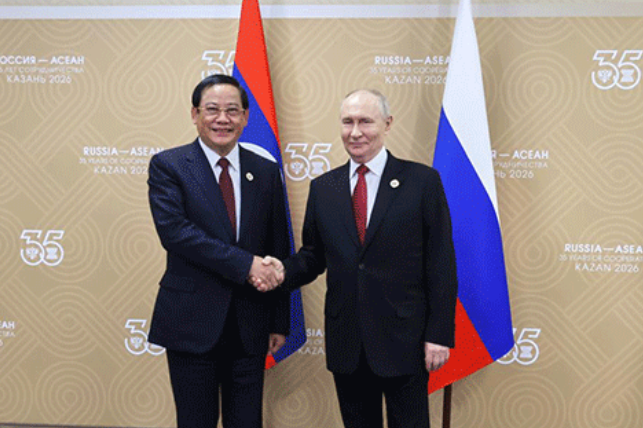
Prime Minister Sonexay Siphandone has wrapped up his inaugural official visit to Russia with concrete commitments to broaden bilateral cooperation, culminating in talks with President Vladimir Putin during the Russia-Association of Southeast Asian Nations Summit in Kazan. The June 14-17 visit, undertaken at the invitation of Russian Prime Minister Mikhail Mishustin, underscores Laos's continued alignment with Moscow despite the Southeast Asian nation's efforts to balance its foreign policy ties across multiple major powers.
The centrepiece of the diplomatic engagement was an intergovernmental agreement on cooperation in the peaceful use of nuclear energy, marking a significant expansion in the two nations' strategic relationship. According to the Kremlin, Putin described this accord as a landmark achievement that establishes the legal framework for constructing a small nuclear power plant in Laos utilising Russian technology. This development represents a substantial commitment from Russia to help modernise Laos's energy infrastructure and reflects Moscow's deepening influence across Southeast Asia through strategic sectors beyond traditional trade and military cooperation.
During their bilateral meeting, Putin emphasised Russia's valuation of its longstanding relationship with Laos, characterising it as rooted in friendship, mutual respect, and balanced consideration of each other's interests. The Russian president acknowledged Laos's role in facilitating cooperation between Russia and ASEAN, noting that 2026 will mark the 35th anniversary of Russia-ASEAN relations—a milestone that underscores Moscow's sustained engagement with the regional bloc despite international tensions and sanctions.
Putin also expressed gratitude for Laos's participation in Russian commemorative events, including President Thongloun Sisoulith's attendance at Russia's Victory Day celebrations in May and the Lao People's Army's participation in the 80th anniversary parade of the Soviet victory in World War II. These gestures carry symbolic weight beyond ceremonial significance, demonstrating Laos's willingness to maintain visible solidarity with Russia on matters of historical and political importance—a position that distinguishes Laos from several neighbouring ASEAN members maintaining greater diplomatic distance from Moscow.
The two leaders reviewed a comprehensive agenda spanning energy, industry, agriculture, mining, the digital economy, banking, transport, tourism, and education. This breadth of sectoral cooperation illustrates how Laos-Russia relations extend well beyond traditional defence partnerships, encompassing civilian infrastructure development and human capital investment. The emphasis on these diverse sectors suggests that both nations view their relationship as foundational to Laos's broader development trajectory rather than limited to geopolitical positioning.
A notable component of Russia's support involves educational development. Prime Minister Sonexay specifically thanked the Russian government for its continuing assistance in human resource development through annual scholarships and training opportunities for Lao nationals, including government officials. This educational pipeline has long served as a mechanism for deepening institutional ties and cultivating pro-Russian sympathies within Laos's bureaucracy—a soft power tool that complements more formal diplomatic and economic engagements.
The two premiers also discussed collaborative construction of the Laos-Russia Friendship School in Vientiane, expected to be completed soon. Such educational institutions serve dual purposes: they provide tangible symbols of bilateral friendship visible to the Lao public while simultaneously offering venues for Russian cultural and linguistic promotion. The school's completion will reinforce Russia's cultural footprint in Laos's capital and provide institutional continuity to the relationship beyond individual diplomatic cycles.
Prime Minister Sonexay highlighted Laos's consistent policy orientation toward cooperation with Russia and reaffirmed the value his government places on their strategic partnership. His public endorsement of Russia's hosting of the ASEAN summit further demonstrated Laos's alignment with Moscow's regional engagement strategy. For Malaysia and other ASEAN nations pursuing more cautious approaches to Russia, Laos's positioning illustrates the diversity of strategic preferences within the bloc—a reality that complicates efforts toward unified ASEAN positions on major powers.
At the summit's conclusion, Sonexay presided over a symbolic gesture when two elephants were handed over to the Kazan Zoo as gifts from President Thongloun and the Lao people. These animals were presented to commemorate the 65th anniversary of Laos-Russia diplomatic relations and Russia Day on June 12. While largely ceremonial, such exchanges carry cultural significance and serve as memorable symbols of friendship that resonate beyond political circles, helping to cement popular perceptions of bilateral goodwill.
Sonexay also addressed a Laos-Russia business forum aimed at stimulating trade and investment cooperation, indicating that both nations view commercial engagement as an increasingly important dimension of their relationship. This emphasis reflects broader regional trends wherein Southeast Asian nations seek to diversify their economic partnerships while maintaining established political relationships. For Malaysian businesses, Laos's deepening economic ties with Russia may open indirect opportunities for trilateral cooperation, though Western sanctions frameworks will require careful navigation.
The convergence of these developments—nuclear energy cooperation, educational partnerships, cultural exchanges, and business engagement—reveals a relationship that Moscow has cultivated methodically across multiple domains. For Southeast Asia more broadly, Laos's positioning demonstrates how smaller nations within the region continue navigating complex great power competition while pursuing development objectives. The nuclear energy agreement, in particular, signals Russian technological ambitions in Southeast Asia that extend beyond energy into advanced infrastructure sectors.
As ASEAN grapples with pressures to adopt more unified positions on major powers, the Laos-Russia relationship exemplifies the challenge of achieving consensus within a bloc containing nations with substantially different strategic orientations and historical ties. Laos's unwavering commitment to Russia contrasts with other ASEAN members' more calibrated approaches, reflecting divergent national interests and threat perceptions. Understanding these variations proves essential for regional analysts assessing ASEAN's future trajectory on critical geopolitical issues.

