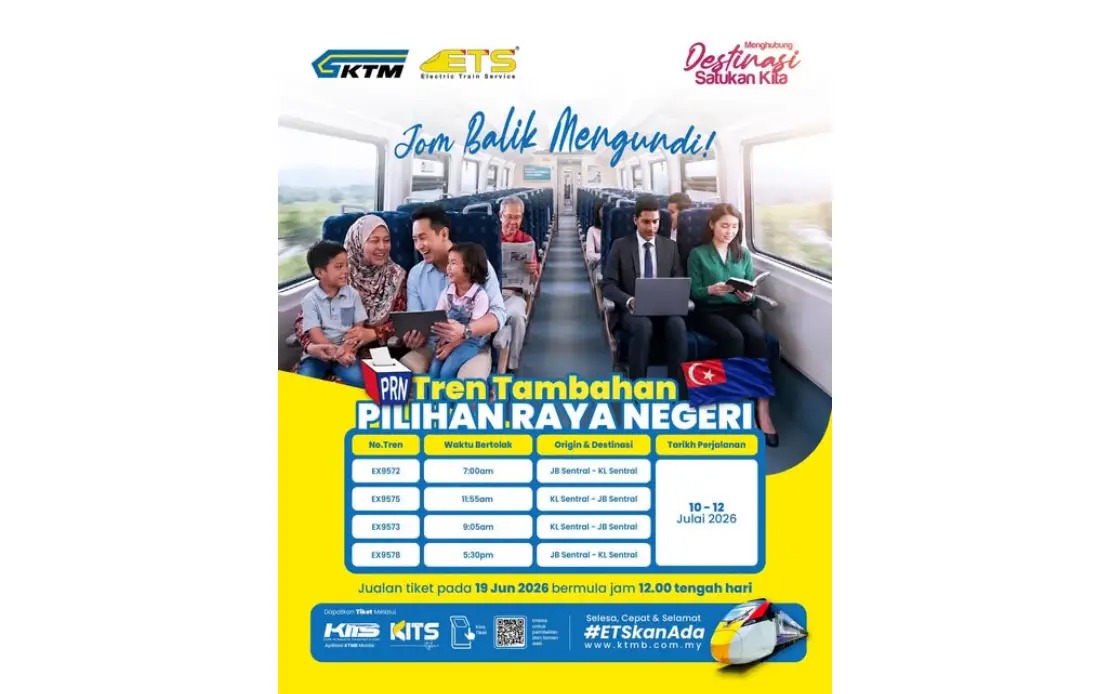
Keretapi Tanah Melayu Berhad (KTMB) has rolled out expanded electric train services connecting to Johor ahead of the state election scheduled for July 11, recognising the critical logistical challenge of moving voters across the country during the poll period. The additional ETS trains will operate between July 10 and 12, providing southbound commuters with multiple booking options as Malaysians make their way to their home constituencies to cast their votes in this closely watched state contest.
Ticket bookings for the enhanced service commenced at noon on June 19, with KTMB offering multiple purchase channels to maximise accessibility for the travelling electorate. Passengers can acquire tickets through the KTMB Mobile app, the KITS Style platform, KTMB's official online portal at online.ktmb.com.my, or directly at ticket kiosks across the network. This multi-channel approach reflects an understanding that voters often arrange their travel at short notice and may be scattered across different regions, requiring flexible and convenient booking mechanisms.
The timing of this transportation initiative underscores the practical considerations facing election management bodies when polling occurs across a geographically dispersed state. Johor, Malaysia's second-largest state by area and the southern economic powerhouse, encompasses communities spread across substantial distances. Many working professionals and young voters have migrated to Kuala Lumpur, Selangor, and other employment centres, necessitating return travel to exercise their franchise. The railway operator's response demonstrates how essential transport infrastructure providers must anticipate electoral requirements and adjust capacity accordingly.
The Johor state election stems from the dissolution of the State Legislative Assembly on June 1, with the Election Commission formally setting polling day as July 11. This timeline compresses the campaign period while extending transport needs across several days, as voters begin returning from June 10 and continue arriving through polling day itself. The three-day window for rail travel accommodates the reality that not all electors can leave employment or other commitments simultaneously, requiring staggered departures and a corresponding expansion of train capacity.
KTMB's proactive stance aligns with broader best practices in ensuring inclusive participation during democratic exercises. When voting requires physical presence in specific locations and voters are distributed across large geographical areas, removing transport barriers becomes a governance imperative. The decision to increase ETS capacity reflects recognition that railway infrastructure can meaningfully shape electoral participation rates, particularly among middle and lower-income earners for whom train travel represents a cost-effective option compared to private vehicles or air travel.
The southern corridor served by these additional ETS services is among Malaysia's most economically vital, connecting Kuala Lumpur to major Johor population centres including Johor Bahru, Skudai, and other municipalities. Regular demand on this route already runs high, as the north-south axis facilitates commerce, commuting, and migration between Malaysia's economic heartland and Johor's manufacturing, port, and digital economy clusters. Adding election-specific capacity requires coordination between timetabling, crew deployment, and locomotive availability, suggesting that KTMB initiated planning for this electoral surge weeks in advance.
For Southeast Asian observers, KTMB's approach offers insights into how developing economies manage the intersection of transport infrastructure and democratic participation. Unlike developed nations where private vehicle ownership predominates, Malaysia and neighbouring economies rely substantially on public transport, making railway and bus operator decisions critical variables in electoral accessibility. The precedent of proactively augmenting capacity demonstrates that state enterprises can contribute to democratic resilience through responsive infrastructure management.
The initiative also carries commercial implications for KTMB, as election-driven volume spikes provide revenue opportunities that help offset costs across lower-demand periods. This creates economic incentives for the operator to coordinate effectively with election authorities, establishing a virtuous cycle where both entities benefit from seamless execution. When passengers experience smooth travel during peak periods, satisfaction with public transport improves, potentially increasing ridership during non-electoral periods.
From a policy perspective, the expanded service indicates that Malaysian authorities recognise electoral participation as a matter warranting targeted infrastructure support. Rather than treating voters as incidental travellers during campaign periods, positioning them as a distinct user group deserving dedicated capacity reflects a commitment to accessibility and inclusivity. This framing proves particularly significant in a multi-ethnic democracy where turnout disparities between regions can meaningfully influence electoral outcomes.
As the July 11 polling day approaches, the success of KTMB's augmented services will likely attract scrutiny from electoral observers and transport analysts alike. Measuring whether expanded capacity actually increased voter participation, particularly among younger and more geographically dispersed cohorts, would provide valuable data for future elections. If the initiative successfully reduces transport-related barriers to voting, it may become a template replicated across other state and federal elections, gradually embedding electoral accessibility considerations into routine transport planning.
The announcement ultimately represents a relatively modest but symbolically significant intervention in Johor's electoral machinery. By mobilising transport capacity to facilitate voting, KTMB acknowledges that democratic participation depends not solely on individual will or political mobilisation, but on the mundane infrastructure that physically enables people to reach polling stations. In an era when turnout and electoral legitimacy face scrutiny globally, such operational commitments to removing practical obstacles deserve recognition as genuine, if unglamorous, contributions to democratic health.

