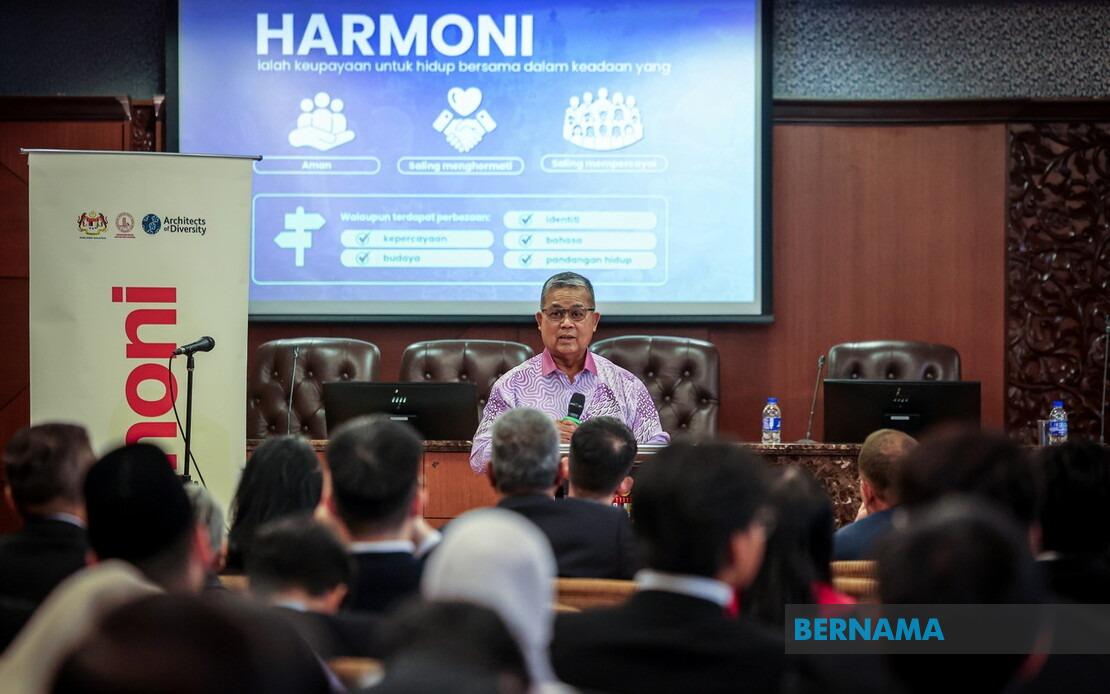
The Department of National Unity and National Integration (JPNIN) is creating a comprehensive Community Tension Index designed to measure the state of social cohesion across Malaysia and track emerging flashpoints around sensitive matters. Minister of National Unity Datuk Aaron Ago Dagang announced the initiative at the 2026 Harmony Symposium held at Parliament, underscoring the government's commitment to proactive rather than reactive approaches to preserving national harmony in an increasingly fractious social environment.
The index represents a strategic shift towards data-driven policy making in the sphere of national cohesion. By developing quantifiable metrics for assessing community tensions, JPNIN aims to equip policymakers with evidence-based intelligence that can inform the design and timing of government interventions before tensions escalate into tangible conflict. Aaron explained that the findings would function as a crucial reference point, allowing authorities to address sensitive issues concerning religion, royalty and race—the so-called 3R categories—before they metastasize into broader social divisions.
The urgency of this initiative reflects a measurable shift in where threats to national unity now materialise. Rather than disputes confined to physical spaces, contemporary challenges increasingly unfold in the digital domain, where reach is instantaneous and amplification is algorithmic. Between January 2025 and January 2026, the Malaysian Communications and Multimedia Commission (MCMC) successfully removed 1,493 pieces of online content that touched on 3R issues. This figure serves as a sobering reminder that despite regulatory efforts, the volume of potentially divisive material circulating online remains substantial enough to warrant systematic monitoring and early warning mechanisms.
The digital environment presents structural challenges that traditional harmony-building efforts were not designed to address. As Aaron observed, social media algorithms often function to reinforce existing viewpoints rather than expose users to diverse perspectives. The resulting "filter bubbles" and "echo chambers" fracture the information ecosystem into isolated communities, each consuming a fundamentally different narrative reality. This fragmentation undermines the shared understanding necessary for social cohesion, as citizens increasingly lack common reference points from which to conduct reasoned discourse across lines of difference.
Parallelisms exist between Malaysia's challenges and those faced by other plural societies grappling with digital polarisation. Southeast Asian nations with significant religious or ethnic diversity—from Indonesia to Myanmar—have witnessed how social media can amplify communal tensions. Malaysia's proactive development of measurement tools positions it as a potential regional leader in addressing these systemic challenges through institutional innovation rather than heavy-handed censorship alone.
Complementing the Community Tension Index, JPNIN has been consulting widely with stakeholders regarding a proposed National Harmony Commission (SKN). This institutional framework would function as a dedicated mechanism for early prevention, mediation, and constructive conflict resolution when tensions do emerge. Unlike reactive enforcement actions, the commission would operate with explicit authority to investigate issues affecting national harmony and to intervene at nascent stages of conflict before polarisation calcifies into entrenched opposition. The consultation phase reflects recognition that legitimacy and effectiveness in harmony-building require buy-in from diverse societal actors rather than top-down imposition.
The establishment of such a commission would fill an institutional gap currently managed across multiple agencies. By consolidating prevention, mediation and investigation functions under a single body, Malaysia could potentially streamline coordination and develop specialised expertise in detecting and defusing tensions. Regional precedents offer mixed lessons; some countries have found that dedicated harmony commissions suffer from lack of political will or enforcement capacity, while others have successfully positioned them as forums for dialogue that restore confidence in government impartiality.
Malaysia's plural composition—where Islam, Buddhism, Christianity, Hinduism and traditional beliefs coexist, and where Malay, Chinese and Indian communities form the demographic backbone—means that sustaining harmony is not incidental but foundational to stability. The 3R framework itself reflects an implicit acknowledgment that certain categories of speech touch on core identity markers that shape how Malaysians relate to one another and to the state. Creating systematic ways to understand and monitor tensions in these areas represents mature governance.
For businesses, civil society organisations and community leaders across Malaysia and the broader region, these initiatives signal that governments are investing in infrastructure for dialogue and early warning rather than defaulting to crisis management. The Community Tension Index, once established, could become a public resource informing how organisations engage with potentially contentious issues. It may also establish benchmarks that allow comparative analysis across states or over time, clarifying whether particular interventions actually reduce tensions or merely displace them.
The challenge ahead involves translating institutional architecture into operational effectiveness. A well-designed index and commission remain ineffective if they lack real authority, adequate funding, or sufficient political autonomy to investigate cases impartially. Early signals from Aaron's remarks suggest ambitions befitting the constitutional framework of a federal democracy, but implementation will reveal whether these remain aspirational or become embedded in practice.
Malaysia's moment of demographic and religious diversity, combined with its relatively mature democratic institutions, positions it to develop sophisticated approaches to managing plurality in the digital age. Should the Community Tension Index and National Harmony Commission function as intended, they could offer valuable lessons for other Southeast Asian nations wrestling with comparable pressures on social cohesion, while demonstrating that monitoring and mediation offer viable alternatives to either ignoring tensions or suppressing speech entirely.

