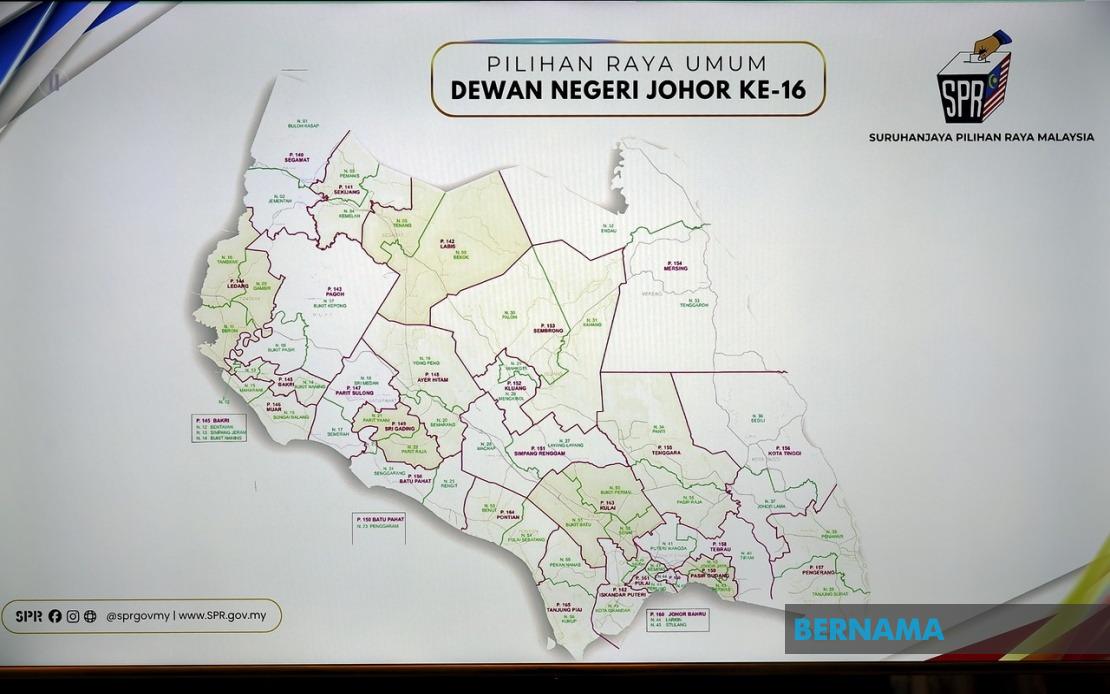
The 16th Johor state election enters its most consequential phase tomorrow as nomination day officially opens the door for candidates seeking the state's 56 assembly seats. The tightly scheduled electoral calendar will see candidates submit their nomination papers between 9 am and 10 am at designated registration centres, after which the Election Commission will screen applications and announce the full roster of contenders. This compressed timeline reflects the organised chaos typical of Malaysian state elections, where the weeks between nomination and polling day determine which parties can effectively mobilise their grassroots machinery and capture public attention amid competing narratives.
The election itself will culminate on July 11, with early voting scheduled for July 7. This early-voting window is particularly significant for military and police personnel, acknowledging the operational challenges these uniformed services face in coordinating large-scale electoral participation. The election rolls encompass 2,727,926 eligible voters, a substantial electorate that underscores Johor's importance to Malaysia's broader political landscape. Beyond the ordinary voter base of over 2.7 million, the electoral equation includes 12,041 military personnel and their spouses, alongside 12,710 police officers and their families, constituencies whose voting patterns have historically favoured stability-oriented candidates.
All three major political coalitions have committed to contesting every available seat, signalling that none wishes to cede ground without a fight. Pakatan Harapan's strategy deploys its federal-level alliance architecture at the state level, with Parti Keadilan Rakyat fielding 20 candidates, Parti Amanah Negara 19, and the Democratic Action Party 17. This distribution reflects careful internal negotiations among coalition partners, each securing territory that aligns with their historical strongholds and demographic advantages. Barisan Nasional counters with an equally comprehensive slate led by United Malays National Organisation's 36 candidates, supplemented by the Malaysian Chinese Association's 16 and the Malaysian Indian Congress's four, maintaining the traditional power-sharing formula that has anchored the coalition since independence.
Perikatan Nasional, the relative newcomer among the major coalitions, has staked its claim with Parti Islam Se-Malaysia contesting 11 seats, Parti Pribumi Bersatu Malaysia 16, and the Malaysian Indian People's Party five. This configuration allows PN to present itself as a broad-based alternative while concentrating Bersatu's resources in constituencies where the party believes it can capitalise on shifting voter sentiment. Alongside these established coalitions, a constellation of smaller parties seeks to influence the outcome. The Malaysian United Democratic Alliance targets four seats, the Socialist Party of Malaysia contests one, and Parti Bersama Malaysia makes its electoral debut with candidates across 15 seats, representing an ambitious entrance strategy for a nascent political force.
The logistics of nomination day demand meticulous attention from prospective candidates. The Election Commission has explicitly cautioned aspirants to verify their nomination forms at the Returning Officer's Office or State Election Office well in advance, a seemingly straightforward instruction that reflects hard lessons learned from previous elections where technical irregularities have disqualified candidates days before polling. Payment of nomination deposits must occur early, with candidates advised to retain their receipts as proof when submitting papers, a bureaucratic safeguard designed to prevent disputes over financial compliance that could otherwise bog down the process.
Corruption prevention remains a central concern for Malaysian electoral authorities, particularly in Johor where development-related patronage has historically flavoured political competition. The Malaysian Anti-Corruption Commission has issued stern directives reminding all candidates and parties to observe strict boundaries against unlawful conduct under the MACC Act 2009 and the Election Offences Act 1954 (Amendment 2012). To enforce these standards, the MACC has established five 24-hour operations rooms strategically positioned in Tampoi, Batu Pahat, Kluang, Segamat and Mersing, creating mechanisms through which the public can report suspected corruption or abuse of power immediately. This decentralised monitoring network reflects recognition that Johor's geographical expanse demands responsive enforcement capacity.
The electoral context is shaped substantially by the composition of the state assembly following the 2022 election. Barisan Nasional's commanding position, having won 40 of 56 seats, anchored the previous legislature and enabled the coalition to dominate state governance despite federal-level losses. Pakatan Harapan's 12 seats provided the principal opposition voice, while Perikatan Nasional's three and MUDA's single seat offered marginal representation. The 2022 results reflected voter preferences that diverged from federal trajectories, a phenomenon particularly pronounced in Johor where BN retained provincial control even as national sentiment shifted. This historical outcome shapes candidate selection for 2024, with all coalitions acutely aware that state-level outcomes need not mirror federal patterns.
The dissolution of the Johor State Legislative Assembly on June 1 initiated this electoral cycle, a procedural step that necessarily preceded the campaign period. The timing allows sufficient runway for voter engagement before the July 11 polling date, though Malaysian elections characteristically compress campaign activity into roughly two weeks, a compressed timeline that advantages parties with established machinery and recognisable candidates. The nomination day procedures serve as a filter, ensuring that only candidates meeting legal requirements proceed to campaign, while also providing an early indication of which parties are committing resources and organisational strength to specific constituencies.
For Malaysian observers and Southeast Asian analysts tracking regional electoral dynamics, the Johor contest carries broader significance beyond state boundaries. Malaysia's federal system distributes substantial authority to state governments across education, agriculture, and development policy, making state elections consequential for millions beyond Johor's boundaries. The outcome will signal whether BN's 2022 state-level resilience persists despite the coalition's weakened federal position, or whether the electoral pendulum is gradually shifting toward opposition coalitions. The performance of smaller parties like Bersama will indicate whether space exists for new political actors to gain traction in Malaysia's increasingly fragmented party system. For investors and observers of Southeast Asian governance, this contest reflects Malaysia's resilient democratic institutions even amid political uncertainty, contrasting sharply with instability elsewhere in the region.
The weeks ahead will determine which candidates successfully navigate nomination procedures and advance to campaign for voter support. The breadth of candidacies across 56 seats, spanning multiple coalitions and independent efforts, ensures that diverse ideological perspectives and policy platforms will compete for Johor voters' endorsement. The early voting provisions for uniformed personnel and the comprehensive voter registration list suggest institutional preparedness for conducting a credible election. Whether the actual campaign period brings elevated citizen engagement or voter fatigue from frequent Malaysian electoral contests remains to be seen, but the formal machinery for a competitive, monitored election is now set firmly in motion.

