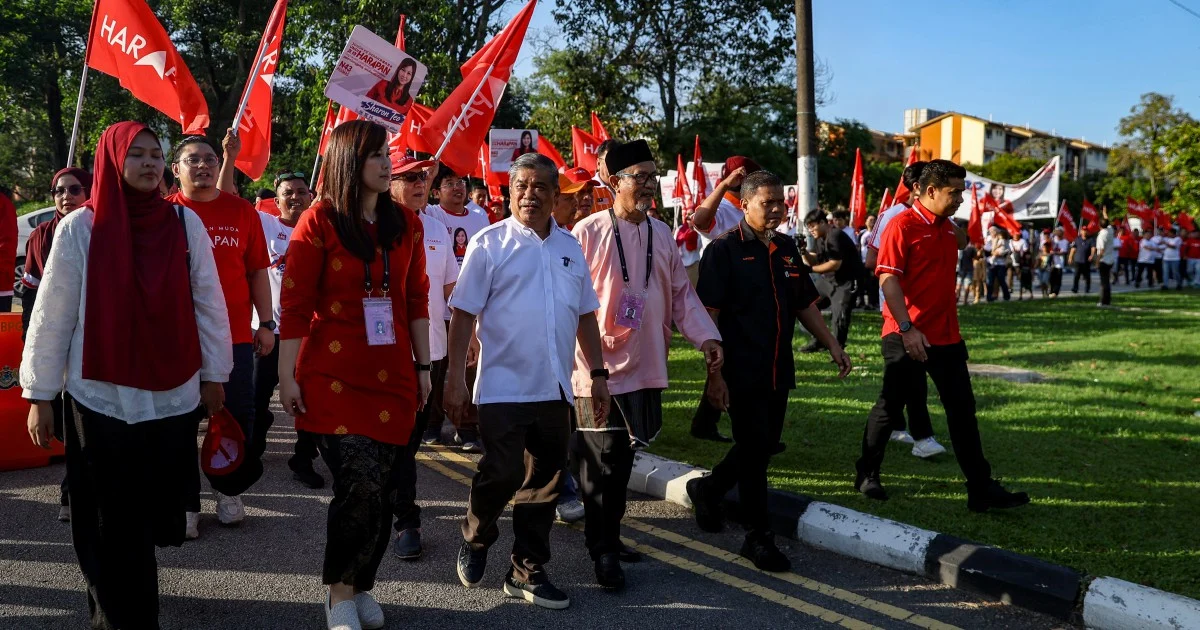
The Permas state constituency nomination centre in Pasir Gudang witnessed energetic scenes as supporters of Pakatan Harapan gathered to demonstrate backing for their coalition candidate Sharon Teo. As she arrived at Dewan Muafakat Taman Mawar to formally register her candidacy, the crowd erupted in coordinated chants calling for voters to support Pakatan Harapan, underscoring the coalition's determination to make electoral gains in what remains a strategically important state.
The show of support reflects broader dynamics within Johor's political landscape, where Pakatan Harapan has been working to strengthen its presence following mixed results in previous electoral contests. The coalition, comprising Parti Keadilan Rakyat, Democratic Action Party, and Amanah, continues its efforts to present a credible alternative to incumbent administrations across the state's various constituencies. Sharon Teo's nomination filing in Permas represents one strand of this wider campaign strategy.
Permas itself holds significance within Pasir Gudang's political makeup. The constituency encompasses urban and semi-urban areas with a diverse demographic profile, making it a focal point for parties seeking to broaden their electoral appeal. The presence of enthusiastic supporters at the nomination centre suggests that campaign mobilisation efforts have resonated with sections of the local electorate, though it remains too early to assess whether such ground-level energy will translate into actual vote gains on polling day.
The visual and auditory nature of the support—with coordinated chanting forming the centrepiece of coverage—illustrates how contemporary election campaigns in Malaysia have become increasingly spectacle-driven. Such moments serve multiple functions simultaneously: they energise volunteer networks and committed supporters, generate social media content that extends messaging reach beyond the physical venue, and create imagery that news organisations naturally gravitate toward reporting. For Pakatan Harapan, this kind of footage reinforces narratives about grassroots momentum and youthful engagement with the political process.
Johor's electoral importance cannot be overstated within Malaysian politics. As the nation's second-most populous state and a longstanding political battleground, results from Johor constituencies carry outsized symbolic weight. Any gains or losses by major coalitions in this state reverberate through federal political calculations and shape perceptions about which bloc possesses genuine popular momentum. This is why Pakatan Harapan's presence in constituencies like Permas matters—not merely for local representation, but for what such contests signal about the overall health of coalition politics.
Sharon Teo's candidacy itself warrants attention. The composition of candidate slates reveals parties' strategic thinking about which demographic groups they are targeting and which areas they believe winnable. Women candidates like Teo occupy an increasingly significant portion of nomination slates across Malaysian politics, reflecting both genuine efforts at greater gender representation and pragmatic calculations about voter preferences in specific constituencies. Her positioning as the coalition's standard-bearer in Permas suggests Pakatan Harapan has assessed the constituency as sufficiently receptive to warrant a competitive campaign effort.
The nomination filing process, while procedurally routine, functions as an unofficial campaign launch for candidates. Media attention clusters around this moment, providing free publicity and an opportunity for candidates to frame their intended campaign message. The coordinated chanting at Teo's nomination filing demonstrates sophisticated campaign orchestration—supporters were mobilised, transported, and cued to deliver consistent messaging simultaneously. This level of organisation suggests resource commitments and volunteer coordination that extend beyond casual political interest.
Johor's political trajectory over recent years has seen periodic shifts in voter sentiment. The state experienced significant changes during the 2018 federal election cycle when Pakatan Harapan captured the federal government, then again in 2022 following the collapse of that administration. State-level contests in Johor have generally tracked these national-level movements, though with important local variations. Whether the enthusiasm displayed at Permas reflects genuine change in voter preferences or merely standard campaign theatrics will become clearer as the electoral campaign progresses and actual voting behaviour manifests.
The broader context of Johor politics involves substantial competition not merely between Pakatan Harapan and Barisan Nasional, but increasingly from other political groupings and independent candidates. Perikatan Nasional has also been organising campaigns and fielding candidates across the state, adding additional complexity to the electoral arithmetic. In this three-way or multi-way competition, the ability to mobilise supporters at moments like nomination filings becomes even more strategically valuable, as it signals which coalitions can generate and sustain grassroots energy.
For Malaysian voters and observers of regional politics, developments in Johor elections merit close attention. The state often functions as a bellwether for broader trends in Malaysian electoral behaviour, and the performance of coalition candidates like Sharon Teo in constituencies such as Permas will provide early indicators about voting intentions and engagement levels as the election campaign builds momentum. The enthusiastic reception she received at the nomination centre provides one data point, but actual electoral outcomes will ultimately determine whether such visible support translates into the practical realities of representation and governance.

