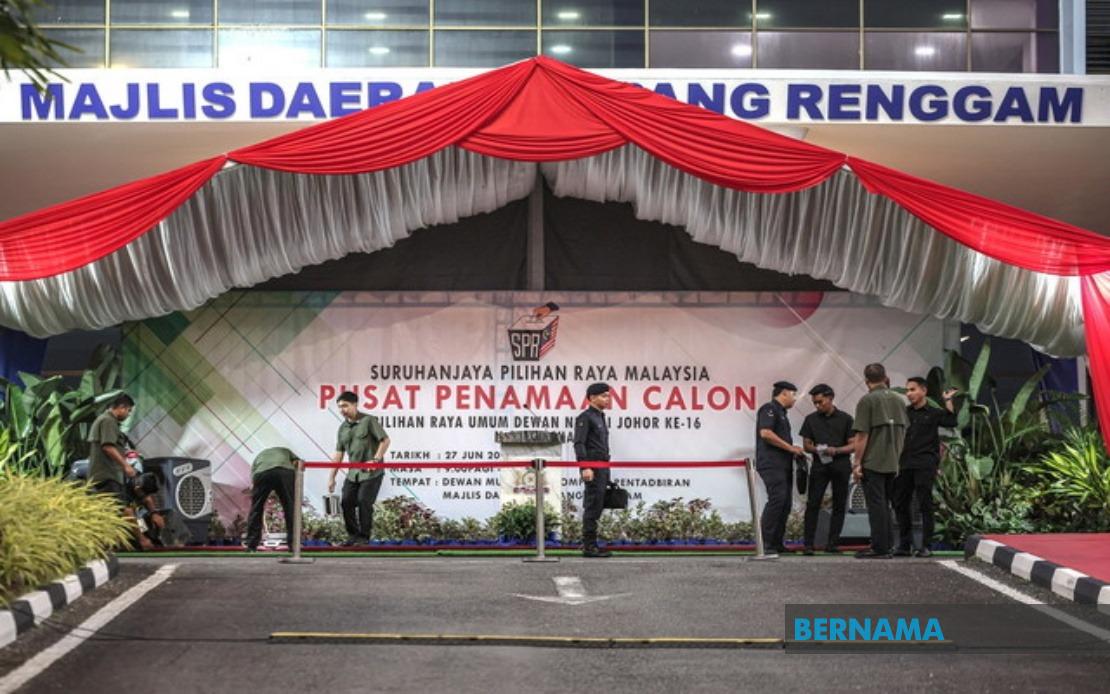
The 16th Johor State Election took a decisive step forward today as all 56 nomination centres across the state opened their doors at 9am sharp, marking the official commencement of the candidate registration process. This synchronized opening across multiple districts represents a carefully coordinated effort by the Election Commission to ensure fair and transparent proceedings in what promises to be a closely watched regional contest.
Candidates had precisely one hour to lodge their nomination forms with the returning officer at their designated centres, a tight window designed to maintain administrative efficiency while accommodating the substantial volume of submissions expected. The compressed timeframe—closing at 10am—reflects standard electoral practice, though it places considerable pressure on campaign teams to have all documentation prepared and verified beforehand. Once the returning officer receives nomination papers, a comprehensive verification process begins to confirm the eligibility of all applicants before the official list is publicly announced.
The staggered calendar leading to the actual election provides multiple critical dates for stakeholders. After nomination verification concludes, the Election Commission has mandated a 14-day campaign period running until 11.59pm on July 10, providing political parties and candidates with a defined window to conduct their outreach activities. Early voting is scheduled for July 7, catering to those unable to vote on the main polling day, with July 11 set as election day when the state's voters will make their final choice. This structured timeline allows for adequate preparation while preventing an extended campaign period that could strain resources.
The nomination submission process itself accommodates various scenarios to ensure accessibility for candidates. The returning officer accepts nomination papers from the candidate together with both proposer and seconder, or from any two of these three parties, or even from a single representative if necessary. This flexibility recognizes practical realities—candidates and their supporters may face scheduling conflicts or logistical challenges—while maintaining the integrity of the nomination process through the requirement that proper authorization be demonstrated.
The atmosphere at nomination centres reflected the political energy surrounding this election. Party supporters began assembling as early as 6.30am, some hours before the official opening, demonstrating the enthusiasm within Johor's political landscape. These early arrivals testified to the significance stakeholders attach to the exercise, with different political factions deploying their supporters to visibly demonstrate backing for their respective candidates. The sight of party colors and symbols gathering around nomination centres underscored the competitive nature of the contest and the personal stakes involved for candidates seeking to represent their constituencies.
Weather considerations featured prominently in pre-election planning. The Malaysian Meteorological Department issued forecasts indicating that several Johor districts—including Johor Bahru, Muar, Batu Pahat, Kota Tinggi, Pontian, Tangkak and Kulai—faced morning rain conditions on nomination day. However, other areas such as Segamat, Kluang and Mersing were expected to experience clear weather. Afternoon thunderstorms were predicted across most districts including Johor Bahru, Segamat, Kluang and Kota Tinggi, potentially affecting the comfort of supporters gathered at nomination centres, though such weather variations are typical for Johor's monsoon-influenced climate.
Security arrangements received careful attention given the scale and sensitivity of electoral proceedings. Police personnel, supported by members of the People's Volunteer Corps (RELA), established strict security perimeters and traffic management around nomination centre areas. These measures aimed not only to prevent disruption or untoward incidents but also to ensure smooth logistics for candidates, officials, and supporters navigating the centres during the critical nomination window. The visible security presence reinforced the formal nature of the electoral process and provided reassurance about the integrity of proceedings.
The voting population that will ultimately determine the election outcome demonstrates the substantial reach of Johor's electorate. According to Election Commission statistics, a total of 2,727,926 voters qualify to participate, comprising 2,703,175 ordinary voters registered on the standard electoral roll, 12,041 military personnel and their spouses, and 12,710 police personnel and their spouses. This comprehensive electorate reflects Johor's status as a major Malaysian state with significant population centers, diverse constituencies, and substantial institutional presence. The inclusion of military and police voters acknowledges the electoral rights of uniformed services while maintaining their distinct registration categories.
For Malaysian observers and regional analysts, the Johor contest carries considerable significance beyond the state itself. As one of Malaysia's largest and most developed states, Johor's electoral outcome carries implications for national political calculations. The state's demographic diversity, spanning urban centers like Johor Bahru, established towns, and rural constituencies, makes it a microcosm of broader Malaysian political trends. The conduct of this election—from the smooth opening of nomination centres through to the final results—will be closely examined by political scientists, media analysts, and interested international observers as an indicator of the health of Malaysia's electoral system.
The coming weeks will see the campaign period translate nomination centre activity into sustained political engagement across Johor. Candidates will traverse constituencies, present platforms, and seek to mobilize support while adhering to the Election Commission's regulatory framework. Early voting on July 7 will provide initial data points about voter turnout patterns, while July 11's polling day will represent the culmination of months of political preparation and positioning. The election concludes a phase of uncertainty and speculation, finally allowing Johor's electorate to express their preferences at the ballot box.

