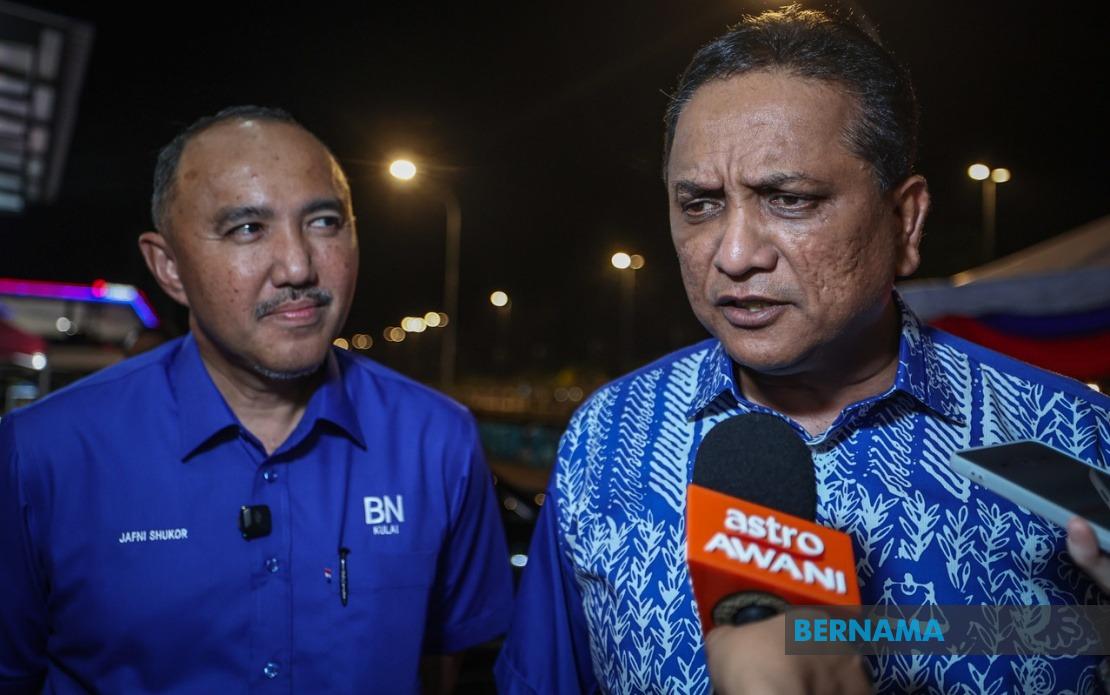
Senior UMNO politician Datuk Seri Reezal Merican Naina Merican has firmly rejected allegations that the Regent of Johor, Tunku Mahkota Ismail, exercises improper control over the state administration, characterising such claims as grossly overstated and without factual foundation. Speaking in Johor Bahru on June 25, the Supreme Council member emphasised that the Regent's active engagement in matters concerning Johor's development represents a legitimate expression of his constitutional role and duty to the people, rather than evidence of governmental manipulation.
The controversy emerged following the departure of Datuk Dr Mohd Puad Zarkashi, the former Speaker of the Johor State Legislative Assembly, from UMNO. Mohd Puad had contended that the state's Menteri Besar had effectively become a puppet subject to royal direction, a claim that has now drawn sharp rebuttal from party leadership. Reezal Merican's intervention seeks to defuse mounting tensions within UMNO ranks as the party gears up for critical state elections scheduled for early July.
Reezal Merican articulated a constitutional perspective on the Regent's prerogatives, arguing that issuing directives and maintaining oversight over state governance falls squarely within Tunku Mahkota Ismail's legal rights and obligations. He positioned the Regent's interventions not as overreach but as an essential mechanism for ensuring executive accountability and protecting public welfare in Johor. This framing attempts to distinguish between legitimate institutional checks and the alleged usurpation of governmental authority that Mohd Puad had implied.
Central to Reezal Merican's defence was his assertion that no credible evidence supports suggestions that Johor's UMNO division operates as an instrument of palace interests. Drawing on his experience within the party's highest decision-making body, he argued that such characterisations misrepresent both the nature of royal constitutional authority and the operational independence of the state government. His comments reflect broader efforts within UMNO to contain political damage ahead of the June 27 nomination day and July 11 polling.
The timing of Mohd Puad's departure carries particular significance given Johor's electoral calendar. The former Speaker's decision to exit UMNO while publicly questioning the Regent's influence in state affairs introduces a destabilising element into party dynamics at a moment when unity appears crucial. By calling out what he perceived as excessive royal direction, Mohd Puad appeared to challenge not merely the current administration but the legitimacy of the institutional arrangements underpinning Johor governance.
Reezal Merican also questioned the motivations behind Mohd Puad's public statements, suggesting that invoking the Royal institution in partisan political contestation served narrow factional interests rather than legitimate governance concerns. He indicated that introducing the monarchy into electoral calculations and internal party disputes represented a problematic conflation of constitutional authority with political competition. This critique implies that Mohd Puad weaponised royal concerns to advance personal or ideological objectives within UMNO.
The dispute illuminates ongoing tensions within Malaysia's federal system regarding the proper boundaries between royal constitutional roles and executive governmental functions. While the Johor constitution clearly vests significant authority in the Regent, including the power to advise and even direct the Menteri Besar on matters deemed vital to state interests, interpreting where legitimate oversight ends and improper control begins remains contested. Reezal Merican's intervention attempts to establish that current arrangements fall comfortably within constitutional parameters.
For Malaysian observers accustomed to strong royal influence in certain states, the Johor situation reflects broader questions about executive autonomy and monarchical power. Unlike purely ceremonial constitutions found in some democracies, Malaysia's federal and state systems grant substantial active authority to rulers and their representatives. The Regent of Johor, as heir to the throne, commands particular influence and exercises considerable discretionary powers over state administration. How these powers are exercised and perceived remains consequential for political stability.
The allegations also emerge within a context of evolving state politics in Johor, where electoral competition has intensified and coalition dynamics have shifted substantially in recent years. The defection of a former legislative Speaker carries symbolic weight beyond its immediate numerical impact, potentially signalling broader dissatisfaction within certain UMNO quarters. Reezal Merican's robust defence suggests party leadership takes seriously any suggestion that royal concerns rather than democratic processes or party mechanisms determine governmental outcomes.
Looking ahead to the July 11 election, both UMNO and competing coalitions will need to navigate perceptions about the nature of Johor governance and the extent of royal involvement in electoral outcomes. Reezal Merican's remarks represent an attempt to preemptively counter narratives suggesting that royal preferences rather than voter choices determine state leadership. Such narratives, if they gain traction, could undermine confidence in electoral legitimacy and party governance.
The dispute between Reezal Merican and Mohd Puad's implied criticism also reflects generational or ideological divisions within UMNO regarding how the party should relate to royal institutions. For Reezal Merican, strong royal engagement in governance represents an asset and constitutional feature worthy of respect. For Mohd Puad, such engagement appeared to compromise the autonomy and democratic accountability of elected officials. These divergent perspectives will likely resurface in post-election analyses and future Johor politics.

