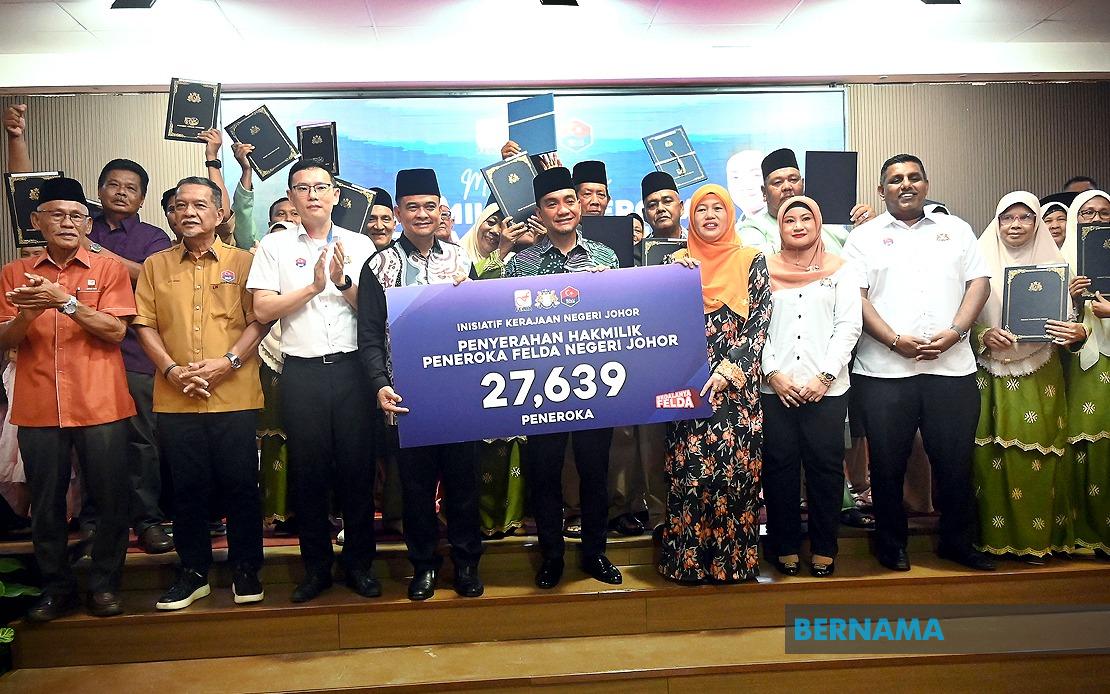
The Johor state government has moved decisively to close the chapter on a protracted dispute over land titles affecting Federal Land Development Authority (FELDA) settlers, a problem that has troubled rural communities across the state for years. At a ceremony held in Kluang on June 23, Menteri Besar Datuk Onn Hafiz Ghazi announced that 27,639 of 27,642 applications had been successfully processed, representing a 99.99 per cent resolution rate. This near-complete clearing of the backlog signals a turning point for FELDA communities that have long struggled with administrative and bureaucratic obstacles to securing formal ownership of their land.
The three districts of Kluang, Kota Tinggi and Mersing witnessed the handover of land titles to 210 settlers on the day, a symbolic moment that crystallised the state administration's resolve to address systemic inequities within the FELDA scheme. These documents, representing both plantation plots and residential properties, translate years of regulatory gridlock into concrete proof of ownership. For many beneficiaries, the titles represent not merely legal recognition but vindication of their stake in enterprises that have sustained their livelihoods and those of their families across generations.
The FELDA scheme, established to provide land development opportunities for rural Malaysians, has historically generated administrative friction points where settlers found themselves disadvantaged despite fulfilling their obligations. The ambiguity surrounding land ownership—whether formal titles existed or were perpetually suspended in bureaucratic limbo—created uncertainty that constrained settlers' ability to borrow against their assets, sell portions of their holdings, or plan with confidence for succession. This long-standing impediment affected not only individual welfare but also the viability of entire settlement schemes as productive economic units.
Menteri Besar Onn Hafiz framed the resolution as part of a broader rural development philosophy that positions FELDA communities as integral to Johor's economic and social fabric. His remarks emphasised that the state government would maintain FELDA settlements as a policy priority, suggesting a structural commitment rather than a temporary intervention. This positioning carries significance beyond the immediate beneficiaries, signalling to other rural constituencies that land security and administrative clarity are non-negotiable governance objectives in the current administration's framework.
The achievement reflects intensified coordination between state agencies responsible for land administration and FELDA management. Processing 27,639 applications to resolution—whether through formal title issuance, transfer, or administrative clarification—demands systematic organisation and sustained bureaucratic effort. The near-perfect completion rate suggests either that existing cases were relatively straightforward or that the state devoted sufficient resources to untangle the handful of genuinely complex situations. Either way, the execution demonstrates administrative capacity that Malaysian readers across other states may view with interest, given that similar land title disputes persist in other regions.
For FELDA settlers in Johor, the practical implications are substantial. Formal land titles strengthen collateral positions, enabling access to agricultural financing, equipment loans, and expansion capital on improved terms. Banks and microfinance institutions are more likely to extend credit when confronted with documented ownership rather than claims dependent on scheme regulations or oral traditions. This improved access to capital becomes particularly consequential during commodity price downturns or when settlers require investment in plantation rehabilitation or replanting cycles.
The resolution also carries succession planning benefits that will ripple through FELDA communities across generations. Settlers can now draft wills with confidence, knowing that their heirs will inherit formally recognised property rights rather than contestable interests. This clarity reduces potential family disputes and strengthens the intergenerational transmission of wealth and productive capacity within FELDA schemes. For younger members of settler families considering whether to remain engaged in agricultural pursuits, the availability of formally documented land stakes may prove psychologically and economically reassuring.
The involvement of Johor Agriculture, Agro-based Industry and Rural Development Committee chairman Datuk Zahari Sarip in the ceremony underscores that this initiative operates within the state's broader agricultural and rural policy architecture rather than existing as an isolated land administration matter. FELDA settlements represent significant agricultural production units, with implications for palm oil, rubber and other commodity outputs that contribute to Johor's economic profile. Clarifying ownership and ensuring settler security thus intersects with agricultural productivity objectives and food security considerations.
From a regional perspective, Johor's progress on FELDA land titles offers lessons for other Malaysian states managing similar schemes or grappling with comparable historical ambiguities in settler land rights. Selangor, Pahang and Terengganu administer their own FELDA schemes, and settlers in those jurisdictions may scrutinise Johor's approach as evidence of what coordinated state-level effort can accomplish. The pathway from 99.99 per cent completion to absolute resolution of the final three cases may provide operational guidance regarding the most intractable types of disputes and appropriate mechanisms for their resolution.
Looking forward, the Johor government faces the challenge of maintaining momentum on land administration issues that may emerge in non-FELDA rural communities or in other contexts where historical arrangements lack formal documentation. The political capital and administrative credibility generated by the FELDA resolution creates an opportunity to address related grievances affecting other constituencies. Whether the state channels this achievement into systematic land titling programmes affecting broader rural populations will determine whether this initiative represents a one-off success story or the foundation for institutionalised improvement in land administration governance.
The resolution also reflects evolving expectations around governance accountability in Malaysian federalism, where state governments increasingly face pressure to demonstrate tangible improvements in rural welfare and administrative transparency. The Johor government's willingness to quantify and publicly commit to near-complete resolution of the FELDA dispute set a measurable standard against which performance could be evaluated. This approach to governance—anchoring announcements to specific, verifiable metrics—represents a rhetorical shift toward outcomes-based accountability language, a pattern Malaysian political observers will likely see replicated across other state initiatives.

