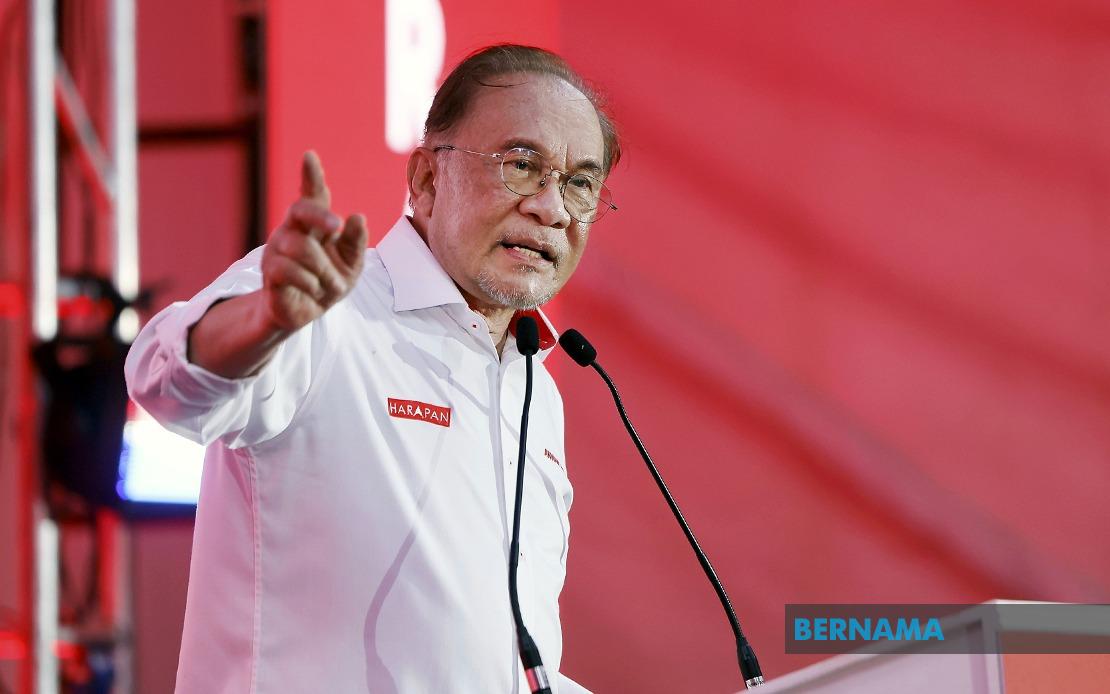
Prime Minister Datuk Seri Anwar Ibrahim has highlighted what he characterises as the Federal government's financial commitment to Johor, revealing that the state received RM16 billion in federal allocations between 2023 and 2025 despite contributing only RM14 billion in tax revenue to federal coffers during the same period. Speaking at a Pakatan Harapan candidate announcement ceremony in Tangkak on June 22, Anwar sought to demonstrate the administration's prioritisation of Johor's development through concrete fiscal figures, underscoring a net transfer of RM2 billion from the centre to the state.
As Finance Minister and Prime Minister, Anwar presented the comparison as evidence of the Federal government's sustained dedication to advancing Johor's infrastructure and welfare programmes. The breakdown of the RM16 billion returned to Johor encompasses various channels including capital development projects, routine operating expenditures, and targeted assistance schemes designed to benefit the state's population. This framing appears calculated to counter opposition narratives ahead of the Johor State Election, positioning the current MADANI Government as a more generous benefactor to the state than its predecessors.
The data revealing Johor's improved financial position under the current administration becomes clearer when examining trends in operating expenditure allocations. During the previous government's tenure, Johor received between RM6 billion and RM7 billion annually for operational purposes. Under the MADANI Government, this figure has expanded to RM8.7 billion, representing a substantial year-on-year increase that Anwar contends reflects enhanced federal priority given to the state's administrative needs and service delivery capacity.
When contextualised within Malaysia's broader federal spending landscape, Johor's position as the third-largest recipient of combined operating and development expenditure allocations—trailing only Sabah and Sarawak—carries significant political weight. This ranking acknowledges Johor's status as the nation's second-most populous state while recognising the particular fiscal demands of the East Malaysian states, which face greater geographical and infrastructural challenges. For 2026, the allocation trajectory continues upward, with operating expenditure projected at RM8.7 billion while development expenditure is forecast to reach RM4.8 billion, compared to RM2.3 billion in 2022.
The development expenditure growth from RM2.3 billion to RM4.8 billion over a four-year period represents more than a doubling of capital investment commitments, signalling accelerated infrastructure development across Johor. This expansion includes highways, public transport systems, urban renewal projects, and industrial park developments intended to enhance the state's competitiveness within Malaysia's economic landscape. For Malaysian readers particularly those in Johor, such increases translate into tangible improvements in roads, schools, hospitals, and commercial facilities.
Beyond headline figures, Anwar emphasised Johor's substantial share of two major social assistance programmes. The state ranks second only to Selangor as a recipient of Sumbangan Tunai Rahmah (STR) and Sumbangan Asas Rahmah (SARA) cash assistance schemes. These programmes, designed to provide direct financial support to lower-income households, have become flagship initiatives of the current government's approach to wealth redistribution and cost-of-living relief. Johor's elevated status within these schemes reflects both its population size and the Federal government's assessment of eligible beneficiaries' needs within the state.
The political context underlying Anwar's disclosure deserves examination. By quantifying federal support to Johor and demonstrating fiscal transfers flowing from centre to state rather than vice versa, the Prime Minister addresses a common grievance within state politics—the perception that states contribute disproportionately to federal revenues without receiving proportional returns. Whether through infrastructure investment or direct cash transfers, the administration's strategy emphasises tangible benefits reaching ordinary Johoreans' lives, a messaging approach particularly potent during election periods when voter attention to economic performance peaks.
For Southeast Asian observers monitoring Malaysian federalism, the Johor fiscal relationship illustrates broader tensions inherent in systems where economic power concentrates in specific states while political authority remains centralised. The revenue-return gap Anwar highlights reflects deliberate redistribution mechanisms embedded within Malaysia's fiscal architecture. Sabah and Sarawak's higher allocations reflect constitutionally entrenched provisions acknowledging their federal integration terms, while Johor's elevated position among Peninsular states signals economic significance and electoral competitiveness combined.
Anwar's disclosure also contextualises within Malaysia's ongoing political realignment. Johor's shift from opposition control to Federal government influence represents a significant development, particularly given the state's historical importance. The enhanced federal allocations Anwar announces may be interpreted partly as consolidation of this political realignment through material benefit distribution. State administrations receiving increased federal support typically generate improved public satisfaction metrics, creating electoral momentum favouring ruling coalitions.
The broader implications extend to how Malaysian governments justify fiscal decisions to taxpayers nationally. Citizens from states potentially perceiving themselves as net contributors to federal coffers may question allocation methodologies. Anwar's transparency regarding Johor's financial flows suggests an administration willing to address such scrutiny directly, though sceptics might note that detailed federal-state fiscal accounting remains opaque across many Malaysian state-centre relationships.
Looking forward, the trajectory established through 2026 projections suggests sustained federal investment in Johor's economic capacity and social welfare infrastructure. Whether these commitments persist beyond election cycles will significantly influence both Johor's economic trajectory and perceptions of federal fairness across Malaysia's state system. The figures Anwar presented establish benchmarks against which future allocations will inevitably be compared by Johor voters evaluating government performance.

