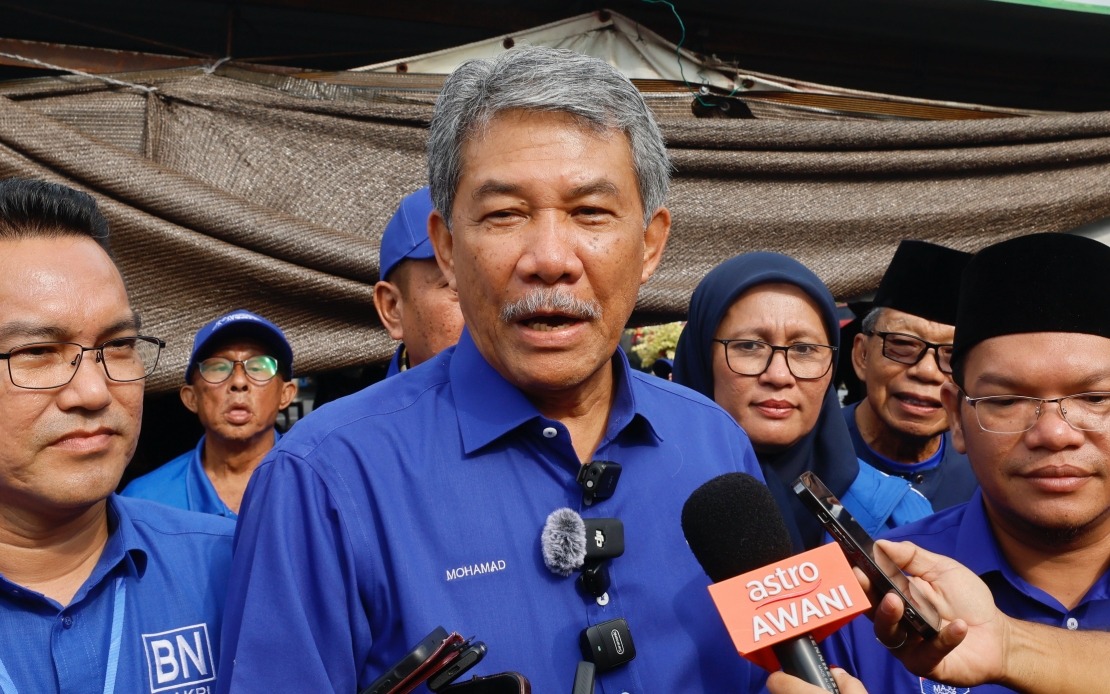
The Johor state election campaign must be conducted with maturity and restraint, steered clear of personal attacks that could undermine national stability, according to UMNO deputy president Datuk Seri Mohamad Hasan. Speaking during an engagement with voters in the Tiram state constituency, the Foreign Minister emphasised that while parties are entitled to present their platforms and proposals to the electorate, the campaign should not jeopardise the cooperative relationships that sustain the Unity Government at federal level.
Mohamad Hasan drew a distinction between healthy political competition and divisive personal conduct. He acknowledged that political parties inevitably engage in some form of banter and criticism, describing this as a normal part of democratic discourse. However, he stressed the importance of maintaining professional boundaries and avoiding rhetoric that crosses into personal territory. His remarks reflect growing concern among senior UMNO figures about the tone and nature of political campaigning in recent years, particularly when state and federal interests intersect.
The timing of Mohamad's statement is significant given the complex political dynamics in Johor. The state election, scheduled for July 11 with early voting on July 7, comes at a moment when Malaysia's federal administration depends on the delicate balance maintained by the Unity Government coalition. Any escalation in campaign rhetoric that threatens to splinter this arrangement could have consequences extending well beyond state boundaries, affecting the government's ability to function effectively at the national level.
A key concern that has circulated in political circles involves allegations that the Johor state election is linked to efforts to secure a pardon for former Prime Minister Datuk Seri Najib Tun Razak. Mohamad Hasan explicitly addressed these claims, characterising them as entirely without foundation. He articulated a clear legal and constitutional framework to explain why the state election holds no bearing on federal matters regarding Najib's legal status. This point speaks to fundamental principles about separation of powers and the distinct jurisdictions of state and federal governments.
The Foreign Minister elaborated on the constitutional constraints that make such speculation illogical. A state government, he explained, has no capacity whatsoever to intervene in matters of national clemency or pardons. The power to grant such relief rests exclusively with the Federal Government, and more specifically, the absolute prerogative belongs to the Yang di-Pertuan Agong. Mohamad emphasised that this constitutional arrangement must be respected and protected, warning against any attempt to circumvent or diminish the Agong's authority in this domain.
Mohamad's emphasis on the rule of law and constitutional supremacy reflects UMNO's positioning as a party committed to institutional stability. By insisting that Malaysia operates as a nation anchored in legal principles, he sought to reassure both coalition partners and the broader public that the party respects established governance structures. This framing is particularly important for a coalition that has faced questions about its cohesion and durability, especially given the complexities of managing multiple parties with different interests and constituencies.
The Johor state election represents one of the largest electoral contests in Malaysia since the 2022 general election, with 172 candidates competing for 56 seats in the State Legislative Assembly. The scale of this contest makes campaign conduct all the more consequential, as messaging and tone can reverberate across multiple constituencies and influence perceptions of the broader political environment. Mohamad's intervention suggests party leadership recognises the risks of allowing campaign dynamics to spiral beyond what can be easily managed or contained.
The appeal for campaign prudence also reflects practical political calculations. The Unity Government depends on cooperation between ideologically diverse parties, each with their own bases and interests. Should the Johor campaign become marked by acrimonious attacks, this could generate pressure within parties to take harder stances, potentially destabilising the national coalition. Mohamad's framing of this issue—distinguishing between acceptable political competition and counterproductive personal animosity—represents an attempt to set clear boundaries that allow robust campaigning without triggering wider systemic consequences.
For Malaysian voters, particularly those in Johor, Mohamad's comments signal that the state election, while locally significant, must be understood within the context of federal political arrangements. The implicit message is that Johor voters should focus on state-level issues and performance when making electoral decisions, rather than viewing the contest through the lens of national-level grievances or controversies. This approach seeks to compartmentalise the election and prevent it from becoming a proxy referendum on federal government performance or national issues.
The distinction Mohamad drew between parties and personalities carries implications for how Malaysian political competition develops. By privileging policy-based competition over personal attacks, he articulated a vision of politics centred on ideas and governance outcomes. This contrasts with campaign styles that rely heavily on character assassination or personal controversies. Whether contesting parties will heed this call remains to be seen, but his statement establishes a normative standard against which campaign conduct can be measured and assessed.
Looking at the broader Southeast Asian context, Malaysia's approach to managing state elections while maintaining federal coalition stability offers lessons for other democracies in the region grappling with similar tensions. The challenge of holding elections without destabilising governing coalitions is not unique to Malaysia, and Mohamad's attempt to navigate this challenge reflects broader regional concerns about maintaining institutional continuity even as electoral competition proceeds.
The Foreign Minister's comments also underscore the maturity expected of political leaders in a multi-party system. By calling for restraint and forward-thinking, he positioned UMNO and the government as institutions capable of managing competing interests without allowing elections to become vehicles for destructive conflict. This positioning matters both domestically and internationally, as Malaysia's stability and institutional competence affect investor confidence, regional standing, and public trust in democratic institutions.

