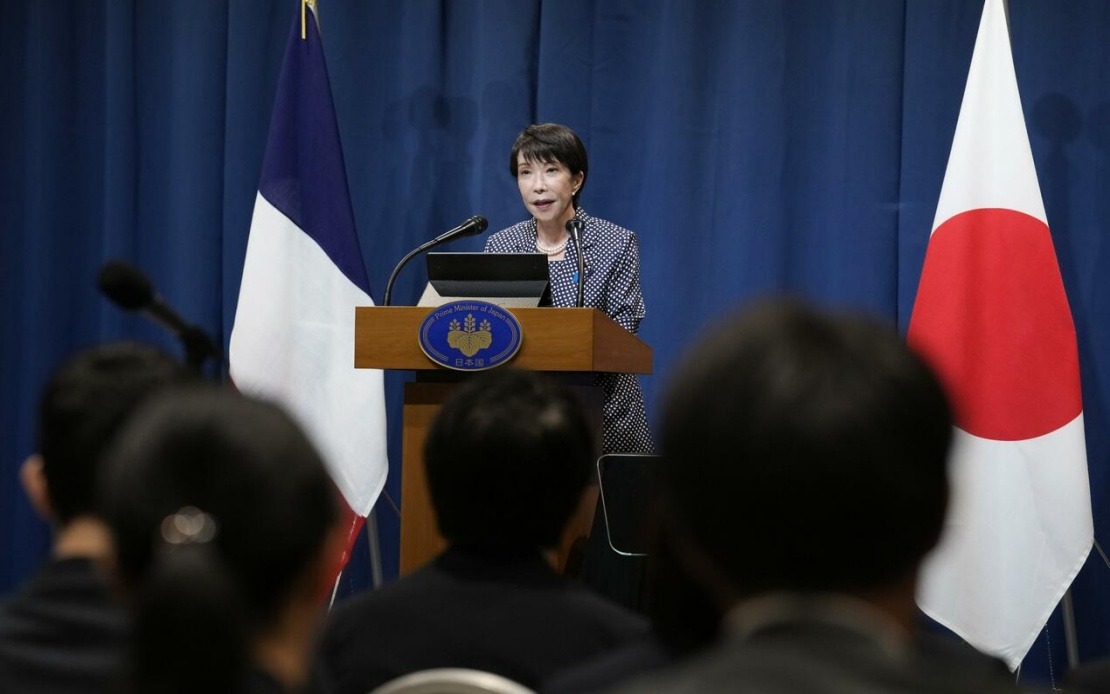
Japanese Prime Minister Sanae Takaichi's administration faces mounting political headwinds, with her cabinet's approval rating declining to 55.8 per cent—a new low-water mark since she took office last October. The erosion of public support, revealed in a Kyodo News survey conducted over the weekend, signals deepening discontent among voters grappling with persistent economic challenges and geopolitical uncertainties that directly affect Japan's resource-dependent economy.
The poll's timing coincides with a pivotal moment in international relations: the United States and Iran had just concluded preliminary peace negotiations that would include Tehran reopening the Strait of Hormuz, a critical chokepoint through which roughly one-third of seaborne traded oil passes globally. For Japan, a nation heavily reliant on Middle Eastern petroleum imports, such developments carry profound implications for energy security and inflation pressures already squeezing household budgets across the nation.
Japan's historical vulnerability to disruptions in resource supplies makes geopolitical stability in the Middle East a matter of existential economic importance. The country imports approximately 85 per cent of its oil, with a significant portion flowing through the Strait of Hormuz. Any prolonged conflict or blockade in West Asia threatens to drive energy costs higher, exacerbating the inflationary pressures that have already pushed Japanese consumers to the brink of their financial tolerance. Takaichi's government appears caught between managing these external pressures and addressing the legitimate grievances of households facing squeezed purchasing power.
One pressing policy question that the Takaichi administration must navigate concerns Japan's potential military role in the region. The poll revealed that 54.7 per cent of respondents opposed dispatching Japanese Self-Defence Forces to the Strait of Hormuz or other key waterways to protect commercial shipping. This stance reflects broader public skepticism about military interventionism abroad, a position deeply embedded in Japan's post-war pacifist constitution and political culture. Conversely, 36.6 per cent of respondents believed such deployment would be justified, representing a significant minority who view military presence as necessary for safeguarding national economic interests. This split underscores the difficult balancing act that the Takaichi Cabinet must perform between reassuring international allies and respecting public wariness toward military adventures.
The domestic economic malaise, however, appears to be the primary driver of declining public confidence. Elevated prices for everyday goods have become the dominant concern for ordinary Japanese families, creating political vulnerability for the government. With real wages failing to keep pace with inflation, households have seen their living standards erode, and this material discontent translates directly into declining approval ratings for political leaders perceived as unable to deliver relief.
Takaichi's cabinet has clearly recognised this challenge and has attempted to respond through targeted fiscal measures. The survey findings on consumption tax policy reveal the complex political calculations surrounding attempts to address food price inflation. Approximately 43.9 per cent of poll respondents indicated willingness to accept a reduction in the consumption tax on food and beverages from the current 8.0 per cent to 1.0 per cent, provided such a cut could be implemented more rapidly. This qualified acceptance suggests that voters are not reflexively opposed to lower tax rates; rather, they are prioritising speed of implementation and tangible relief.
A notably more aggressive constituency exists within the electorate: 22.6 per cent of respondents called for eliminating the consumption tax on food entirely—setting it to zero. This position aligns with pledges made by ruling coalition parties and reflects the depth of public frustration with food affordability. The fact that nearly two-thirds of respondents support some form of consumption tax reduction demonstrates that this issue resonates powerfully with the electorate and represents fertile political ground for Takaichi to rebuild eroded support.
The trajectory of Takaichi's approval rating carries significance beyond Japan's borders. As the world's third-largest economy and a linchpin of regional security architecture in East Asia, Japan's political stability matters to its neighbours and strategic partners. A weakened prime minister facing declining public approval may find it difficult to maintain consistent foreign policy positions or to commit the political capital necessary for complex international negotiations. For Southeast Asia and broader Asia-Pacific stability, Japanese domestic political weakness could translate into less predictable policy outcomes.
Moreover, the underlying tensions revealed in this polling data—between external security threats and internal economic distress—mirror challenges facing other developed economies. Japan's experience of elevated prices eroding public confidence, even as governments attempt to manage complex geopolitical relationships, provides a cautionary template relevant to Malaysia and other regional economies grappling with similar pressures of globalisation, energy security, and inflation management.
For Malaysia specifically, Japan's policy responses to Middle East tensions hold direct relevance. Both nations depend heavily on Middle Eastern oil and gas supplies. Malaysia's economic performance and price stability will be influenced by the same regional dynamics affecting Japan. Furthermore, Malaysian policymakers observing Takaichi's political difficulties stemming from unaddressed cost-of-living pressures may draw lessons about the political costs of allowing inflation to persist without demonstrable government intervention.
Takaichi now faces a narrowing window to arrest the decline in public confidence. Whether through accelerated consumption tax reductions, broader economic stimulus, or more effective communication about efforts to manage Middle East risks, the prime minister must demonstrate to Japanese voters that her administration commands the capacity and competence to protect their interests in an uncertain global environment. The current 55.8 per cent approval rating, while still above critical thresholds, represents a warning that political capital is finite and eroding.

