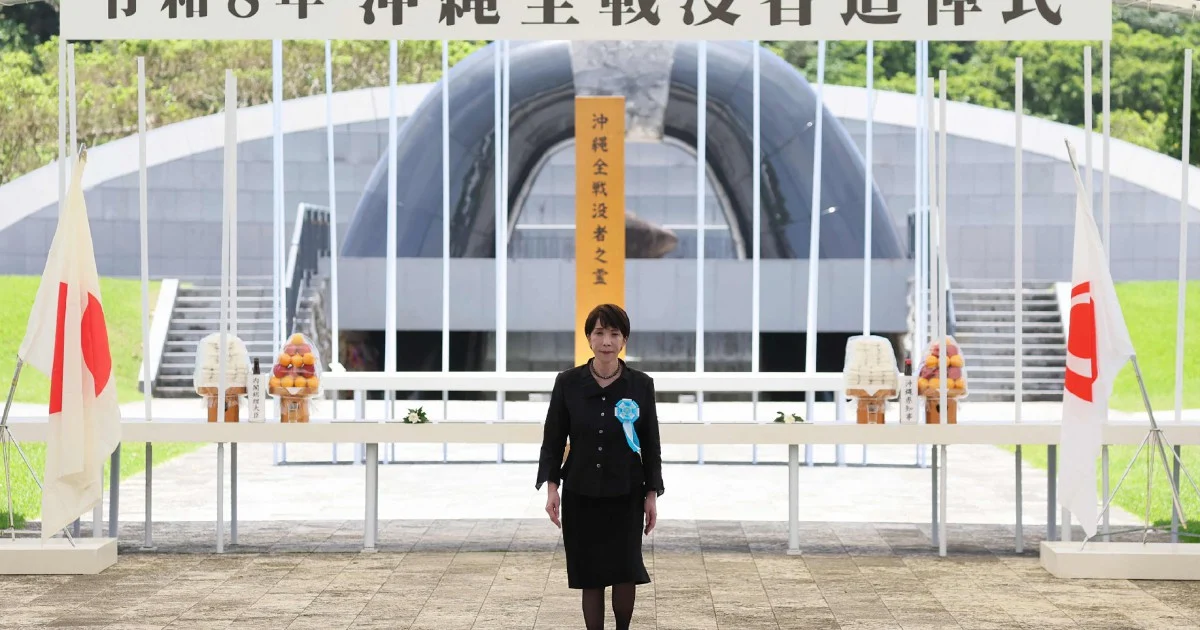
Japanese Prime Minister Sanae Takaichi encountered organised opposition during a World War II memorial observance when demonstrators voiced strong disapproval of the government's accelerating military modernisation agenda. The confrontation, captured by news crews at the event, underscores deepening domestic divisions over Japan's shifting security doctrine and its implications for the nation's post-war constitutional framework.
The timing of the protest carries particular significance within Japan's fractured political landscape. Takaichi's administration has championed substantially elevated defence budgets and doctrinal changes that move Tokyo further from the non-militarisation principles enshrined in the 1947 Constitution. This represents a dramatic departure from seven decades of strategic restraint, a posture that had largely defined Japan's regional relationships and international standing throughout the Cold War and beyond.
For Malaysian and broader Southeast Asian observers, Japan's military trajectory warrants close examination. As the region grapples with rising Chinese assertiveness and North Korean weapons development, Japan's rearmament carries consequences that ripple throughout the Indo-Pacific security architecture. Malaysia, alongside fellow ASEAN members, has sought to maintain equilibrium between major powers; Tokyo's expanded military footprint and capability development could reshape regional force balances and security calculations that smaller nations must navigate.
The protesters who confronted Takaichi represent a significant constituency within Japanese society that remains deeply attached to pacifist constitutional principles. This group fears that incremental security policy adjustments—presented as defensive necessities—constitute a fundamental betrayal of post-war values forged from the ashes of 1945. They argue that military expansion, regardless of stated intentions, invites strategic competition and undermines the diplomatic approaches that have historically characterised Japan's engagement with neighbours.
Takaichi's position within Japan's factional politics amplifies these concerns. Her administration has signalled willingness to reinterpret constitutional constraints on military deployment, arguing that contemporary threats justify expanded self-defence capabilities and enhanced interoperability with allied forces. Critics contend this represents constitutional amendment by administrative decree rather than through legitimate democratic processes, circumventing public debate required for such consequential shifts.
The memorial event itself symbolises the ideological fault lines dividing contemporary Japan. Such observances traditionally emphasise remembrance and reflection on war's devastation, yet they have increasingly become platforms for contemporary political messaging. Defence advocates frame military strengthening as honouring fallen soldiers and preventing future conflicts, while pacifist groups view such rhetoric as instrumentalising history to legitimise militarisation they consider both unnecessary and destabilising.
Regional governments including Malaysia must carefully monitor how Japan's domestic security debates ultimately resolve. Should constitutional reinterpretations proceed unchecked, Japan might eventually pursue capabilities that fundamentally alter regional strategic stability. Conversely, should domestic opposition constrain military expansion, Tokyo might rely increasingly on alliance relationships and collective security arrangements, potentially drawing additional nations into great power competition dynamics.
The heckled ceremony reflects broader patterns evident across East Asia, where historical memory and contemporary strategy intersect provocatively. Japan's experience differs markedly from South Korea's or Taiwan's security trajectories, both of which emerged from different post-war settlements and face distinct threat environments. Yet all grapple with balancing historical consciousness against present-day strategic imperatives—a tension Japan's divided society has not yet fully resolved.
Takaichi's government appears determined to advance its military modernisation programme regardless of domestic opposition, suggesting the protest represents a persistent but ultimately insufficient counter-force. Japan's ageing population and fiscal constraints might prove more limiting factors than public dissent, particularly if defence spending continues expanding at proposed rates. This structural reality complicates the narrative that popular will alone will determine Tokyo's security trajectory.
For Southeast Asia specifically, Japan's military reorientation carries practical implications beyond abstract strategic theory. Increased Japanese defence presence in regional waters, enhanced coordination with Western partners, and expanded military-to-military relationships with ASEAN members all flow from policies that remain contested within Japan itself. Malaysian policymakers must therefore recognise that Tokyo's security posture reflects unresolved domestic tensions, not settled national consensus.
The confrontation between Takaichi and protesters ultimately illustrates that Japan's security transformation, while strategically significant, lacks the unanimous backing that such fundamental shifts ordinarily require. This domestic fracture may ultimately constrain Tokyo's ability to project the unified strategic purpose that contemporary regional challenges arguably demand. As ASEAN nations calibrate responses to evolving great power competition, understanding the contested nature of Japan's military shift proves essential for informed policy formation.

