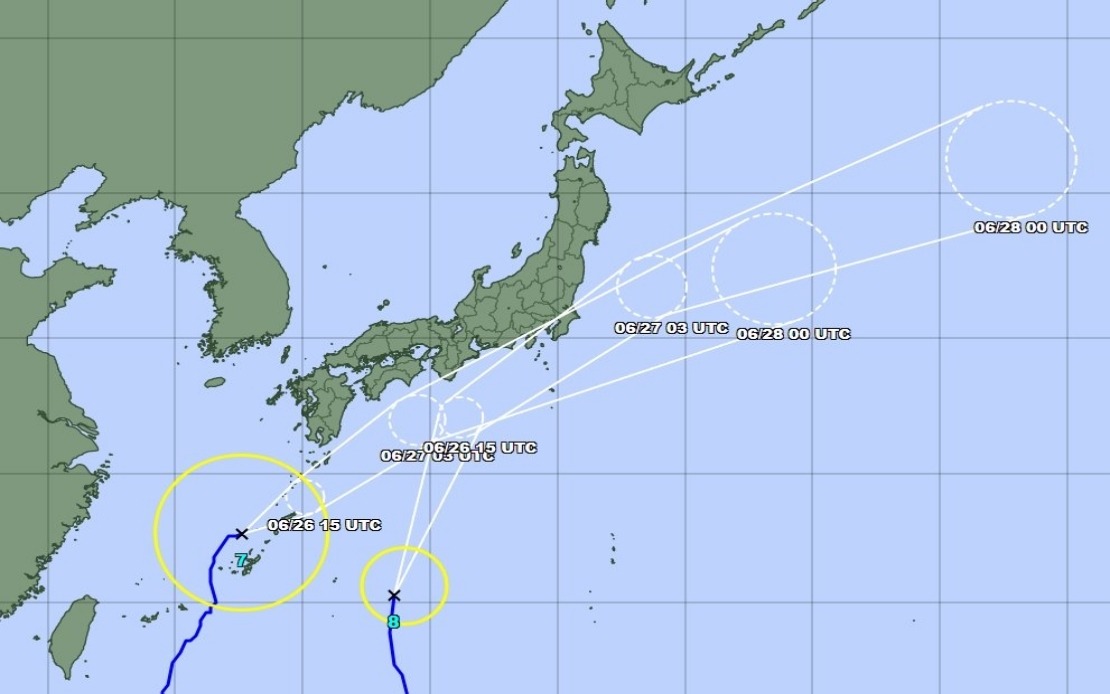
Japan faces an unusually challenging weather weekend as two separate typhoons threaten the archipelago simultaneously, forcing authorities to issue evacuation orders affecting more than two million people across thirteen prefectures in the western and central regions. The Japan Meteorological Agency sounded the alarm on Friday morning as Typhoon Higos approached from the Pacific while another system, Typhoon Mekkhala, was already battering the southwestern coast with torrential downpours that have persisted since midweek.
The dual-typhoon scenario presents a rare and complicated challenge for Japan's disaster management infrastructure. Typhoon Mekkhala had already reached the Amami region in Kagoshima Prefecture by Friday, with forecasters expecting it to track toward the heavily populated Kanto region east of Tokyo. Simultaneously, Typhoon Higos was positioned to make landfall the following day, setting up conditions where rainfall could intensify dramatically across central Honshu as the two systems interact with the country's geography and existing monsoon patterns.
According to Japan's Fire and Disaster Management Agency, the sheer scale of evacuations underscores the severity of the threat. By Friday morning, local authorities had ordered the displacement of over two million residents from the Kinki region, which includes Osaka and Kyoto, and the entire Kyushu region in southwestern Japan. In Seika, Kyoto Prefecture, town officials declared the highest level five emergency safety alert for specific neighborhoods after a landslide struck during Friday morning, destroying homes and blocking evacuation routes that residents typically use during weather emergencies.
The rainfall statistics paint a sobering picture of the moisture these systems have already delivered to southwestern Japan. Goto in Nagasaki Prefecture accumulated six hundred millimetres of rain between Tuesday and Friday morning—equivalent to more than two weeks of typical monthly precipitation in a mere four days. Aso in Kumamoto Prefecture and Ureshino in Saga Prefecture each recorded more than five hundred millimetres, intensifying the risk of additional ground failures, flooding of rivers, and infrastructure damage as the ground becomes increasingly saturated.
Looking ahead to Saturday, the weather agency forecast even more intense rainfall as Typhoon Higos moves northward along Japan's southern coast, channeling warm, moisture-laden air inland. The Tokai region, which encompasses parts of Shizuoka and Aichi prefectures and serves as an economic and industrial heartland, faces up to three hundred millimetres of additional rain by noon Saturday. The broader Kanto-Koshin zone, encompassing the Tokyo metropolitan area and surrounding prefectures, is expected to receive up to one hundred fifty millimetres. These rainfall projections carry serious implications for flooding along major rivers and overflowing water management infrastructure across Japan's most densely populated corridor.
The weather agency emphasized that both typhoons are expected to gradually weaken into extratropical cyclones as they penetrate further north and encounter cooler air masses. However, this transition does not guarantee safety, as extratropical cyclones can still produce dangerous winds, flooding, and landslides, particularly when multiple weather systems interact. The agency specifically warned of strong storms developing across Okinawa Prefecture, where tourism infrastructure could sustain damage, and across eastern Japan, where residents and businesses have had minimal time to prepare for the second system.
For Malaysian and Southeast Asian observers, Japan's weather crisis carries instructive lessons about climate volatility and extreme precipitation events that are becoming increasingly common across the tropical and subtropical regions. Multiple concurrent typhoons are rare but no longer anomalous, reflecting broader atmospheric patterns influenced by ocean temperature variations and jet stream behavior. Japan's response—with its pre-positioned evacuation protocols, real-time weather monitoring, and coordinated government response—demonstrates institutional capacity that contrasts sharply with disaster preparedness capabilities in many developing Asian nations.
The timing compounds dangers for Japanese authorities managing the crisis. Evacuations themselves require enormous logistical effort; coordinating shelter, food, medical services, and security across millions of displaced persons strains government budgets and personnel. When two typhoons arrive in close succession, emergency responders cannot fully stand down from one crisis before engaging the next, exhausting reserves of personnel, vehicles, and supplies. Power outages from weather damage further hamper communications and emergency coordination in affected zones.
Japan's experience also illustrates how climate change is reshaping seasonal weather patterns that communities have adapted to over centuries. The traditional typhoon season—August through October—is becoming less predictable, with major systems appearing earlier and sometimes later in the calendar year. June typhoons, while not unprecedented, arrive when summer preparations are underway and agricultural crops are growing, multiplying economic consequences beyond immediate human safety concerns.

