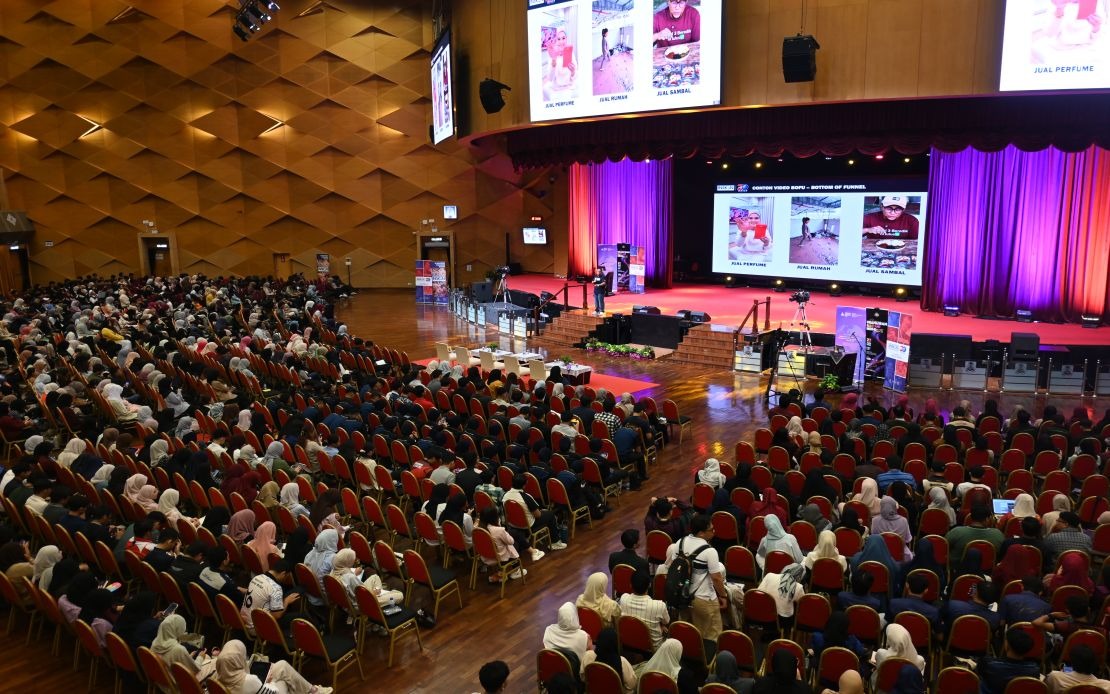
The Usahawan MADANI Mega 2026 entrepreneurship seminar demonstrated unprecedented momentum in Malaysia's drive to cultivate a new generation of business founders, attracting 6,877 participants through both in-person and virtual channels. The scale of participation earned the event a place in the Malaysia Book of Records as the country's largest student-attended entrepreneurship seminar, underscoring the rising appetite among university-age Malaysians for business knowledge and venture development.
Organised by the National Entrepreneurship Institute (INSKEN) in partnership with the Malaysian Academy of SME and Entrepreneurship Development (MASMED) and Universiti Teknologi MARA (UiTM), the seminar created a structured environment for knowledge exchange among students from across the nation. The event featured practical capacity-building workshops, mentorship networks, and strategic discussions designed to equip aspiring entrepreneurs with foundational business competencies and industry connections.
Datuk Mohamad Alamin, deputy minister for Entrepreneur and Cooperatives Development, highlighted that the seminar's success reflects a broader cultural shift toward entrepreneurship as a legitimate and desirable career trajectory for younger Malaysians. Beyond individual aspirations, he emphasised that entrepreneurship now functions as a fundamental economic lever for the nation, particularly as Malaysia navigates an increasingly competitive regional and global marketplace where innovation and agility determine competitive advantage.
The ministry's strategic vision, articulated through the MADANI government's commitment via KUSKOP (Ministry of Entrepreneur and Cooperatives Development), prioritises the systematic strengthening of Malaysia's entrepreneurial infrastructure. This multi-pronged approach encompasses capacity enhancement programmes, improved access to financing mechanisms, expanded market opportunities, digital transformation initiatives, and targeted business support services. The emphasis on ecosystem development rather than isolated incentives reflects international best practice in entrepreneurship policy.
Entrepreneurs, as Mohamad Alamin stressed during his attendance at the seminar held at Dewan Agung Tuanku Canselor in UiTM Shah Alam, function as multipliers within the economy. They generate employment, fortify domestic supply chains, accelerate technological innovation, and accumulate wealth that circulates throughout the national economy. This reasoning explains why governments increasingly view entrepreneurship development not as a niche programme but as core economic strategy.
Datuk Mustaffa Kamil Ayub, chairman of INSKEN's Board of Trustees and a UiTM board member, contextualised the seminar's strong attendance within Malaysia's evolving entrepreneurial culture. He reframed entrepreneurship beyond occupational choice, positioning it as an integrated mindset, cultural value, and societal movement capable of fundamentally reshaping Malaysia's economic trajectory. This reconceptualisation matters because it signals a shift from viewing business ownership as an individual achievement toward recognising it as a collective national endeavour.
The seminar's curriculum incorporated the MOFA framework, a practical pedagogical tool addressing four foundational business dimensions: marketing, operations, finance, and business administration. This structured approach recognises that entrepreneurial success depends not on inspiration alone but on systematic mastery of operational fundamentals. By exposing thousands of students to this integrated framework, the seminar provided accessible entry points into professional business thinking.
SUM MEGA 2026 functions strategically as an institution-building initiative designed to foster entrepreneurial culture specifically within Malaysia's university system. The concentration on students and recent graduates addresses a critical demographic window—young adults with limited financial obligations but substantial energy, technological fluency, and educational foundation. By intervening at this stage, policymakers aim to shape career preferences and business formation patterns across an entire cohort.
INSKEN's portfolio of supporting programmes—including the INSKEN Masterclass, BANGKIT, and PROTÉGÉ initiatives—creates a structured pathway for sustained entrepreneurial development beyond the seminar. This multi-programme architecture recognises that a single event, however large, cannot comprehensively transform entrepreneurial capacity. Instead, complementary initiatives provide progressively advanced support, from foundational awareness to mentored venture development.
The seminar explicitly anchored itself within Malaysia's National Entrepreneurship Policy 2030, demonstrating alignment between grassroots event programming and high-level national strategy. By assembling government ministries, academic institutions, industry representatives, financial intermediaries, and business development agencies within a single platform, SUM MEGA 2026 modelled the whole-of-ecosystem collaboration increasingly recognised as essential for entrepreneurship development. Malaysia's relatively small population and integrated economy require such coordinated approaches to achieve scale and impact.
For Malaysian entrepreneurs and potential founders, the seminar's success signals official commitment to reducing barriers to business launch and growth. The concentration of resources toward student and young professional cohorts suggests that financial, mentoring, and market-access support increasingly targets early-stage founders. Observing this trajectory, aspiring entrepreneurs can reasonably expect continued institutional investment in their sector and expanded opportunities for access to development support.
The international context matters here as well. Regional competitors including Indonesia, Thailand, and Vietnam have invested substantially in entrepreneurship ecosystems over the past decade, producing visible clusters in fintech, e-commerce, and technology services. Malaysia's SUM MEGA initiative and accompanying policy infrastructure represent a deliberate effort to maintain competitive parity and prevent brain drain of entrepreneurial talent to more attractive neighbouring ecosystems.
Looking forward, the challenge for Malaysian policymakers lies in converting seminar attendance into actual venture formation and scaling. Participation metrics alone do not guarantee economic outcomes. The true measure of success will emerge over subsequent years as cohorts of SUM MEGA participants launch businesses, create employment, and generate measurable economic activity. The infrastructure and programming now in place provides necessary but not sufficient conditions for transformation.

