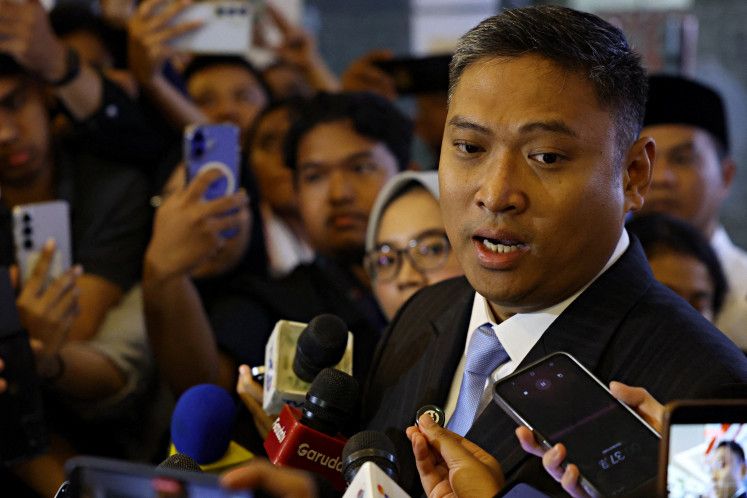
President Prabowo Subianto's flagship free nutritious meals programme experienced yet another leadership upheaval this week when National Nutrition Agency (BGN) chief Nanik Sudaryati Deyang stepped down just weeks into her tenure, deepening concerns about institutional stability at the heart of one of the administration's most prominent social initiatives. Nanik's departure marks the latest in a series of governance disruptions that have undermined public confidence in the agency responsible for distributing meals to millions of Indonesians across the archipelago.
The resignation unfolded publicly through social media on Wednesday when Nanik announced her decision to President Prabowo and requested relief from her duties. Her departure centred on a serious health crisis: doctors had identified a blockage in one of her heart arteries, a condition she attributed partly to the overwhelming stress of overseeing the programme's colossal budget. In candid posts detailing her decision, she described the responsibility of safeguarding public funds as tantamount to standing perpetually on the precipice of a steep cliff, where even minor lapses could prove catastrophic for national finances and her own wellbeing.
The psychological toll on Nanik appears to have been considerable. She reported experiencing what she termed acute trauma from managing the programme's financial dimensions, revealing that she had adopted an abundance of caution in her administrative approach, refusing to sign documents independently and subjecting every policy decision to repeated questioning. This hypervigilant stance itself became a source of debilitating stress, forcing her to seek overseas medical treatment for her deteriorating cardiovascular condition. Her frank acknowledgement of these struggles offered a rare window into the immense pressure surrounding the management of Indonesia's largest social welfare initiative.
Nanik's fall from the leadership position occurred with striking rapidity. Appointed to the role less than two months earlier as a replacement for her disgraced predecessor, she had been brought in with the explicit mandate of restoring institutional credibility following a corruption scandal that had engulfed the agency. Her predecessor, Dadan Hindayana, had been arrested alongside two deputies in June following dismissal by Prabowo, as investigators from the Attorney General's Office probed allegations of procurement irregularities and financial mismanagement within the multitrillion-rupiah apparatus. Nanik, who had previously served as Dadan's deputy, was positioned as an internal reformer capable of reassuring the public and strengthening oversight mechanisms.
Within hours of accepting Nanik's resignation, Prabowo moved decisively to install a replacement. Deputy Agriculture Minister Sudaryono, a politician from Prabowo's own Gerindra Party who previously served as a presidential aide, received the appointment at a formal State Palace ceremony on Wednesday. The swift succession underscored the administration's determination to maintain forward momentum despite the institutional turbulence. Upon assuming office, Sudaryono committed publicly to comprehensive transparency and accountability reforms, pledging to replace opacity with clarity and to digitalise manual processes so that all transactions could be properly documented and monitored.
State Secretary Prasetyo Hadi acknowledged that the latest disruption represented an unfortunate setback for the agency, confirming that President Prabowo had instructed his administration to undertake comprehensive structural and procedural reforms at the BGN. Officials selected Sudaryono partly on the rationale that his earlier involvement in conceptualising and developing the free meals scheme positioned him to shepherd it through its current crisis. This decision to return to an insider familiar with the programme's architecture suggested that the administration viewed technical continuity and political loyalty as more valuable than bringing in external expertise or fresh institutional oversight.
The programme itself has accumulated a troubling record of operational failures since its launch in early 2025. Beyond the corruption allegations and leadership instability, the initiative has grappled with questions concerning food quality and has been marred by repeated mass poisoning incidents across various regions of Indonesia. These public health episodes generated significant media coverage and public anxiety about the safety of meals distributed through the programme. In response, Nanik had imposed a moratorium on establishing new kitchens while subjecting approximately 28,000 existing facilities nationwide to comprehensive review and assessment procedures.
The kitchen moratorium, though intended to improve quality controls, generated substantial pushback from thousands of prospective food preparation operators who had invested considerable capital in constructing and equipping their facilities in anticipation of programme participation. The sudden halt on expansion created financial hardship for these entrepreneurs and sparked organised protests that further damaged public perception of the initiative. These tensions illustrated the difficult balancing act between implementing necessary safety reforms and managing the economic expectations and interests of stakeholders who had committed resources based on earlier programme expansion plans.
Recognising the scope of institutional challenges, the government has recently recalibrated its ambitions for the scheme. The BGN announced this week that it had reduced the provisional 2026 budget allocation to Rp229 trillion (US$12.8 billion), down substantially from the previously planned Rp268 trillion. More strikingly, the agency scaled back its beneficiary targets for 2026 to 62.7 million individuals, representing a significant contraction from the original allocation of Rp335 trillion intended to serve 82.9 million beneficiaries including schoolchildren, toddlers, and pregnant women. BGN deputy chief Agustina Arumsari explained that the administration now prioritised service quality enhancement over numerical expansion, effectively signalling that the programme could not simultaneously maintain its original scope and meet acceptable standards.
Political analysts have seized upon these cascading problems as evidence of systemic institutional weaknesses within the agency. Wasisto Raharjo Jati, a prominent political scientist, characterised the recurring difficulties as reflecting fundamental deficiencies in the programme's foundational planning architecture. Despite the political primacy that Prabowo has attached to the initiative and the substantial resources mobilised in its favour, the programme has consistently demonstrated that it was constructed more around political ambition and electoral messaging than around rigorous technocratic preparation and implementation capacity. This analysis suggests that the underlying challenge extends beyond individual leadership failures or corruption, pointing instead to deeper organisational and planning inadequacies that successive leadership changes may struggle to remedy without more fundamental institutional redesign.
For Malaysian observers and policymakers, Indonesia's experience with the free meals programme offers instructive lessons regarding the implementation challenges inherent in large-scale social welfare schemes. The Indonesian case demonstrates that even well-intentioned flagship programmes backed by political leadership can encounter severe difficulties when implementation capacity, procurement processes, and institutional oversight mechanisms are inadequately developed before rollout. The cascade of resignations, corruption investigations, public health incidents, and budget recalibrations suggests that successful social welfare delivery requires sustained attention to institutional capacity building, transparent procurement processes, and robust quality assurance systems that must be established before programme expansion rather than retrofitted in response to crises.

