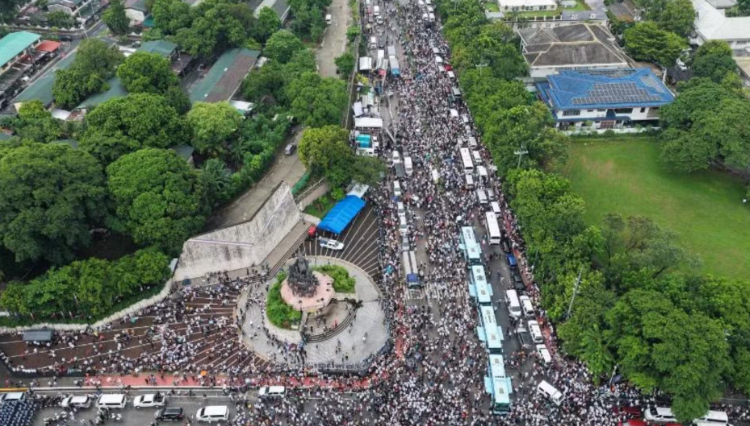
Thousands of members from the Iglesia Ni Cristo, one of the Philippines' most politically influential religious organizations, converged on Manila's main thoroughfare EDSA on Tuesday to demonstrate against the impending arrest of Senator Rodante Marcoleta. The congregation's show of force paralyzed traffic across the metropolis for hours during the morning commute, underscoring the church's formidable capacity to mobilize supporters and its continued relevance in Philippine political affairs. At its peak, organizers anticipated the crowd would swell beyond the initial 8,000 gathered, with only dedicated bus lanes able to accommodate the flow of vehicles as workers and students struggled to reach their destinations.
Marcoleta, who serves as a senator and prominent church member, faces imminent prosecution on graft-related charges stemming from his alleged failure to properly declare approximately 75 million pesos in unused election campaign contributions. Government Ombudsman Jesus Remulla announced the charges on Monday, setting in motion legal proceedings that the religious sect views as selective and politically motivated persecution. The timing of the charges carries particular significance given Marcoleta's widely acknowledged role as a virtually assured vote against conviction during Vice President Duterte's Senate trial, scheduled to commence on July 6, where prosecutors require sixteen of twenty-four Senate votes to secure her removal from office and permanent political disqualification.
The Iglesia Ni Cristo's decision to mobilize its membership reflects the church's historical trajectory as a powerful voting bloc and its enduring alignment with the Duterte political dynasty. Church spokesman Edwil Zabala framed the protest as a principled stand against what he characterized as selective justice, declaring in a Facebook video that the organization would persist in demanding accountability regardless of Marcoleta's incarceration. The rhetoric employed by church leadership emphasized transparency and equal application of the law, positioning the senator's predicament as emblematic of broader institutional injustice rather than addressing the specific charges themselves.
Marcoleta's legal troubles represent merely one dimension of mounting legal pressures on Duterte loyalists within the Senate. In parallel developments, fellow Senator Jose "Jinggoy" Estrada faces charges connected to an extensive corruption scandal involving fraudulent flood control initiatives that galvanized public anger. Additionally, Senator Ronald "Bato" Dela Rosa, another Duterte ally, has evaded arrest by absconding rather than face an International Criminal Court warrant related to his involvement in former President Rodrigo Duterte's controversial antidrug campaign, which resulted in thousands of deaths and sparked international condemnation.
The religious sect's political interventions have intensified alongside the Duterte family's dramatic deterioration of relations with President Ferdinand Marcos. In November, the Iglesia Ni Cristo assembled a crowd estimated at hundreds of thousands to address the burgeoning flood control scandal, with numerous speakers directing criticism at Marcos himself. More recently, in January 2025, the church orchestrated another major demonstration opposing Duterte's impeachment proceedings, demonstrating its willingness to deploy substantial organizational resources to shield political allies from institutional accountability.
Duterte's impeachment trajectory has itself proven turbulent and legally complex. The Supreme Court initially reversed impeachment charges brought by the House of Representatives, but lawmakers subsequently reconstituted the case and voted for her impeachment last month. The approaching Senate trial therefore represents a critical juncture for both the vice president and her supporters, who recognize that conviction remains possible despite their numerical strength within the chamber. Marcoleta's steadfast opposition to conviction appears virtually guaranteed, yet the broader political environment has shifted considerably, with several former administration allies now facing serious criminal investigations.
The Iglesia Ni Cristo's capacity to generate rapid, massive street mobilizations carries implications that extend beyond the immediate legal circumstances confronting individual senators. The organization commands estimated membership in the millions and maintains sophisticated internal communication networks that enable rapid coordination of activism. By demonstrating its willingness to disrupt Manila's central business district and challenge government prosecutorial actions, the church signals its continued influence over political calculations and reminds elected officials of its organizational reach. The decision by President Marcos to cancel a planned foreign press luncheon to monitor developments underscores the political significance that government leadership accords these mobilizations.
The sect's framing of the charges as illustrative of selective justice warrants scrutiny alongside documented concerns about institutional corruption within Philippine governance. Undeclared campaign funds represent a tangible accountability mechanism through which electoral processes maintain integrity, yet the Iglesia Ni Cristo's characterization positions enforcement efforts themselves as instruments of political persecution rather than legitimate oversight. This rhetorical positioning enables the church to defend Marcoleta without directly contesting the factual basis of the graft allegations, instead questioning the motivations behind prosecution.
For Malaysian observers, the unfolding situation illuminates the precarious intersection of religious organizations, political loyalty, and institutional accountability mechanisms within Southeast Asia's democracies. While Malaysia's religious landscape differs substantially from the Philippines, questions regarding the political influence of organized faith communities and the relationship between sectarian affiliation and electoral behavior resonate across the region. The Iglesia Ni Cristo's mobilization demonstrates both the potential and the risks when religious institutions position themselves as political actors capable of swaying legislative outcomes and challenging prosecutorial decisions.

