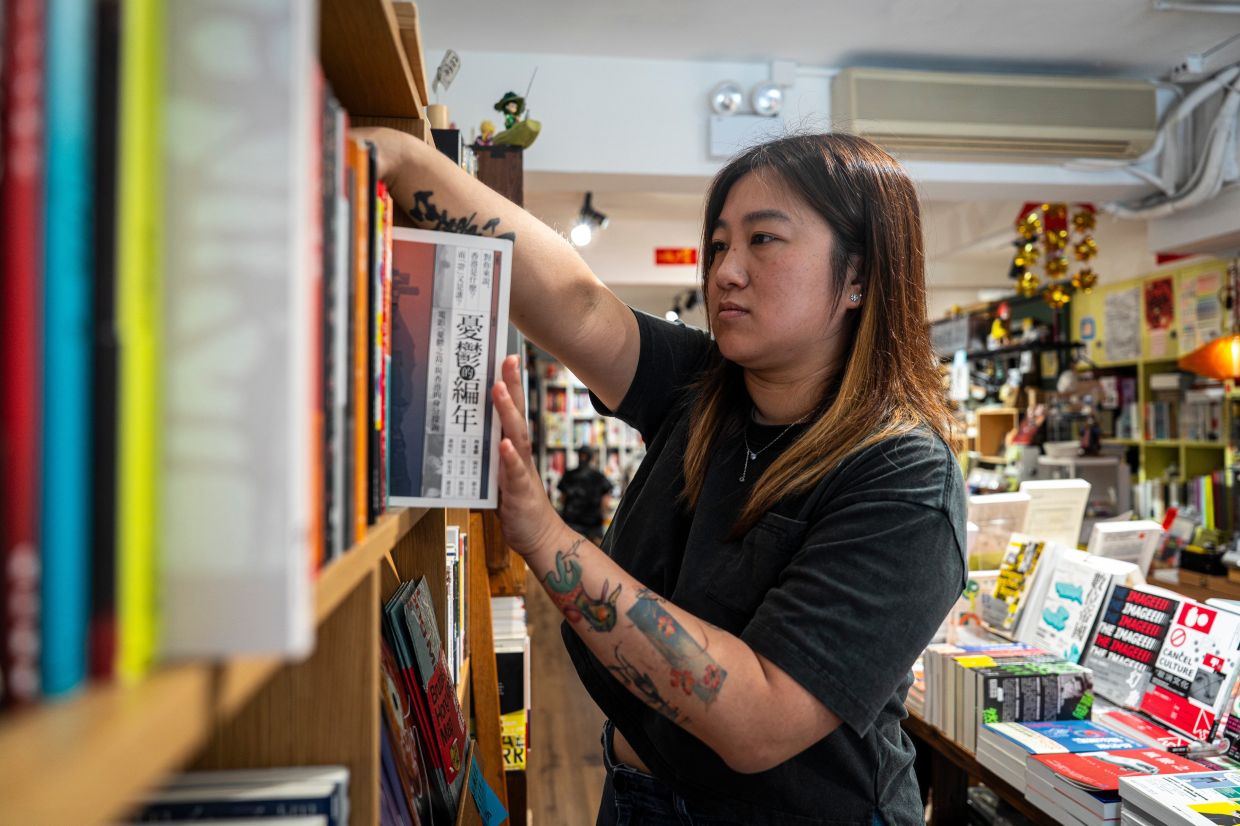
Hong Kong police have intensified their enforcement operations against perceived political dissent, detaining two people on Wednesday on allegations of distributing seditious publications and receiving financial support from foreign political organisations. The arrests, conducted under provisions of the city's 2024 national security law, represent a continuation of the territory's widening crackdown on pro-democracy activism and independent expression.
While official statements from the government have withheld the identities of those arrested, local news organisations including Ming Pao have reported based on unnamed sources that one of the detainees is Leticia Wong, the proprietor of Hunter Bookstore located in Sham Shui Po district. Wong, who previously served as a district councillor aligned with the pro-democracy movement, has maintained a visible public profile even as many of her fellow activists have faced imprisonment following the tumultuous 2019 protest period. The Association Press was unable to independently confirm these identities, and Wong remained unreachable for comment at the time of reporting.
The timing of these arrests carries particular symbolic weight, occurring just one week ahead of the 29th anniversary of Hong Kong's handover from British to Chinese sovereignty in 1997. This convergence underscores international concerns that Beijing's initial commitment to preserve the city's distinctive legal and civil liberties framework—often encapsulated in the "one country, two systems" principle—has become increasingly compromised. For observers in Southeast Asia and beyond, the pattern of enforcement actions targeting independent publishers and retailers signals a narrowing space for political expression in what was once regarded as Asia's freest city.
According to the government's official statement released Thursday, the two individuals in custody are accused of curating and selling materials with seditious intent, including publications alleged to incite animosity toward the Hong Kong government, its judiciary, and law enforcement bodies. The charges also encompass suspicions that they received monetary transfers from foreign political entities. However, the statement provided no specifics regarding which publications fell under scrutiny or which overseas organisations were implicated in the alleged funding arrangements, leaving the scope and justification for the arrests deliberately opaque.
Hunter Bookstore has emerged as a focal point of official scrutiny over the past three years. A pro-Beijing newspaper previously characterised an independent book fair hosted at Wong's premises as embodying "soft resistance" to the government, specifically objecting to the planned sale of a biography of Jimmy Lai, the jailed publisher and pro-democracy figure whose detention has drawn international condemnation. Wong's own testimony reveals the intensity of pressure bearing down on her operation: she documented 92 separate enforcement actions by government authorities between July 2022 and June 2025, ranging from formal inspections and intimidating police patrols outside her shop to warning letters alleging regulatory violations. In one particularly telling incident, an anonymous letter to an organisation planning to host an event at her store prompted that group to cancel their booking entirely.
This latest operation fits within a broader pattern of police activity targeting the independent publishing sector. In March of this year, authorities arrested the proprietor and staff members of another bookstore on comparable charges relating to seditious publications, including the same biography of Lai that has become a symbol of what the government deems unacceptable content. Those individuals were subsequently released on bail, though the legal proceedings remain ongoing. The clustering of such arrests suggests a coordinated strategy to constrict the circulation of materials critical of the government and its policies.
For Malaysian readers, these developments in Hong Kong carry significance beyond mere regional news. Malaysia itself has experienced periodic restrictions on press freedom and political expression, and the Hong Kong model—where security legislation provides broad grounds for suppressing legitimate dissent under the guise of maintaining stability—offers a cautionary template. The incremental erosion of civil liberties in Hong Kong, once considered a safeguard, demonstrates how national security frameworks can be weaponised against ordinary citizens engaged in lawful commerce and expression.
The Hong Kong government has consistently maintained that its two national security laws—the 2020 National Security Law and the more recent 2024 legislation—are essential instruments for preserving social order and economic stability. Officials argue that fundamental freedoms, including the right to freely exchange ideas and information, remain protected within the territory. Yet the lived experience of independent booksellers, publishers, and activists tells a markedly different story. The cumulative effect of arrests, inspections, warning letters, and public intimidation creates a chilling effect that discourages participation in political discourse and constrains the availability of diverse viewpoints in the public sphere.
Wong's predicament also illuminates the vulnerability of small business operators caught between political pressure and commercial survival. A bookstore owner is an unlikely target for security enforcement in most mature democracies, yet in contemporary Hong Kong, the decision to stock particular titles or host certain events carries genuine legal risk. This transformation reflects a fundamental shift in how the territory's authorities conceptualise the relationship between commerce, expression, and political loyalty. What once constituted normal retail operations has been reframed as a potential security threat.
For the broader Southeast Asian region, the Hong Kong situation presents ongoing questions about the trajectory of governance in major financial centres and the role that external pressure—from Beijing in this case—exerts on local institutions. As countries across the region navigate their own relationships with security and free expression, the specific mechanisms employed in Hong Kong serve as both warning and precedent. The use of national security legislation to prosecute what would ordinarily be considered protected speech or legitimate business activity represents an approach that other governments may seek to emulate.
Looking ahead, observers will closely monitor how Hong Kong's courts handle such cases and whether convictions materialise. The international attention focused on these arrests, particularly from the United States and European nations, suggests that the external costs of escalating enforcement action are not insignificant. Yet the Hong Kong government's apparent determination to proceed indicates a calculation that maintaining what it views as essential stability outweighs concerns about international criticism or the deterioration of its reputation as a global business hub where rule of law historically prevailed.

