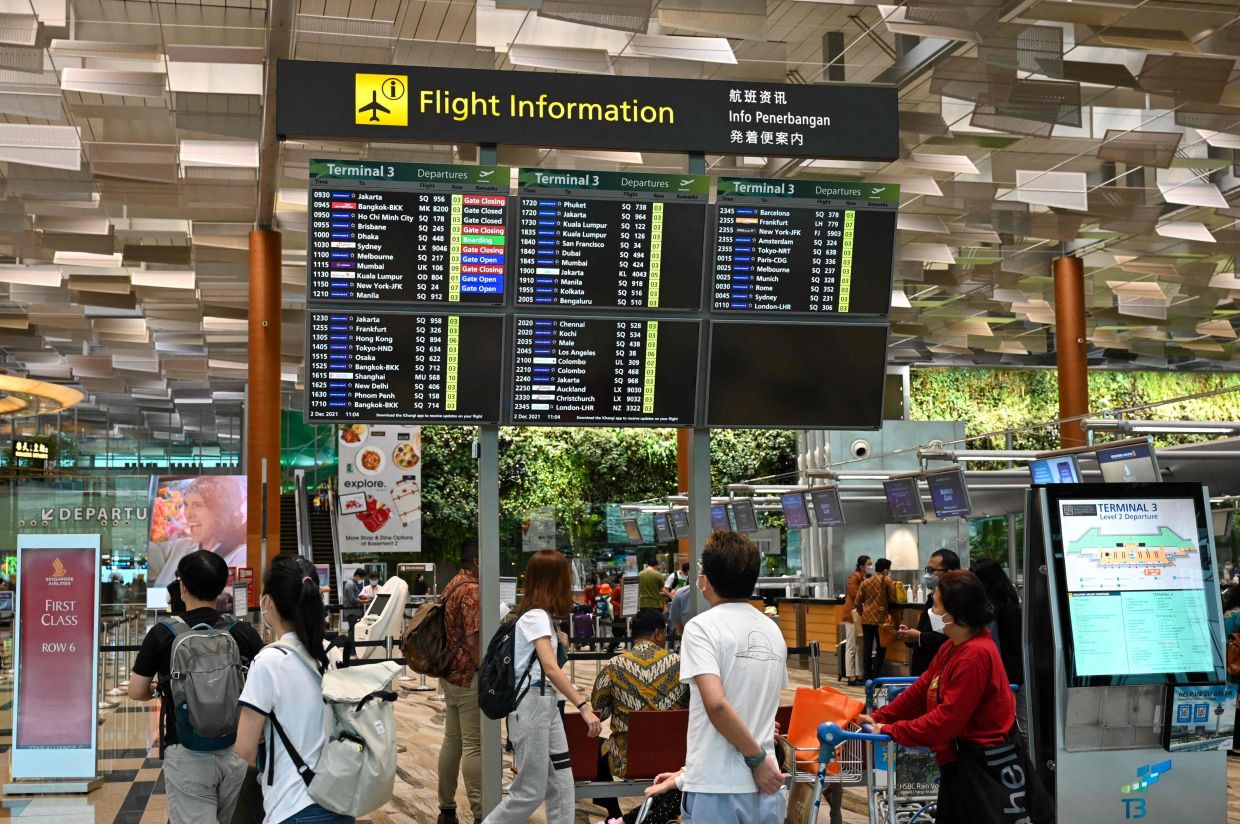
A Singaporean district court has handed down jail sentences to a Hong Kong woman and her adult son for their involvement in a disorderly and violent incident that unfolded across multiple levels of Changi Airport's terminal 3 on the afternoon of June 30, 2024. Chan Sui-kwan, aged 65, received a six-month custodial sentence for voluntarily causing hurt with intent to deter a public servant from fulfilling official duties, while her son, Chan Wing-kwan, 42, was sentenced to 10 days' imprisonment for the separate charge of voluntarily causing hurt. The verdicts were handed down following the pair's conviction on July 29, with sentencing occurring the following day.
The trouble began when Chan Wing-kwan became increasingly agitated after misinterpreting the actions of nearby passengers, whom he believed were directing mockery towards him. In response to his heightened emotional state, he physically lashed out at his mother by kicking her. A 69-year-old bystander, witnessing what appeared to be an assault taking place, intervened with concern for the older woman's welfare and attempted to check on her condition. Rather than accepting assistance, Chan Sui-kwan instructed the man to withdraw from the situation, while her son adopted an openly hostile posture towards him, verbally issuing aggressive challenges and inviting physical confrontation.
The volatile situation deteriorated further when the family members relocated to a different floor within the terminal building. In this secondary location, Chan Wing-kwan again kicked his mother, prompting the same bystander to attempt contacting airport security and police to de-escalate the rapidly worsening circumstances. At this critical juncture, the son lunged towards the concerned citizen with apparent intent to cause harm. What followed was a sustained physical altercation characterised by repeated punching, during which the bystander sustained significant injuries. Medical documentation detailed a cephalic haematoma—a medically serious pooled collection of blood beneath the scalp—alongside abrasions to his knee and contusions affecting multiple fingers.
Police officers responded promptly to the disturbance call and arrived at terminal 3 to investigate the incident. During their initial interaction with the pair, officers documented their identity documents and details before returning the passports to them, seemingly concluding the immediate matter. However, the day's drama was far from concluded. Later that same afternoon, the mother and son were again encountered by police in the departure hall section of the airport. At this point, Chan Sui-kwan refused to surrender her passport documentation to officers and initiated what court records describe as a substantial public disturbance, necessitating her arrest at the scene.
During the arrest procedure, the 65-year-old woman resisted the officers' lawful attempts to take her into custody with considerable physical force. In the course of this struggle, she bit a police officer on the right forearm, an assault that penetrated his uniform sleeve and left a visible one-centimetre-deep mark accompanied by bruising and tissue damage. This action formed the basis for her conviction on the charge of causing hurt to deter a public servant from duty.
The judicial timeline reveals significant delays and complications in the prosecution of the case. Chan Wing-kwan was formally charged on April 24 of the previous year, while his mother did not appear before the courts until November 18, 2024—a gap of several months. Both individuals were scheduled to have their matter heard on July 22 this year, but they failed to appear at that appointed time. This non-appearance triggered the issuance of arrest warrants for both defendants. They were subsequently located, arrested on the strength of those warrants, and brought back before the court where they were convicted and sentenced on consecutive days in late July.
The case carries implications for foreign nationals travelling through Singapore's major aviation hub, reinforcing the jurisdiction's stringent approach to disorderly conduct and violence within public transportation facilities. Changi Airport, one of Asia's busiest and most modern aviation centres, maintains a zero-tolerance policy towards behaviour that threatens passenger safety, compromises airport operations, or endangers the personnel working to maintain orderly conditions. The sentencing demonstrates judicial resolve to protect both bystanders and law enforcement officers from assault, regardless of the nationality or circumstances of the perpetrators.
For Malaysian travellers and residents familiar with regional travel patterns, the incident underscores the importance of maintaining composure during travel delays, disputes, or emotionally stressful moments at airports. The escalation from a misunderstanding between family members to violence against both strangers and police exemplifies how rapidly situations can deteriorate when individuals fail to exercise self-restraint in high-stress environments. The mother's resistance to arrest and physical assault on a police officer proved particularly costly, distinguishing her offence from her son's and resulting in a significantly harsher sentence.
The case also highlights Singapore's consistent application of its criminal code across all nationals. Despite the defendants' Hong Kong residency and potential cultural or language barriers, they received no mitigation based on their status as foreign visitors. The judicial system treated the assault on the bystander and police officer with equivalent seriousness, reflecting broader regional expectations that travellers from all jurisdictions must adhere to local laws governing public order and the safety of others.

