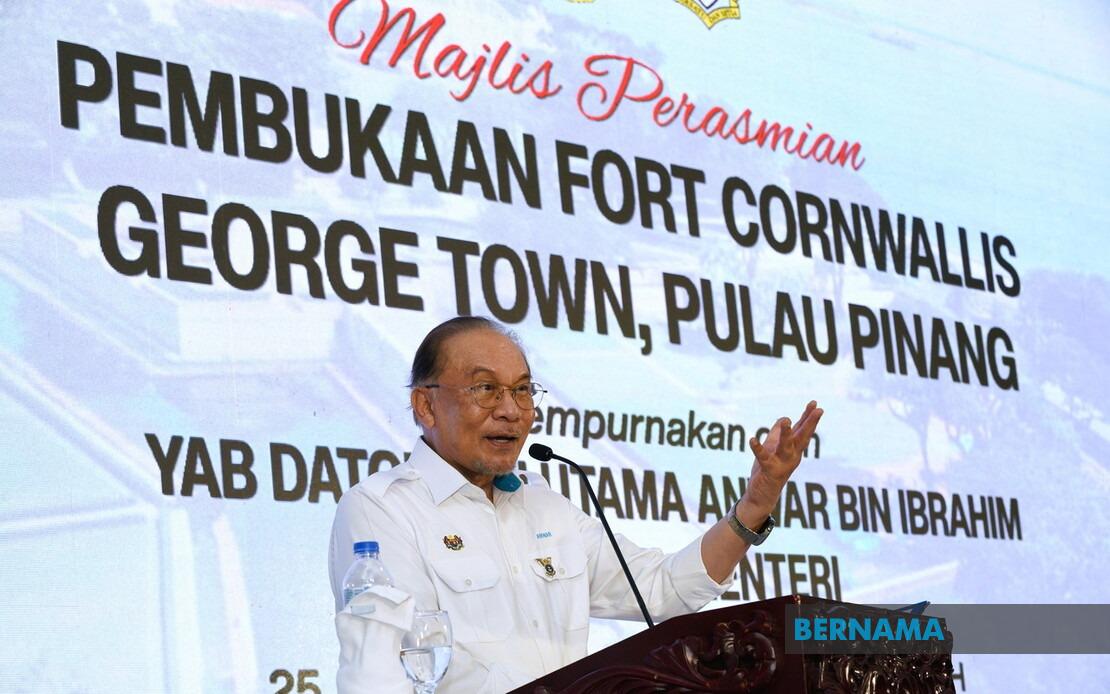
Prime Minister Datuk Seri Anwar Ibrahim has challenged Malaysia to reimagine its approach to historical preservation, urging stakeholders to transform heritage sites into meaningful learning spaces rather than passive tourist destinations. Speaking at the opening ceremony of Fort Cornwallis in George Town on July 25, Anwar emphasised that visits to such locations should transcend superficial appreciation of architecture and aesthetics, instead cultivating deeper understanding of the nation's journey toward independence and the sacrifices that shaped modern Malaysia.
The PM's remarks reflect growing concern among policymakers that younger Malaysians may lose connection to their national narrative if historical education remains confined to textbooks or casual sightseeing. By reframing heritage sites as active educational platforms, Anwar suggests that immersive experiences can embed lasting lessons about why national cohesion matters and what price was paid for sovereignty. This approach recognises that generational memory requires more than static preservation; it demands contextualised storytelling that resonates with contemporary audiences.
Central to Anwar's vision is the deliberate rejection of colonial-era interpretations of Malaysia's past. Rather than accepting the historical frameworks imposed by former colonial powers, he advocates reconstructing narratives from the perspective of Malaysians themselves—prioritising the experiences and suffering of ordinary citizens whose labour, sacrifice, and resilience underwrote independence. This reframing challenges a common problem in Southeast Asian heritage tourism, where colonial architecture is sometimes celebrated without adequately acknowledging the exploitation and subordination it represented.
The Prime Minister illustrated this principle through Fort Cornwallis itself, a structure laden with colonial symbolism yet fundamental to understanding Penang's history. Rather than demolishing such monuments, Anwar proposed that they be preserved and recontextualised, allowing visitors to confront uncomfortable truths about colonial rule while appreciating the fortitude of those who resisted or endured it. This middle path avoids both erasure and veneration, instead positioning heritage as a tool for critical historical consciousness.
Anwar stressed that educational programmes accompanying heritage visits should explicitly highlight the perils of disunity and weakness that made Malaysia vulnerable to external domination. The colonial experience, in this framing, becomes a cautionary tale about the consequences of internal fragmentation and the strategic interests of foreign powers. By drawing these connections, young Malaysians can better appreciate why racial harmony, institutional strength, and regional solidarity remain vital to national survival and prosperity in an uncertain geopolitical environment.
The initiative also carries implications for how Malaysia positions itself as a tourist destination. Rather than competing solely on aesthetic appeal or convenience, heritage sites could differentiate themselves by offering sophisticated, intellectually rigorous engagement with history. International visitors seeking deeper cultural understanding might find greater satisfaction in destinations that provide contextualised narratives and facilitate genuine learning, potentially attracting a more discerning demographic and generating longer stays and higher spending.
Implementing Anwar's vision will require coordinated effort across government agencies, educational institutions, and heritage management organisations. Interpretive materials must be carefully crafted to balance historical accuracy with accessibility for young audiences. Tour guides and educators will need training to move beyond rote recitation toward facilitating critical reflection. Museums and heritage sites must invest in interactive exhibits, digital resources, and community engagement programmes that transform passive observation into active learning.
The proposal also underscores the responsibility of the current generation to safeguard the achievements of their predecessors. By exposing youth to the hardships endured under colonialism and the collective effort required for independence, Anwar implies that such knowledge should inspire commitment to preserving national unity and strengthening institutional capacity. This educational mission becomes a form of civic investment, breeding citizens more conscious of their obligations to the nation.
For Malaysia's educational sector, Anwar's remarks suggest an opportunity to integrate heritage site visits into formal curricula more systematically. Schools could coordinate trips with structured learning objectives, ensuring that student visits generate measurable outcomes in historical knowledge and civic awareness. This would require teacher training and curriculum alignment but could significantly enhance the effectiveness of experiential learning.
The emphasis on indigenous perspectives in historical reconstruction also resonates with broader trends across Southeast Asia, where nations increasingly reclaim their narratives from colonial frameworks. Vietnam, Indonesia, and Thailand have undertaken similar efforts to centre national experiences in heritage interpretation. Malaysia's adoption of this approach positions it within a regional movement toward historical decolonisation—a shift with implications for how ASEAN nations understand their shared past and collective future.
Moreover, Anwar's framework acknowledges that historical memory serves contemporary political purposes. By cultivating understanding of sacrifices made for independence, the government hopes to strengthen social cohesion and reinforce support for institutions that preserve national interests. This is not revisionism in a dishonest sense, but rather a deliberate choice to emphasise certain aspects of history—particularly those that underscore interdependence and collective vulnerability—as a foundation for present-day unity.
The Fort Cornwallis initiative represents a pragmatic middle ground between heritage preservation and critical historical consciousness. Rather than treating colonial-era structures as relics to be abandoned or celebrated uncritically, the site becomes a space for Malaysia to confront its past honestly and extract lessons relevant to its future. If executed thoughtfully, this model could serve as a template for other heritage sites across the country, gradually transforming how Malaysians—especially younger generations—understand their history and their place within the nation.

