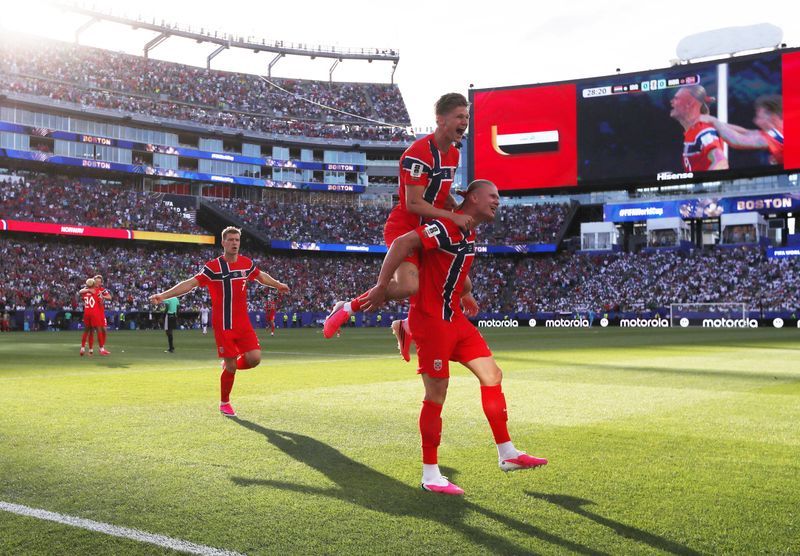
Erling Haaland wasted little time announcing himself on football's grandest stage, scoring twice in a dominant first-half display that propelled Norway to a 4-1 victory over Iraq on Tuesday. The prolific striker's brace represented another chapter in an extraordinary run of debuts, adding his name to an elite list of players who have found the net across the German Bundesliga, English Premier League, UEFA Champions League, and now the FIFA World Cup within their opening appearances at each level.
The Norwegian striker's clinical finishing proved the decisive factor in a match that, despite the emphatic scoreline, revealed occasional vulnerabilities in his team's overall performance. While Norway controlled possession and dominated long stretches of play, the team struggled to maintain consistent rhythm and rhythm, with wayward passing and loose touches creating unnecessary complications. Yet with Haaland positioned to capitalise on any opportunity, such lapses mattered little as the forward's predatory instincts ensured his country's opening fixture ended in resounding success.
Haaland's first goal exemplified the poacher's art—a perfectly weighted cross from David Moller Wolfe found the Norwegian at the back post, where clinical finishing made it seem effortless. His second showcased a different skill set, as aggressive pressing on Iraq's backline forced a hurried return pass, which Haaland then blocked past the goalkeeper for what would prove a decisive moment. These two interventions provided Norway with breathing room and established a psychological advantage that carried through the remainder of the encounter.
Notably, Haaland maintains an almost monastic approach to international football, rarely engaging with assembled media personnel and allowing his performances to provide the only commentary required. This reticence contrasts sharply with the intensity he demonstrates on the pitch, where communication becomes purely physical—movement, positioning, and opportunism replacing verbal exchanges. Such discipline has served him well across multiple environments, and at this World Cup, the approach appears validated by immediate results.
Norway's tactical framework, as articulated by manager Stale Solbakken, essentially revolves around a singular objective: create opportunities for Haaland and trust his finishing to convert them into points. Norwegian Prime Minister Jonas Gahr Stoere had highlighted this dynamic the day before kickoff, noting the paradox that while individuals score goals, teams ultimately win matches. The philosophy proved sound in practice, though certain players failed to execute their supporting roles consistently. Captain Martin Odegaard, typically influential in midfield, offered surprisingly muted contributions, while the defence demonstrated occasional lapses in concentration—most notably when Aymen Hussein equalised for Iraq following a moment of ball-watching inattention.
The victory places Norway atop their group standings with three points, edging out France on goal difference after the Europeans' 3-1 dismantling of Senegal earlier that day. However, Haaland offered measured assessment of his team's display, cautioning that substantially improved performance standards would be required in upcoming matches. His warnings reflected genuine concern rather than false modesty; while the result satisfied immediate objectives, the manner of achievement suggested room for refinement across multiple departments.
For Norwegian football enthusiasts and the nation's supporters worldwide, the significance of this victory transcends mere group-stage points. Norway's return to the World Cup finals stage comes after a 28-year hiatus, a lengthy absence that had rendered multiple generations of supporters unfamiliar with their country's participation at this level. The return itself represents a triumph of qualification and rebuilding, with Tuesday's dominant display providing compelling early evidence that the patience and investment proved justified.
When reflecting on the occasion moments after final whistle, Haaland's characteristic straightforwardness emerged as he contemplated celebrations unfolding across Norway despite the temporal distance. His observation that the country would likely be "partying a bit" captured the cathartic release that accompanies such milestone occasions—not merely winning, but winning convincingly upon triumphant return to sport's premier tournament. For Malaysian and Southeast Asian football followers accustomed to supporting European powers, Norway's resurgence and Haaland's individual brilliance offer a reminder that even prolonged absences from the world stage can be overcome through sustained commitment and the emergence of generational talent.
Looking ahead, Norway faces the considerable challenge of maintaining this momentum and navigating a group containing established World Cup powers. Yet with Haaland operating at the peak of his capabilities and demonstrating the clinical finishing that has defined his career trajectory, the Norwegian federation possesses a genuine asset around which to build tournament aspirations. The double against Iraq may represent merely an opening statement, but it serves notice that any team facing this resurgent Nordic nation must account for one of modern football's most lethal finishers.