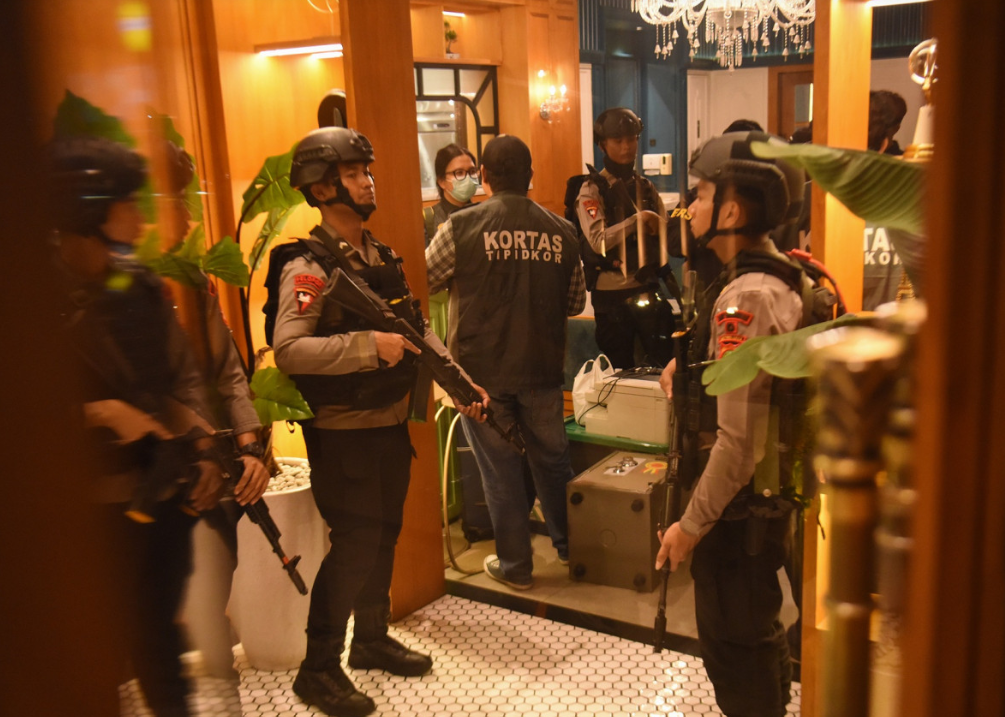
A coordinated police operation across Jakarta last week has exposed one of Indonesia's most significant corruption scandals in recent years, with authorities discovering approximately US$26.3 million in gold bars and cash during raids spanning multiple locations across the capital and its suburbs. The sweeping searches, which commenced on Wednesday afternoon and extended into the early hours of Thursday, targeted numerous sites including upscale restaurants, money-changing operations, residential properties and corporate offices, fundamentally shaking public confidence in the country's law-enforcement establishment.
The dramatic discovery at de'Clan Signature, an upmarket dining establishment situated in the Cipete neighbourhood of South Jakarta, provided an early indication of the scope of the investigation. Armed personnel from Jakarta's metropolitan police department and the National Police's specialised corruption unit, accompanied by Mobile Brigade officers dressed in tactical gear and wielding automatic weapons, forced entry and located a substantial safe positioned behind a cabinet. The vault contained documents and cash denominated in multiple foreign currencies, with the monetary value alone reaching several million dollars. The operation did not end there, however, as police immediately shifted focus to an adjoining money-changing business called Koin Money Changer, where they accessed another safe containing hundreds of thousands of dollars in Indonesian rupiah banknotes.
Yet the most substantial discoveries emerged from searches conducted beyond the city limits. At an exclusive residence nestled in the Sentul hills—a verdant residential enclave approximately one hour's drive south of Jakarta—police uncovered seven suitcases crammed with 74 kilograms of gold bullion alongside substantial quantities of cash in various international currencies. This single location accounted for the lion's share of the total confiscated assets, with the combined valuation reaching US$26.3 million. The property belongs to Febrie Adriansyah, a high-ranking government official who had occupied the position of deputy attorney general for special crimes for more than four years before tendering his resignation following the initiation of these raids.
Febrie has been designated as a suspect in investigations concerning corruption and money laundering, though authorities have not yet effected an arrest. In a public statement, he claimed ownership of the Sentul residence but categorically denied that the seized assets were his personal property, insisting that their origin and rightful ownership would be established through the formal legal process. His response has done little to quell the widespread speculation and concern sweeping through Indonesian political and legal circles, particularly given his former responsibility for overseeing special crimes within the attorney general's office.
The visual documentation of the confiscated wealth—photographs depicting gleaming rows of gold bars interspersed with carefully stacked bundles of currency in orange and red denominations—has become the defining imagery of this unfolding scandal. Indonesian and international media outlets have circulated these images extensively, crystallising public perception of the magnitude of alleged misconduct within the higher echelons of the nation's law-enforcement apparatus. The dramatic nature of the discoveries has overshadowed routine corruption cases and generated intense speculation about systemic vulnerabilities within Indonesia's prosecutorial institutions.
The investigation expanded significantly beyond the initial sites, with police executing searches at more than ten additional locations throughout Jakarta and its metropolitan area. These extended operations included a luxurious apartment at the Pacific Place towers, located adjacent to Jakarta's stock exchange, as well as numerous corporate offices dispersed throughout the city's business districts. Investigators also targeted residential properties, notably a dwelling in the Gandaria sector of South Jakarta with alleged connections to Don Ritto, a legal practitioner who has similarly been named as a suspect in the ongoing investigations. Ritto, according to local media reporting, has been taken into police custody pending further questioning. Corporate records indicate that Ritto maintains business interests in companies with demonstrated links to both the raided restaurant and money-changing operation.
The breadth and precision of these coordinated operations suggest substantial preliminary investigative work had been undertaken before the raids commenced, pointing to a degree of institutional coordination that many observers initially perceived as evidence of properly functioning anti-corruption mechanisms. By Monday afternoon, however, Jakarta's political and legal establishment had begun engaging in more critical analysis, with influential commentators and constitutional scholars questioning both the methodology employed and the underlying structural arrangements governing the investigation's trajectory.
Prominent constitutional law specialist Mahfud MD, whose distinguished career includes tenure as chief justice of Indonesia's Constitutional Court and coordination of political, legal and security affairs at cabinet level, publicly articulated serious reservations regarding the investigation's procedural regularity. During a presentation delivered via his YouTube channel, Mahfud specifically challenged the lawfulness of transferring investigative authority from the police force to the Attorney General's Office, contending that such a transfer lacks foundation in Indonesia's established criminal procedure code. His analysis suggests that the procedural irregularity could render the entire case vulnerable to dismissal through pretrial legal challenges, potentially undermining the prosecution regardless of substantive evidence gathered.
Mahfud's intervention carries particular weight given his position as a recognised authority on Indonesian constitutional law and his previous stewardship of the nation's highest constitutional institution. He has publicly advocated for the Corruption Eradication Commission, an autonomous state body statutorily independent from standard law-enforcement hierarchies, to assume full investigative responsibility. This recommendation reflects broader institutional concerns that have periodically surfaced in Indonesia's post-democratic transition period regarding the concentration of anti-corruption powers within politically vulnerable agencies.
The scandal unfolds amid ongoing international scrutiny of Indonesia's commitment to combating corruption, an issue that continues to affect the nation's investment climate and international standing. The discovery of such substantial undeclared wealth held by a senior prosecutorial official raises fundamental questions about whether existing institutional safeguards possess sufficient strength and independence to curb high-level misconduct. Simultaneously, the apparent functional capacity of investigative units to identify and pursue such cases suggests that institutional will may exist, even if systemic vulnerabilities compromise ultimate effectiveness.
Observers have noted the paradoxical nature of the situation: the raid's scale and success could legitimately be interpreted as vindication of Indonesia's anti-corruption architecture, yet the very circumstances that necessitated such dramatic intervention—the accumulation of millions in undeclared assets by a national law-enforcement leader—simultaneously demonstrate systemic weakness. Moving forward, the manner in which prosecutors navigate the procedural questions raised by Mahfud MD and other legal scholars will substantially determine whether this scandal catalyses meaningful institutional reform or merely represents another high-profile prosecution subsequently compromised by structural dysfunction.

