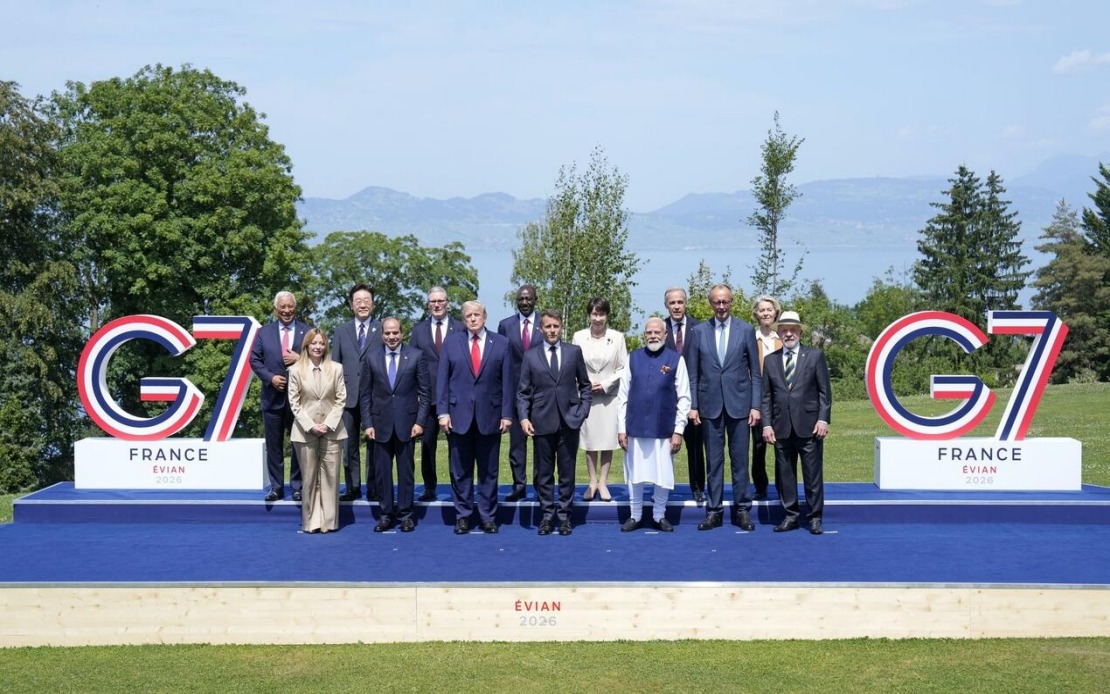
The Group of Seven nations concluded a major diplomatic session at their annual summit in Evian-les-Bains, France, by committing to strengthen support for Ukraine and maintaining coordinated pressure on Russia to pursue peaceful resolution. The gathering brought together leaders from Britain, Canada, France, Germany, Italy, Japan and the United States, alongside European Union representation, with Ukrainian President Volodymyr Zelenskyy participating directly to brief the assembled powers on Kyiv's immediate needs and strategic priorities.
President Donald Trump, in remarks to journalists following the Ukraine-focused session on Tuesday, urged the Russian government to enter into meaningful negotiations to end the conflict that has raged since the full-scale invasion in February 2022. Drawing parallels to his administration's recent diplomatic breakthrough with Iran—which involved reopening the Strait of Hormuz and adjusting sanctions arrangements—Trump suggested that comparable deal-making could resolve the Ukraine crisis. His framing of the war as mutually devastating, emphasising substantial losses on both sides, reflected a transactional approach to conflict resolution that diverges from the European emphasis on Ukrainian sovereignty and territorial integrity.
The consensus among G7 members to maintain unified pressure on Moscow represents a significant diplomatic achievement given the increasingly fractious relationship between Washington and its European allies. Disagreements over trade policy, NATO contributions, Trump's interest in acquiring Greenland, and responses to the Middle Eastern conflict have strained the traditional alliance. Yet all parties recognised that the Ukraine situation demanded a coordinated front, even as they held differing views on negotiating timelines and preconditions.
Japanese Prime Minister Sanae Takaichi articulated the group's position with particular clarity, emphasising that Russia must demonstrate "positive and concrete action quickly" and warning against any attempt to "unilaterally change the status quo by force." Her remarks reflected growing anxiety among G7 members about Russia's deepening military partnerships with China and North Korea, developments that complicate the geopolitical landscape far beyond the Ukraine theatre and carry direct implications for Indo-Pacific security—a region of paramount concern to both Japan and Australia's strategic interests.
Zelenskyy's priorities, as communicated to the G7 gathering, centred on bolstering Ukraine's air defence capabilities and advancing diplomatic channels simultaneously. This dual-track approach acknowledges that while military resilience remains essential, the conflict ultimately requires a negotiated settlement. The Ukrainian leader's emphasis on coordinating with European partners reflects a strategic recalibration, as Kyiv has increasingly deepened security cooperation with France, Germany and other EU nations even as American focus has shifted toward broader geopolitical competition with Russia and China.
Trump's references to potentially lifting temporary sanctions relief mechanisms related to Iran warrant closer examination for Southeast Asian observers. The suggestion that oil market stability following the Iran agreement could free American leverage to reimpose Russian sanctions demonstrates how interconnected global energy markets have become. For oil-importing nations throughout the region—including Malaysia—fluctuations in crude supplies and pricing driven by geopolitical settlements have immediate implications for inflation, energy security and manufacturing competitiveness.
The broader development finance agenda discussed during the summit carries significant relevance to the Indo-Pacific region and developing economies more generally. The G7's recognition that traditional official development assistance has become insufficient to address the infrastructure and investment needs of poorer countries prompted a shift toward structuring partnerships around mutual strategic benefit and private capital mobilisation. This approach represents a response to China's Belt and Road Initiative and reflects growing competition for influence in developing regions through financial mechanisms rather than traditional aid relationships.
France's presidency of the G7 this year has enabled expansion of the group's outreach to include Brazil, Egypt, India, Qatar, South Korea and the United Arab Emirates—a deliberate strategy to broaden consensus-building beyond the traditional Western alliance. This inclusivity signals recognition that contemporary global challenges, from conflict resolution to development financing, demand engagement with emerging economies that increasingly shape international outcomes. For Malaysia and other ASEAN members, the implicit message suggests that participation in ad-hoc coalitions addressing specific challenges may matter more than formal membership in traditional blocs.
The working lunch on West Asia highlighted another layer of complexity in current geopolitical alignments. The G7's collective welcome for the preliminary US-Iran agreement and emphasis on ensuring free navigation through the Strait of Hormuz reflects understanding that Middle Eastern stability directly impacts global energy flows and regional security architectures. Japan, as a major energy importer dependent on Gulf supplies, has particular interest in sustained maritime security and de-escalation mechanisms in the region.
Trump's suggestion that recent successes with Iran negotiations could translate to Ukraine resolution oversimplifies fundamentally different conflict dynamics. The Iran situation involved discrete parties with defined negotiating objectives and limited territorial disputes, whereas the Ukraine conflict involves existential questions about national sovereignty, territorial integrity and the permissibility of forcible border revision. European leaders, while maintaining G7 unity, implicitly rejected the notion that comparable diplomatic mechanics could apply equally across these distinct contexts.
The joint declaration on development finance reform emphasised creating "mutually beneficial partnerships" while promoting "effective mobilisation of private capital." This language signals the G7's pivot toward acknowledging that state-to-state aid relationships increasingly favour frameworks that embed commercial returns alongside development objectives. For Malaysia and comparable middle-income nations, this shift creates both opportunities and challenges—access to larger pools of capital but on terms that require proving commercial viability rather than relying on concessional terms.
The three-day summit in the French spa town near Switzerland's border reflected the enduring centrality of European locations to Western diplomatic architecture, even as actual geopolitical weight has shifted toward the Indo-Pacific. The inclusion of South Korea among outreach partners acknowledged the region's technological sophistication and strategic alignment with Western interests, positioning it as a counterweight to Chinese and Russian influence in Asia.
Looking forward, the Ukraine situation remains suspended between the G7's public commitment to Kyiv's defence and Trump's evident eagerness to broker a settlement. For Southeast Asia, the outcome of negotiations will substantially influence the regional security environment, as resolution in Ukraine could either stabilise Russian-Western relations or, conversely, free Moscow to pursue more assertive policies in Asia. The summit's implicit message—that unified Western pressure remains essential but negotiation pathways must remain available—suggests a prolonged period of managed tension rather than swift resolution.