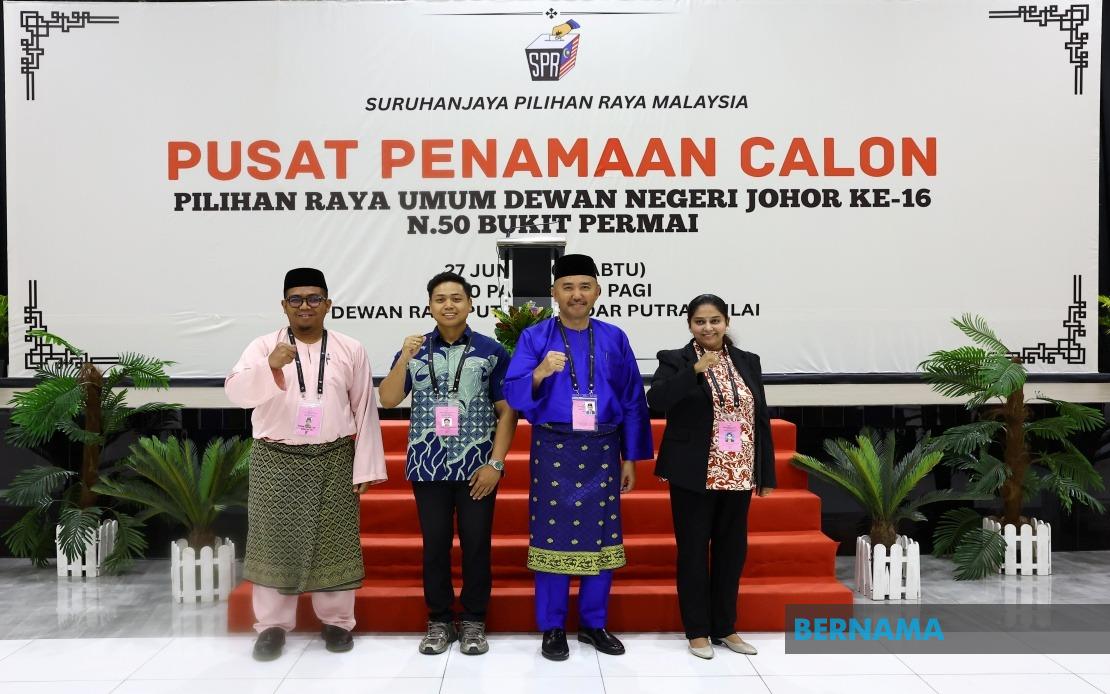
The race for Bukit Permai has taken shape as a competitive four-cornered battle in the 16th Johor state election, with incumbent Datuk Mohd Jafni Md Shukor of Barisan Nasional facing serious challenges from candidates representing three major opposition coalitions and a newer political force. Nomination officers confirmed the candidate lineup on June 27 following the close of the nomination period at the nomination centre in Bandar Putra, setting the stage for what promises to be a closely watched contest in the southern state.
The sitting assemblyman confronts an unusually crowded field this time around. Mohamad Shafwan Ani flies the Pakatan Harapan banner, positioning the opposition coalition to leverage discontent with the incumbent administration. His arrival at the nomination centre accompanied by Johor DAP chairman Teo Nie Ching underscored the coalition's commitment to this particular seat. Perikatan Nasional has fielded M. Lina Manoh, representing the rival Malay-Muslim aligned coalition that has gained traction in peninsular politics since 2020. Perhaps most significantly for vote fragmentation, Parti Bersama Malaysia—a relatively newer entrant to the electoral landscape—has nominated Muhammad Aidil Riduan Mohd Yusof, potentially drawing votes from dissatisfied voters seeking an alternative to established players.
Mohd Jafni enters the contest as the defending member, having secured Bukit Permai in 2022 with a majority of 4,755 votes in what was also a four-cornered contest. That victory, though achieved in a divided field, came at a time when Barisan Nasional was rebuilding its electoral fortunes following the 2018 general election watershed. His previous success suggests a solid base of support in the constituency, yet the return of a four-way fight introduces fresh uncertainty. The presence of competing opposition candidates could either fragment anti-BN votes or, conversely, allow one opposition nominee to consolidate a challenger majority.
For Malaysian and Southeast Asian observers, Bukit Permai represents a microcosm of broader electoral trends reshaping Malaysian politics. The emergence of Parti Bersama Malaysia as a genuine contender signals voter appetite for non-traditional political options beyond the established BN-PH-PN triangle. This fragmentation can work either way: it might split the opposition vote sufficiently to hand the incumbent an easier path, or it could galvanize younger and dissatisfied voters around a fresh political brand. The composition of Bukit Permai's electorate—spanning urban and semi-urban areas of Batu Pahat—makes it particularly susceptible to such shifts in voter sentiment.
The Johor state election carries significance beyond the peninsula's southern state. Following the 2022 elections, BN had regained footing in several state assemblies, stabilizing what appeared to be a broader pattern of political realignment. However, subsequent federal and state contests have demonstrated that voter preferences remain volatile and constituency-specific. A loss in Bukit Permai would represent a meaningful setback for BN's consolidation efforts, whereas retention would affirm the continued relevance of the traditional coalition in Johor's political economy.
The Election Commission's scheduling—with early voting designated for July 7 and main polling on July 11—provides campaigners with approximately two weeks to mobilize support. This compressed timeline favors incumbents with established ground networks and financial resources, advantages clearly held by Mohd Jafni. However, the multiplicity of candidates could prove disruptive to traditional campaign messaging, as voters face genuine choices rather than the simplified BN-versus-opposition binary that has historically dominated Malaysian electoral discourse.
Pakatan Harapan's strategy in placing Mohamad Shafwan against the incumbent reflects the coalition's ongoing effort to present a credible alternative government in Johor, a state where BN retains deep institutional roots. The coalition's role in previous state administrations and its continued presence in federal government provides a baseline of credibility, though recent controversies and internal disputes have somewhat eroded the reformist narrative that propelled PH to prominence after 2018. Perikatan Nasional, by contrast, positions itself as offering authentic Malay-Muslim representation unconstrained by the compromises inherent in multiethnic BN politics.
The appearance of Parti Bersama Malaysia in this race warrants closer examination. Founded and championed by former prime minister Mahathir Mohamad, the party seeks to carve out political space by emphasizing localized and non-ideological governance. In Bukit Permai, its presence may appeal to swing voters fatigued by the entrenched nature of mainstream opposition politics yet hesitant to revert to BN. The party's ability to convert such sentiment into actual votes remains an open question, particularly given its limited organizational infrastructure compared to established players.
Geographic and demographic considerations will shape outcomes significantly. Bukit Permai encompasses areas with distinct socioeconomic profiles—pockets of prosperous urban settlement alongside working-class neighborhoods and rural zones. Urban, educated voters may gravitate toward DAP-backed Pakatan Harapan or the perceived fresh politics of Bersama, while rural constituencies traditionally favor BN's distribution networks and established patronage structures. Younger voters and first-time electors in the constituency could prove decisive, particularly if they view the contest as an opportunity to punish incumbent complacency or to experiment with alternative political arrangements.
The four-way contest also complicates BN's ability to achieve the overwhelming majorities that characterized its pre-1998 dominance in Johor. Even with Mohd Jafni retaining his seat, a narrowed winning margin would signal weakening support and embolden opposition narratives about the coalition's declining appeal. Conversely, a decisive victory would allow BN to claim renewed public confidence and potentially set the tone for subsequent electoral contests in the state and beyond.
Looking ahead, the results in Bukit Permai will offer important signposts about the health of Malaysia's major political coalitions and the viability of emerging challengers. A strong opposition showing would validate PH's continued relevance in peninsular politics despite recent setbacks, while a Bersama breakthrough could accelerate the emergence of post-factional political competition. The race encapsulates the broader uncertainty characterizing Malaysian politics as traditional patterns erode and voter preferences increasingly defy simple categorization, making the July 11 polling day a significant moment for understanding the state's political trajectory and its implications for regional democratic competition.

