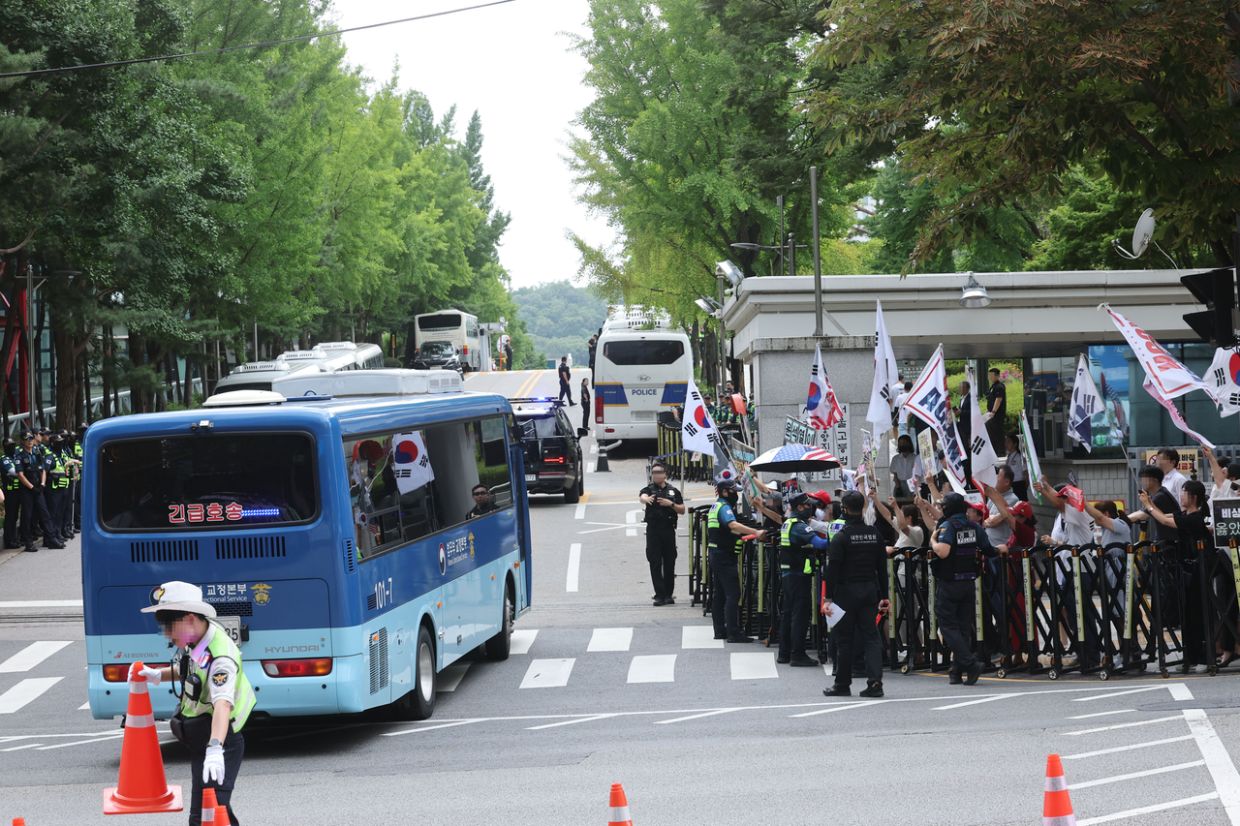
Former South Korean President Yoon Suk Yeol received a two-year prison sentence on Monday after the Seoul Central District Court found him guilty of breaching election finance laws by accepting unpaid polling services during his presidential campaign. The conviction centres on 14 surveys valued at 27.92 million won (approximately $18,600) that were provided by political broker Myung Tae-kyun without proper disclosure or payment. This verdict represents a landmark moment in South Korean politics, demonstrating the judiciary's willingness to hold even former heads of state accountable to the same electoral regulations that govern all political candidates.
The court's judgment hinged on establishing that Yoon and his wife, former first lady Kim Keon Hee, conspired to receive these polling services in violation of the Political Funds Act. Prosecutors had originally charged the couple with receiving 58 free surveys worth more than 270 million won across the June 2021 to March 2022 period. However, the court found sufficient evidence to convict on only 14 surveys, calculating their cumulative value at 27.92 million won. The judges determined that Kim Keon Hee had authorized Myung to control the polling process—including timing, content, methodology, and publication decisions—and that Yoon possessed implicit knowledge of and consent to this arrangement.
Paying particular attention to the broader implications for democratic integrity, presiding Judge Lee Jin-gwan emphasised that opinion polls wield considerable influence over voter behaviour and that their credibility underpins democratic processes. The judge warned that when political figures receive in-kind contributions outside the parameters of the Political Funds Act, and polling organisations provide survey results as a quid pro quo, it threatens to distort public opinion formation and compromises the fairness of electoral contests. This reasoning signals judicial concern about protecting the information landscape that citizens rely upon when making electoral choices, a matter of increasing relevance across democracies grappling with misinformation and the politicization of data.
A separate thread running through the case involved allegations that Yoon promised political broker Myung that former lawmaker Kim Young-sun would receive the People Power Party's nomination in exchange for the free polls. Investigators and prosecutors presented evidence suggesting that Yoon later exercised influence over the party's nomination process through Chang Je-won, then chief of staff to the president-elect, to deliver on that purported commitment. The court acknowledged finding credible evidence of this arrangement. Notably, however, the judgment clarified that establishing such a quid pro quo arrangement was not a prerequisite for conviction under the Political Funds Act—the illegal provision and acceptance of in-kind contributions constituted the violation regardless of whether political favours were exchanged in return.
Myung Tae-kyun, the political broker at the centre of the arrangement, was sentenced to 18 months in prison and immediately taken into custody in the courtroom. His conviction underscores that those who facilitate illegal campaign contributions bear equal legal responsibility as the politicians who benefit from them. This approach aims to discourage political operatives from establishing networks designed to circumvent electoral finance regulations, a persistent challenge in South Korea's political system.
The case has created an unusual asymmetry in the courts' treatment of Yoon and his wife. While the former president stands convicted on Monday, Kim Keon Hee was acquitted at both trial and appellate levels in her separate case involving the same polling services. Judge Lee explained that the allegations in Kim's case and those in Yoon's case cannot be regarded as legally identical, though the underlying facts appear substantially similar. In Kim's proceedings, the lower courts found that prosecutors had failed to demonstrate she received a measurable financial benefit equivalent to the cost of the surveys or that the polling services were conditioned upon the Kim Young-sun nomination. This divergence raises questions about the evidentiary standards applied across related cases and may prove significant as the Supreme Court prepares to issue its final ruling in Kim's case on Thursday.
For Malaysian and Southeast Asian observers, the Yoon conviction offers instructive lessons about the mechanics of electoral accountability in established democracies. South Korea maintains relatively robust institutional mechanisms for investigating and prosecuting political corruption, including a dedicated prosecution task force and courts willing to impose custodial sentences on former heads of state. Yet the case also reveals vulnerabilities in campaign finance enforcement—the use of intermediaries like Myung and the difficulty of attributing knowledge and intent to senior political figures create investigative challenges that prosecutors worldwide must navigate.
The conviction arrives amid broader scrutiny of Yoon's conduct since leaving office. His presidency ended under a cloud of controversy surrounding his imposition of martial law in December 2024, an action that triggered impeachment proceedings and raised fundamental questions about civilian control of the military. The polling scandal conviction, while distinct from those constitutional concerns, reinforces perceptions of systematic misconduct during his tenure. Combined with the martial law crisis, the polling conviction paints a picture of a leader who tested institutional boundaries repeatedly and across multiple dimensions of governance.
The decision also reflects evolving standards in South Korean electoral politics regarding the treatment of in-kind contributions and the commercialization of polling services. By focusing on the failure to disclose and properly account for these services rather than requiring proof of explicit quid pro quo arrangements, the court established a broad principle: politicians cannot circumvent campaign finance rules by accepting services through informal networks of brokers and associates. This standard potentially affects how future campaigns in South Korea structure their communications, research, and advisory relationships.
The imprisonment of a former president for campaign finance violations may seem routine in some mature democracies but remains historically significant in South Korea, where past leaders have often received pardons or light sentences. The Seoul court's imposition of a custodial term signals that such conduct is treated seriously regardless of the defendant's former status. Whether Yoon will serve the full sentence depends on his appeals process, which is expected to continue for months or possibly years. Nevertheless, Monday's conviction marks a watershed moment in South Korea's struggle to enforce electoral rules consistently and fairly across all political actors.

