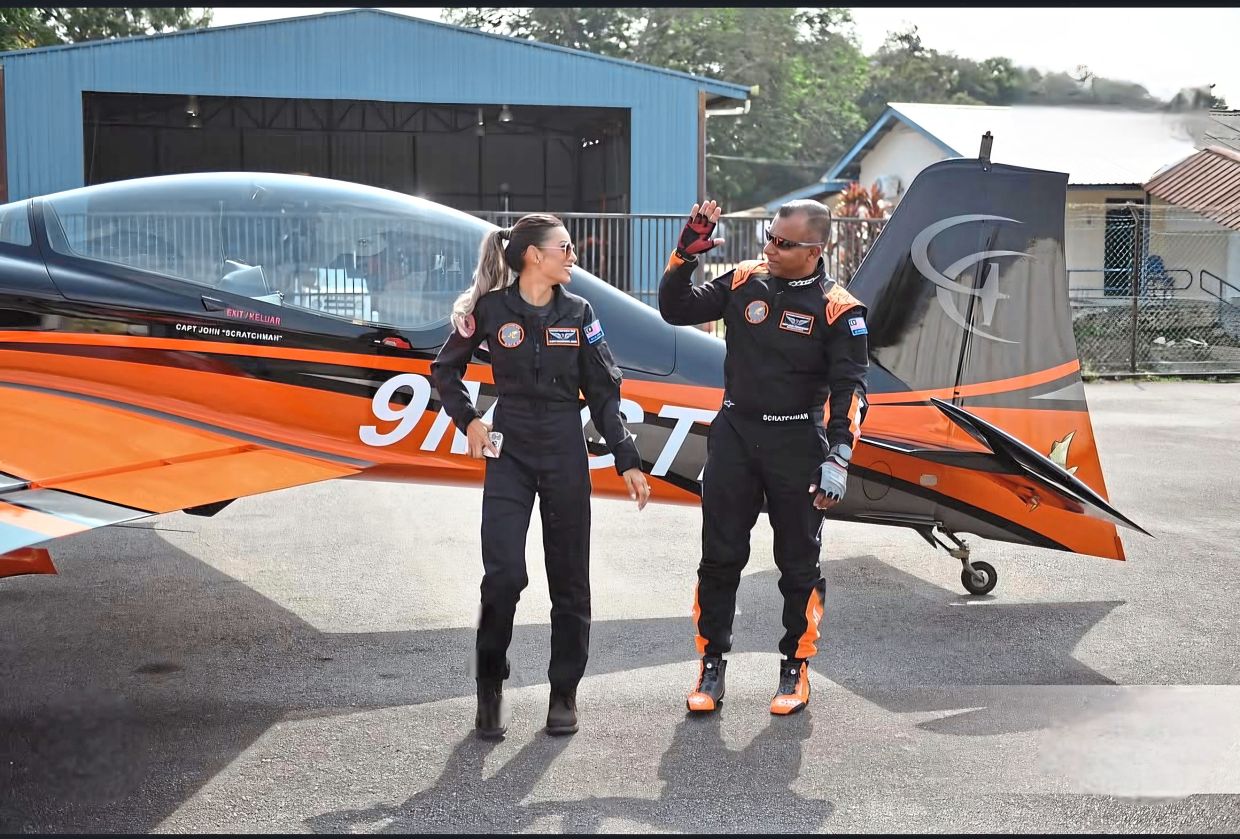
When Samantha Laura John completed her flight training at an Ipoh flight school in 2025, she did more than secure a commercial pilot's licence—she joined a select group of female aviators in Malaysia and cemented a family bond forged in hangars and cockpits. At 26 years old, the daughter of retired Royal Malaysian Air Force fighter pilot Lieutenant-Colonel (R) John Sham Alagarsamy has realised a dream shaped by childhood encounters with her father's uniform, his dedication to national service, and the discipline of military life across Malaysia's air force bases.
Growing up with a parent who spent 26 years as an RMAF fighter pilot, instructor and examiner provided young Samantha with an intimate window into the demands and rewards of aviation. She recalls being captivated by the spectacle of her father preparing for "missions"—training exercises and combat readiness drills that impressed upon her the gravity of his work protecting Malaysia's airspace. Yet rather than simply inherit her father's passion, she initially charted her own course, enroling in a two-year cadet pilot programme with an airline in Sepang, Selangor in 2018 after completing her International General Certificate of Secondary Education. That detour, however, only clarified what she suspected all along: flying was her true calling.
Her father's perspective on parenting and career choice reflects a philosophy emphasising aspiration over coercion. "I always hoped my children would follow in my footsteps, but I never forced them," John says. "I always told them that if they aim for the stars, at least they'd reach the sky. The bigger your dreams, the greater your success—you have to dream it before you achieve it." This approach resonates with academic research on parental influence in career development. A study from Universiti Teknologi Malaysia's social science journal, titled "Parental Influence and Undergraduates' Career Choice Intentions," demonstrates that strong parent-child relationships, open communication and mutual trust can meaningfully shape career decisions by encouraging self-exploration and deliberate long-term planning.
Lieutenant-Colonel Alagarsamy himself represents an exceptional trajectory within Malaysia's aviation ecosystem. After transitioning to commercial aviation in 2019, he became the country's first and only civil aviator recognised by the Civil Aviation Authority of Malaysia for aerobatics—a distinction that speaks to both technical mastery and pioneering spirit. His performances at major airshows, most notably the Langkawi International Maritime and Aerospace Exhibition, have showcased Malaysia's aviation capabilities to international audiences. Beyond the cockpit, his career encompasses another dimension: he is an accomplished musician and professional deejay operating under the moniker "Scratchman," having claimed the Malaysian Open DJ Competition title in 1992 during the vinyl and turntablism era. This multifaceted professional life illustrates how individuals can sustain passion across seemingly disparate fields.
Samantha's formative years were shaped less by a fixed home than by a sequence of air force postings that took her family from Labuan to Kuantan, Alor Setar and Butterworth in Penang—all before she entered primary school. Rather than viewing frequent relocation as purely disruptive, she describes these experiences as foundational to her worldview. Life on military bases exposed her to environments characterised by discipline, purpose and collective responsibility. Most significantly, she witnessed firsthand the role RMAF pilots play in safeguarding Malaysia's airspace and maritime borders, absorbing lessons about duty that transcended any classroom instruction.
A pivotal chapter came in 2012 when the family relocated to Canberra for her father's attachment to the Australian Defence Force while pursuing a master's degree in military and defence studies from the Australian National University. This international exposure broadened Samantha's understanding of defence architecture and aviation systems within a global context, granting her insights into military cooperation frameworks and comparative air force structures. "It gave me a wider perspective about military cooperation and aviation systems," she reflects. "It was a very formative period for me." Such cross-cultural immersion during adolescence often cultivates adaptability and intellectual curiosity—qualities essential in contemporary aviation, where pilots operate in multinational airspace and interact with international regulatory regimes.
The phenomenon of aviation running through families is not unique to the Alagarsamy household. Sisters Safia Amira Abu Bakar and Safia Anisa Abu Bakar followed their father, Captain Abu Bakar Shafie, into the profession, demonstrating that parental role modelling in specialised fields can create generational continuity. However, when Samantha began her aviation career in the mid-2010s, female pilots remained relatively rare in Malaysia, a reality that only crystallised her determination to pursue the field. Breaking through gender barriers in a traditionally male-dominated sector required not merely technical competence but psychological resilience—qualities she had cultivated throughout her peripatetic childhood.
Today, Samantha is based in Kota Kinabalu, where she operates an event management company alongside her husband, David Chong, 30, while offering vocal coaching services. Although her commercial pilot's licence remains current, she has temporarily stepped back from full-time flying to build her business and family life. Yet she harbours clear intentions to return to commercial aviation, signalling that her certification represents not a concluded chapter but a foundation for future endeavours. The flexibility to pursue varied interests while maintaining her aeronautical credentials reflects contemporary career patterns, especially among younger professionals who resist linear, single-track vocations.
When airborne, Samantha experiences flying as a meditative discipline demanding absolute presence. "Once you're in the cockpit, you have to be fully focused and aware of your surroundings," she observes. "You're always looking ahead, thinking ahead, and staying situationally aware. It's almost like working in six dimensions." This phenomenological description captures what experienced pilots know intuitively: the cognitive load of aviation creates a state of heightened consciousness incomparable to most terrestrial activities. For someone who grew up watching her father master this demanding craft, the ability to inhabit that mindspace herself represents both professional achievement and personal validation.
The relationship between father and daughter extends beyond shared professional interest into a deeper cultural and emotional register. Samantha speaks of her father with evident respect, a deportment reflecting the discipline and values instilled during her upbringing. Her mother, businesswoman Lynda Shanti Ganesaguru, and her brother, Shayne Zacchaeus John, 22, complete a household where achievement and service appear to be foundational principles rather than aspirational rhetoric. During a recent family reunion in the Klang Valley, over lunch at an Indonesian restaurant, stories and laughter flowed as they reminisced about years spent navigating different air force bases across Malaysia—moments that reinforced bonds forged through shared experience.
John himself encapsulates a philosophy about parental influence that prioritises demonstration over didacticism. "It is measured by the positive impact we leave on others, especially our children, who often learn more from what we do than what we say," he reflects. His recognition as recipient of the Most Gallant Order of Military Service (Kesatria Angkatan Tentera) during his RMAF service testifies to a life oriented toward excellence and national contribution. For Samantha, watching her father transition from military aviation to commercial aerobatics to educational leadership at an Ipoh flying school has provided a living curriculum in adaptability and lifelong learning. In following his trajectory into the cockpit, she has not simply replicated his choices but internalised the ethos of continuous growth and purposeful ambition that defines his career. As Malaysia continues developing its aviation sector and encouraging women into traditionally male-dominated technical fields, the Alagarsamy story offers both inspiration and insight: the most powerful legacies are often transmitted not through inheritance but through the example of lives consciously, courageously lived.

