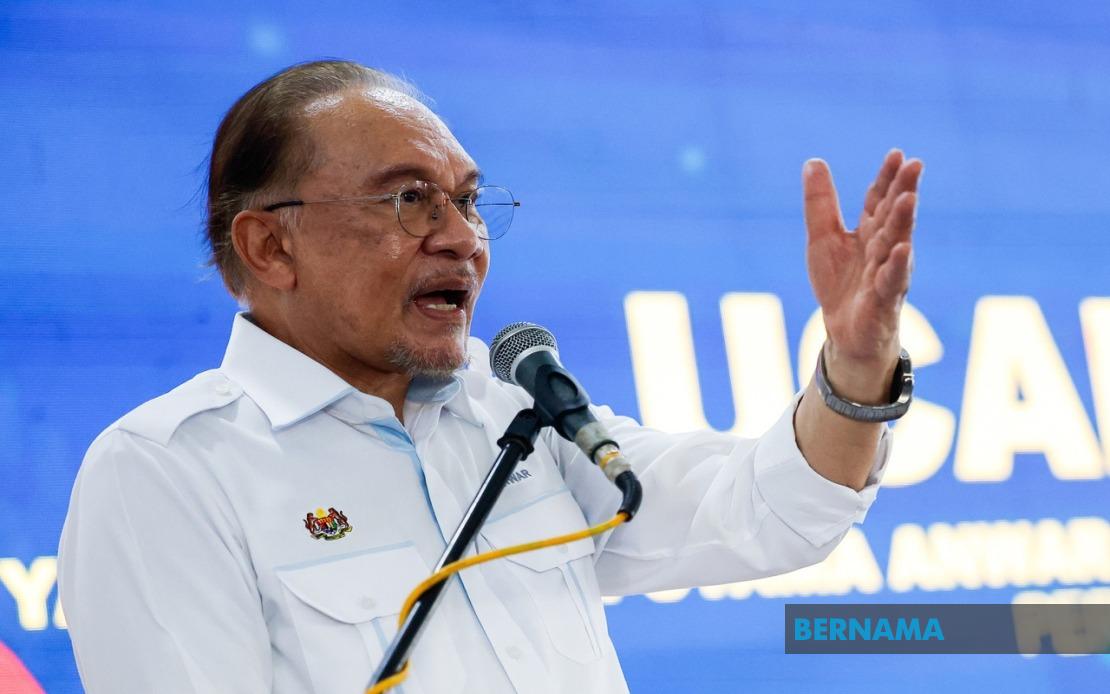
Prime Minister Datuk Seri Anwar Ibrahim has cautioned Pakatan Harapan activists to channel their energy into ground-level campaigning rather than fixating on the proliferation of election surveys, as the coalition prepares for tomorrow's Negeri Sembilan state election. Speaking at the Kembara Inspirasi Belia Akar Umbi programme in Port Dickson, Anwar, who also chairs PH, stressed that the remaining hours before polling day represented a critical window for direct voter engagement. His comments reflect growing tension within Malaysia's political landscape where competing research organisations release contradictory projections, potentially creating uncertainty among supporters and the broader electorate.
The timing of Anwar's intervention is significant given the current polling landscape. At least six separate surveys are circulating predictions about tomorrow's 36-seat contest in Negeri Sembilan, yet their findings diverge so substantially that they offer competing narratives about which coalition will dominate the legislature. This fragmentation of data points underscores a broader challenge in contemporary Malaysian politics, where the multiplication of opinion research—both credible and questionable—can distract campaigns from their fundamental mission. Rather than becoming ensnared in the numbers game, Anwar suggested, PH operatives should treat the countdown to voting day as a period for intensified canvassing, community mobilisation, and direct persuasion activities.
The Ilham Centre has projected that Barisan Nasional and Perikatan Nasional, if they perform to prediction, could jointly capture 22 of the 36 state assembly seats, thereby commanding a significant parliamentary advantage in Seremban. Under this scenario, PH would retain at least nine seats, representing a substantial reduction from whatever gains the coalition achieved in the previous state election cycle. Such a projection, if accurate, would signal a meaningful shift in the state's political arithmetic and potentially reshape the composition of the Negeri Sembilan government. However, Anwar's scepticism toward these numbers—evident in his observation that six surveys produce six different results—suggests the premier recognises that polling data, especially in the Malaysian context where voter sentiment can shift rapidly and local dynamics prove volatile, carries inherent limitations.
Anwar's directive to downplay prognostication aligns with tactical wisdom drawn from recent Malaysian electoral history. The 2022 general election witnessed multiple survey organisations offer competing projections that proved unreliable once ballots were counted. The complexities of multi-cornered contests, the underestimation of rural voter turnout, and the difficulty of accounting for last-minute coalition shifts all conspire to reduce polling accuracy. For PH, which faced significant challenges in recent federal and state contests, the message from the party chair is unambiguous: speculative advantage or disadvantage matters less than the concrete work of persuading undecided voters and mobilising existing supporters to actually cast ballots.
The Negeri Sembilan contest carries implications that extend well beyond the state itself. As a moderate-sized state with a Malay-Muslim majority but significant Indian and Chinese communities, Negeri Sembilan represents a microcosm of Malaysian electoral dynamics. The performance of PH in the state will offer early indicators of whether the coalition's federal-level recovery following the 2023 general election has translated into sustained voter confidence at the state level. Conversely, the results will also reveal whether BN and PN have successfully consolidated their respective voter bases and whether any meaningful coalition between these two nominally distinct blocs has materialised in practical terms. Anwar's emphasis on campaigning rather than predictions suggests PH leadership recognises the stakes are substantial and that complacency bred by favourable polling could prove costly.
The reference to surveys producing divergent results also touches on a methodological reality that Malaysian political observers increasingly grapple with. The country's evolving media landscape, shifting patterns of social media consumption, and demographic changes all render traditional polling techniques potentially problematic. Younger voters, in particular, may be underrepresented in conventional telephone or face-to-face polling, while voters who primarily consume political information through social media platforms present measurement challenges. These technical considerations lend further credence to Anwar's pragmatic approach: rather than attempting to decode which survey might be most reliable, campaign organisations are better served by assuming maximum uncertainty and maximising their direct contact with voters.
From a broader strategic perspective, Anwar's intervention also signals something about PH's internal confidence regarding the contest. Had the coalition possessed overwhelming confidence in the election outcome, the prime minister might have afforded himself the luxury of speculating about victory margins or celebrating predicted gains. Instead, by emphasising the contingency of outcomes and the imperative to campaign intensively until the final moment, Anwar is either appropriately tempering expectations or indicating that PH internal tracking suggests a tighter contest than some external surveys predict. This ambiguity is itself telling, suggesting that Negeri Sembilan represents genuinely competitive terrain rather than settled ground.
The broader pattern of Anwar's remarks also reflects his positioning as a disciplined political operator focused on institutional messaging. By instructing the PH apparatus to concentrate on campaigning, he is simultaneously managing intra-coalition messaging (ensuring that no component party becomes complacent), signalling to voters that PH takes the contest seriously, and establishing a narrative framework wherein any election outcome can be contextualised against the backdrop of intensive ground work. Should PH outperform survey predictions, Anwar can credit his mobilisation strategy; should results prove disappointing, the emphasis on campaigning rather than predictions provides some insulation from accusations of overconfidence.
Looking ahead, the Negeri Sembilan election will serve as a testing ground for various hypotheses about contemporary Malaysian electoral behaviour. The performance of BN and PN separately, and any de facto coordination between them, will offer clues about the evolving structure of Malaysian coalition politics. The turnout figures will reveal whether the 2023 general election enthusiasm has persisted or dissipated. The vote distribution between urban and rural constituencies will illuminate which blocs have shifted allegiance. And the margin by which any coalition secures control will indicate whether Malaysian elections remain characterised by volatility or whether voter preferences have stabilised. Anwar's instruction to focus on campaigning, rather than attempting to forecast these outcomes, represents a sensible acknowledgement that the only reliable predictor of electoral results remains the voting act itself, and that the period before that moment arrives belongs to those willing to work for every single vote.

