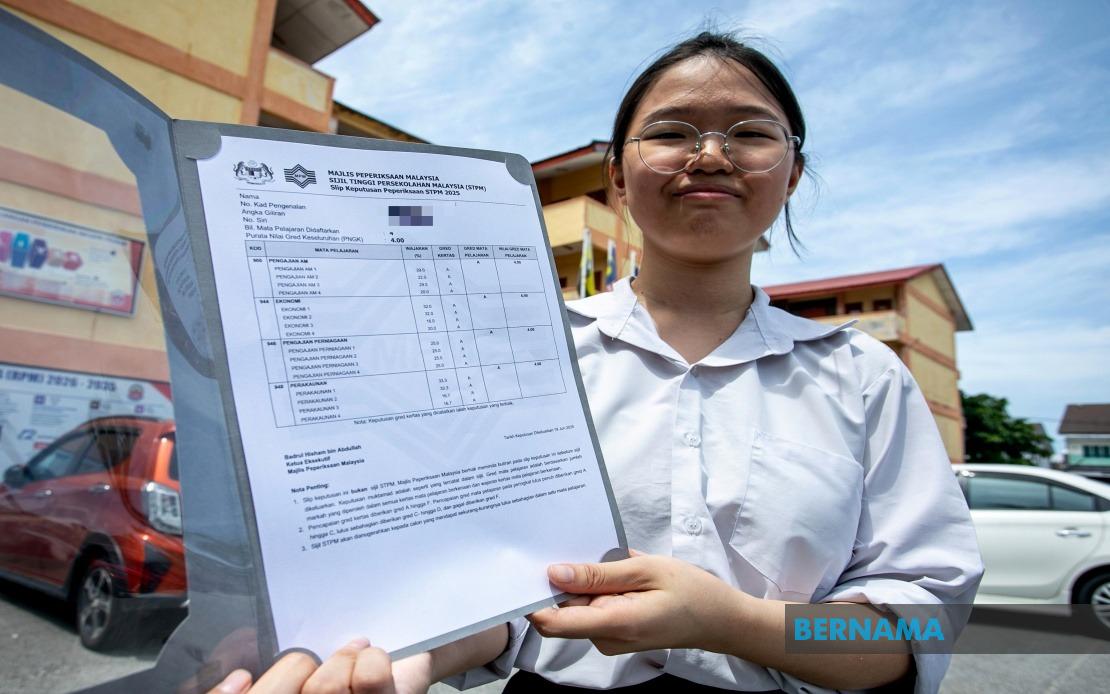
Yong Xin Yi, a 20-year-old student at Sekolah Menengah Kebangsaan Jalan Tasek in Ipoh, has demonstrated that academic excellence in Malaysia's demanding STPM qualification rests not on innate talent alone, but on structured discipline and unwavering commitment. Her achievement of four A grades across her subjects represents the culmination of a carefully orchestrated study regimen that balances intensive classroom engagement with systematic home revision. Her success story offers valuable insights for Malaysian secondary school students navigating the rigorous demands of this crucial qualification, which serves as the gateway to university admission and professional advancement across the country.
The foundation of Xin Yi's achievement lies in a meticulously planned daily schedule that she maintained consistently throughout her examination preparation. She dedicated the five-hour block from 5:00 pm to 10:00 pm each evening exclusively to revising her coursework, transforming her home into a focused learning environment. This approach reflects an understanding that productive study time requires both quantity and quality—mere hours spent at the desk yield diminishing returns without genuine concentration. By anchoring her revision to a fixed time window, she created psychological conditioning that helped her slip into a focused state more readily as the appointed hours approached each day.
What distinguishes Xin Yi's methodology from typical cramming approaches is her equal emphasis on classroom attentiveness as a complement to after-school revision. She recognized that absorbing concepts clearly during lessons directly reduces the cognitive load during home study sessions. When teachers explain complex ideas with real-time interaction, students can ask clarifying questions immediately and build foundational understanding that makes independent revision far more efficient. This insight—that prevention of confusion during instruction is superior to remedying misunderstanding later—demonstrates mature learning awareness that extends beyond many high-achieving students who rely predominantly on late-night intensive review.
Completion of assigned homework featured prominently in her study philosophy, an element that some students dismiss as busywork. Instead, Xin Yi recognized that teachers craft assignments strategically to reinforce specific learning objectives and to identify gaps in student comprehension. By treating homework completion as integral to the learning cycle rather than as a box to tick, she ensured cumulative mastery of topics rather than surface-level familiarity. This approach aligns with educational research emphasizing that spaced practice and multiple exposures to content solidify neural pathways far more effectively than concentrated single-session studying.
Among her four subjects—General Studies, Principles of Accounting, General Studies, and Economics—Xin Yi identified General Studies as particularly demanding. The subject requires students to synthesize information across diverse topics, construct coherent written arguments, and adhere to specific formatting conventions that examiners expect. Recognizing this challenge, she strategically allocated additional attention to the subject, working to transform a relative weakness into competitive strength. This adaptive approach, in which a student diagnoses difficulty and responds with intensified focus rather than avoidance, exemplifies the metacognitive skills that distinguish high performers from average ones.
Xin Yi's cumulative grade point average of 4.00 reflects not merely academic aptitude but her capacity for sustained effort across an extended period. STPM coursework spans two years, requiring students to maintain motivation and discipline through inevitable phases of fatigue and diminishing novelty. The ability to show up daily at 5:00 pm ready to engage rigorously with material, across dozens of weeks and months, demands psychological resilience that transcends intelligence quotient. For Malaysian students contemplating their own STPM journey, her example underscores that long-term consistency trumps sporadic heroic efforts.
Beyond her individual accomplishment, Xin Yi's success reflects broader achievement within her school community. She was one of five students at SMK Jalan Tasek who attained four A grades in this examination cycle, suggesting that institutional factors—teacher quality, school culture, peer influence, and available resources—meaningfully contributed to her outcome. This contextual detail indicates that while personal discipline remains essential, the school environment can either facilitate or hinder the manifestation of student potential. For Malaysian educational stakeholders, this underscores the importance of investing in teacher professional development and creating academic cultures that reward diligence.
Family support emerged as a critical yet often underestimated component of Xin Yi's success. Her parents, working in relatively modest positions as a clerk and phone salesman, prioritized their daughter's education and provided consistent encouragement throughout her studies. This parental investment of emotional and moral support, even when coupled with financial constraints, proves as important as expensive tuition or coaching centers. Xin Yi's acknowledgment of her parents' sacrifices and her aspiration to improve her family's circumstances reveals how academic achievement functions not as individual achievement divorced from social context, but as part of intergenerational aspiration and family mobility.
Looking forward, Xin Yi intends to pursue university education in economics at Universiti Putra Malaysia, having made this decision through careful assessment of her interests and career prospects. Her choice reflects pragmatic career thinking alongside intellectual curiosity—she has evaluated the economics field's employment potential and growth trajectory in Malaysia's economy. For secondary school graduates across Southeast Asia, her deliberate subject selection based on merit rather than default or parental pressure offers a model for aligning educational pathway with realistic career ambitions.
Xin Yi's trajectory from Ipoh student to four-A achiever to aspiring economist offers Malaysian audiences a template for understanding academic success in the contemporary education system. Her story combines individual discipline, strategic thinking, supportive family circumstances, and institutional opportunity in roughly equal measure. Yet the narrative's ultimate significance lies not in replicating her exact schedule—which emerged from her particular circumstances and learning style—but in recognizing the essential principles: structured discipline, classroom engagement, strategic effort allocation, family support, and clear goal orientation. As Malaysia confronts questions about educational quality and student achievement, Xin Yi exemplifies the reality that excellence emerges not from shortcuts or innate genius, but from consistent application of proven learning principles within a supportive ecosystem.

