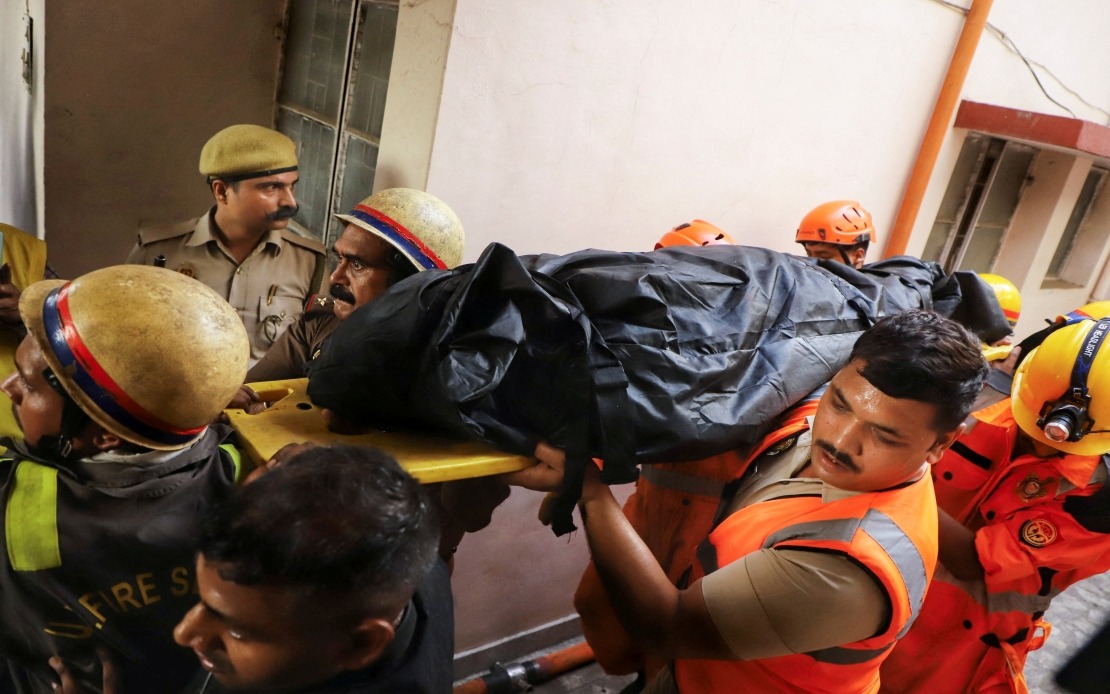
A catastrophic fire tore through a commercial building in Lucknow's Aliganj district on Monday, resulting in the deaths of at least 15 people, predominantly young trainees attending classes at an animation institute located within the structure. The blaze engulfed the three-storey building, which contained multiple commercial operations alongside the training facility, leaving emergency responders to contend with a crowded environment during the critical evacuation phase. The incident has reignited urgent conversations about fire safety standards in India's educational and commercial infrastructure, particularly regarding older buildings that house multiple occupancy types.
Eyewitness accounts and social media footage captured distressing scenes as the fire rapidly consumed the smoke-filled structure. Desperate individuals, including children, could be seen jumping from windows and upper floors as surrounding bystanders attempted to contact emergency services. The chaotic nature of the evacuation underscores the vulnerability of occupants when fire safety protocols are either absent or inadequately enforced. Many of those inside had little warning before smoke inundated the building, leaving limited time for orderly evacuation through conventional exits.
Emergency medical teams responded swiftly to the crisis, transporting over twenty victims to the trauma centre at King George's Medical University (KGMU). Among those rushed to hospital, five individuals survived with injuries requiring medical intervention, though tragically fifteen victims were pronounced dead upon arrival. The clinical toll reflects the severity of the fire's intensity and the volume of smoke inhalation cases among those rescued. Medical authorities indicated that the majority of fatalities occurred before victims could reach safety, suggesting the fire spread with considerable speed through the building's interior.
Uttar Pradesh Chief Minister Yogi Adityanath responded to the tragedy with expressions of condolence, describing the incident as extremely tragic and heart-rending whilst addressing a political rally in a separate city. His remarks acknowledged the devastating impact on bereaved families, though observers noted the delayed physical presence of state leadership at the disaster site. The chief minister's statement represents standard political protocol in India following major accidents, though such gestures often occur alongside broader inquiries into whether adequate building safety measures were maintained.
The Lucknow fire emerges against a troubling backdrop of recurring fire disasters across India's major urban centres. This catastrophe closely follows a devastating hotel fire in Delhi earlier in June that claimed at least twenty-two lives, many of them foreign medical tourists who had travelled to India specifically for healthcare treatment. The succession of major incidents within a single month has intensified scrutiny regarding enforcement of building codes and fire safety regulations across Indian states, particularly in Uttar Pradesh and the national capital region.
Fire safety challenges in India's commercial and educational sectors reflect broader infrastructure concerns. Many older buildings housing multiple businesses and institutions operate with inadequate emergency exits, poorly maintained fire suppression systems, and insufficient fire safety training for occupants and staff. Animation training centres, often operating in rented commercial spaces to minimise overhead costs, frequently lack the financial resources to implement comprehensive safety measures. The concentration of young students in such facilities—often seated at workstations and concentrated in specific rooms—compounds the risk profile during emergency situations.
The animation and digital training industry has expanded significantly across Indian cities over the past decade, driven by demand from the entertainment and technology sectors. However, this rapid growth has outpaced corresponding improvements in occupational safety standards. Many training institutes prioritise affordability and accessibility over premium facility standards, inevitably compromising on fire safety infrastructure. Regulatory bodies tasked with inspection and enforcement often lack sufficient resources or political will to conduct rigorous audits, particularly of smaller educational operations.
For Southeast Asian nations including Malaysia, the Lucknow incident serves as a cautionary reminder regarding the necessity of stringent building code enforcement and regular safety audits. Malaysia's fire safety regulations, whilst generally more rigorous than those observed in some Indian states, require ongoing vigilance. Commercial buildings housing educational institutions must maintain clear escape routes, functional fire detection and suppression systems, and trained personnel capable of coordinating emergency evacuations. The tragedy underscores that economic considerations cannot supersede occupant safety.
The psychological and social dimensions of this disaster extend beyond immediate casualty figures. Families of the deceased students face immeasurable grief, whilst survivors may experience trauma requiring long-term psychological support. The animation industry in Lucknow has suffered reputational damage, likely prompting prospective students to question safety standards at training facilities. Employers recruiting graduates from such institutions will inevitably scrutinise the safety practices of their suppliers of talent and training partners.
Investigative authorities in Uttar Pradesh will likely examine whether the building's owner and the animation centre's management maintained appropriate fire safety certifications, emergency lighting, and functioning alarm systems. Initial reports suggest the building's age and mixed-use configuration complicated evacuation efforts. Regulatory action may follow, potentially including criminal charges against responsible parties if negligence is established. Such accountability measures, whilst crucial, arrive too late for the fifteen individuals who perished.
The incident demands comprehensive policy responses from Indian and regional governments. Mandatory fire safety audits, enforced minimum standards for mixed-use buildings, regular evacuation drills for educational institutions, and stricter penalties for non-compliance represent necessary interventions. Training providers must invest in proper facilities or relocate to purpose-built centres meeting contemporary safety standards. Insurance companies should incentivise compliance through premium adjustments, whilst financial institutions could condition lending on demonstrated fire safety adherence.
For Malaysia's business and educational sectors, the Lucknow fire reinforces the critical importance of viewing fire safety not as an optional expense but as a foundational business requirement. Regular safety inspections, staff training programmes, and investment in modern fire suppression technology protect human lives whilst reducing long-term liability exposure. Organisations housing young people and students bear particular responsibility to maintain facilities exceeding minimum regulatory requirements, ensuring that economic pressures never compromise the safety of those entrusted to their care.

