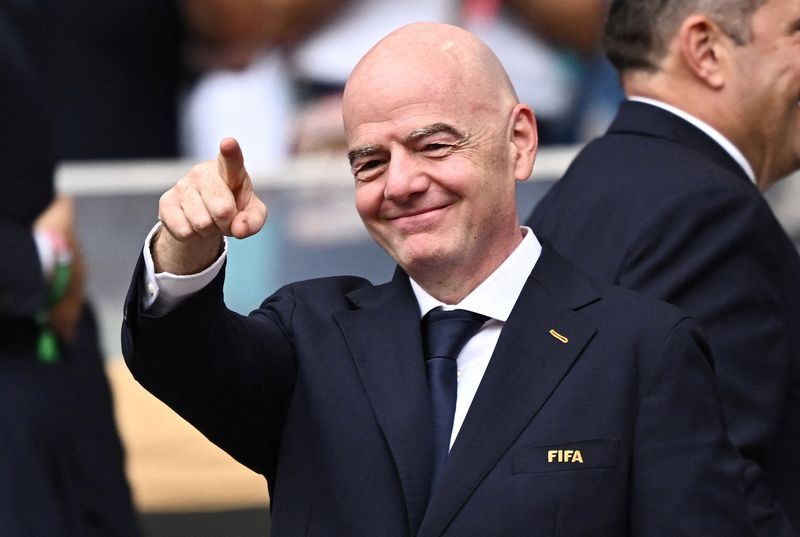
FIFA President Gianni Infantino faces an unprecedented challenge to his authority after the Welsh Football Association became the first national federation to formally withdraw its support for his bid to secure another term leading world football from 2027 to 2031. The dramatic reversal came in the wake of the catastrophic collapse of FIFA's sweeping plan to unlock approximately $4.2 billion in private investment capital by selling roughly 20% of a newly created entity responsible for overseeing major competitions, particularly the World Cup. The plan's abandonment on Friday, following intense pushback from stakeholders across the football world, has triggered a reassessment among member federations about Infantino's suitability to continue leading the global body.
The Welsh FA's statement represents more than a procedural withdrawal of electoral backing. In its formal pronouncement, the organisation cited a litany of governance failures attributed to Infantino, specifically highlighting deficiencies in process management, leadership quality, institutional values, stakeholder relations, and strategic communication. The Welsh football authorities concluded that these shortcomings have fundamentally eroded their confidence in the FIFA president's ability to represent their interests and those of world football more broadly. Crucially, the Welsh federation emphasised that prioritising the sport itself above all other considerations has been compromised, a principle they regard as non-negotiable for FIFA's leadership.
Infantino's proposed privatisation scheme represented one of the most ambitious restructuring efforts in FIFA's recent history. By establishing a separate commercial vehicle and inviting major investors to acquire a minority stake, FIFA sought to monetise the rights attached to its flagship competition in ways previously unexplored. The plan would have provided immediate capital injection while maintaining nominal control of competition administration. However, the initiative triggered coordinated resistance from influential confederations and member associations who viewed the proposal as potentially compromising football's governance autonomy and exposing the sport to external commercial pressures that might conflict with its fundamental values.
The scale of institutional pushback against the plan became evident when both UEFA and CONCACAF issued formal statements indicating they had lost confidence in Infantino's leadership. UEFA, Europe's continental football body, led the charge in opposing the privatisation scheme and welcomed its withdrawal. The European confederation subsequently issued a document preservation order, a procedural measure that prevents the destruction or alteration of communications, records, and digital files when investigations are anticipated. This step suggests UEFA and other organisations may pursue legal remedies regarding the handling and eventual abandonment of the controversial proposal. Media reports have hinted at potential litigation by UEFA against FIFA, though the confederation has not publicly confirmed such plans.
Infantino's trajectory since assuming FIFA's presidency in 2016 after replacing Sepp Blatter had appeared remarkably assured. The Swiss executive successfully completed two unopposed re-election cycles and cultivated an image of stability and forward momentum within the typically fractious world football governance environment. His announcement in April that he would pursue a fourth consecutive term seemed to herald another uncontested succession. Political analysts and football governance experts initially assessed his re-election as virtually inevitable given his apparent command over FIFA's internal machinery and the lack of emerging challengers.
However, the failed commercial initiative has exposed fissures within FIFA's membership coalition that had remained largely dormant during Infantino's earlier tenure. The intensity of resistance and the speed with which national federations abandoned their previous support suggests underlying dissatisfaction with his strategic direction and decision-making approach. Several governance specialists interviewed by news agencies indicated that the botched proposal revealed deep reservations among member organisations about Infantino's willingness to consult meaningfully with stakeholders before pursuing transformative institutional changes. This perception of unilateral leadership style, combined with the plan's practical collapse, has fundamentally altered the political landscape surrounding his re-election bid.
The timing of this institutional crisis compounds the challenges facing Infantino as he approaches the FIFA Congress scheduled for March in Morocco. This gathering of national federation representatives and confederation leaders will determine leadership for the 2027-2031 cycle and provide a forum for members to debate FIFA's strategic priorities. Previously dismissed as a formality, the March Congress now presents a genuine opportunity for reform-minded federations to challenge Infantino's direction or potentially support alternative candidates. The Welsh withdrawal signals that substantial sections of the global football family view this electoral moment as a critical juncture for reasserting membership control over FIFA's governance framework.
The institutional confidence crisis reflects broader anxieties within world football regarding the commercialisation trajectory of the sport. Member federations and continental confederations increasingly worry that prioritising financial maximisation might undermine football's cultural integrity and the balance between competitive integrity and commercial interests. The proposed investment scheme was perceived by critics as an early step toward more radical privatisation, potentially transforming FIFA from a membership-controlled organisation into an entity responsive primarily to external investors and their profit expectations. This fundamental concern about institutional mission transcends the specific failed proposal and shapes how federations will approach Infantino's re-election candidacy.
For Asian football stakeholders and Malaysian observers particularly, these governance developments hold significant implications. FIFA's institutional stability affects the distribution of tournament hosting opportunities, the allocation of competitive schedules, and the financial benefits flowing to regional confederations and national associations. AFC members, including Malaysia, have vested interests in maintaining FIFA governance structures that reflect balanced representation and prevent any single commercial interest from dominating decision-making. The failed privatisation scheme threatened to concentrate commercial control among wealthy investors, potentially marginalising smaller or less commercially attractive football markets in Asia.
The accumulating evidence of institutional dissatisfaction extends beyond Wales's formal withdrawal. Both UEFA and CONCACAF's expressions of lost confidence indicate that Infantino's political position has shifted from apparent dominance to genuine vulnerability. Should additional major federations follow Wales's example and withdraw their support, or should they actively campaign for alternative candidates, the March Congress could produce an unprecedented result in which FIFA's sitting president faces electoral defeat. Such an outcome, while historically unusual in FIFA politics, would represent a significant assertion of membership agency against executive-driven institutional transformation.
Infantino has not publicly responded substantively to the accelerating criticism or the withdrawal of support, with FIFA instead confirming it would issue statements addressing the governance questions raised. The coming months will reveal whether additional federations join Wales in withdrawing backing, whether serious alternative candidates emerge, or whether Infantino can mount a political recovery emphasising reform and renewed stakeholder consultation. The ultimate outcome will shape not only FIFA's leadership trajectory but also the institution's commitment to membership governance and the balance between commercial imperatives and football's organisational autonomy.

