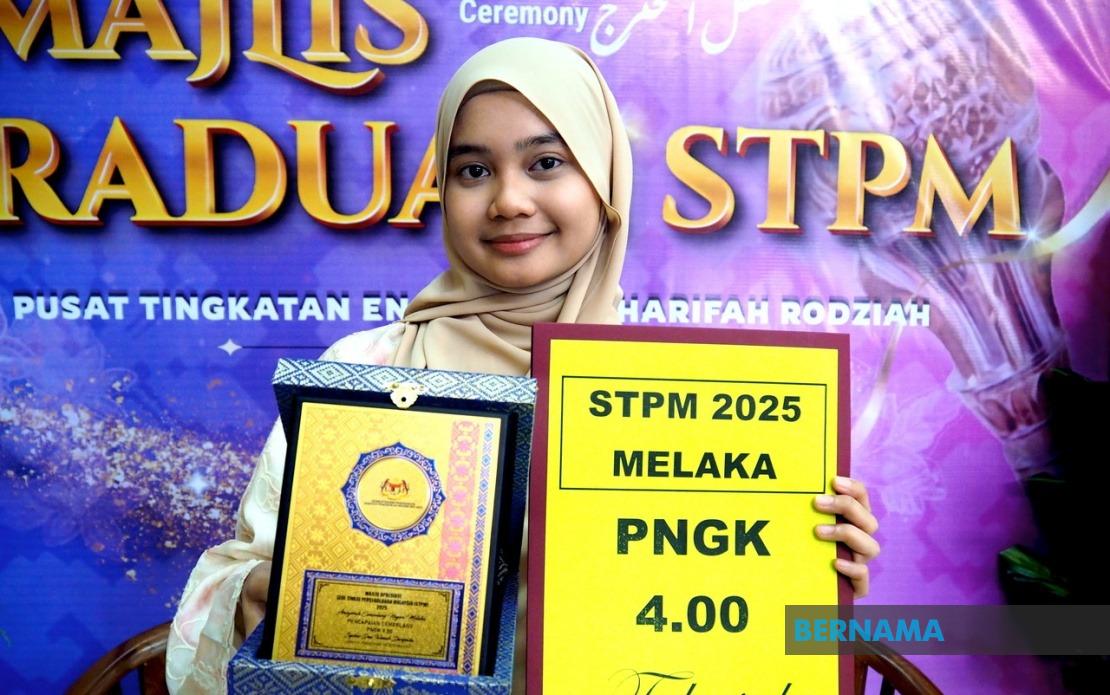
Nurfariesya Nasywa Hamedee's journey to academic excellence bears the profound weight of family loss and inherited determination. The 21-year-old student from Sekolah Menengah Kebangsaan Agama Sharifah Rodziah in Melaka has become one of this year's standout STPM achievers, earning a perfect Cumulative Grade Point Average of 4.00 in the 2025 examination results announced yesterday. Yet her success transcends the typical narrative of diligence and aptitude, rooted instead in a promise made to her father in his final days before his unexpected passing.
The circumstances surrounding her academic trajectory reveal the human dimensions often obscured by examination results and achievement statistics. When her father, Hamedee Asri, died of a heart attack merely one week before Nurfariesya was scheduled to sit for her SPM trial examinations, the loss threatened to derail her educational aspirations entirely. The emotional toll was severe enough that she seriously contemplated abandoning her schooling altogether, viewing full-time employment as a more practical means of supporting her grieving family during their period of vulnerability. This represents a critical juncture where many talented students would have ceded their futures to immediate family obligations.
What preserved her trajectory was a parting instruction, conveyed through her mother Yusnita Ruslan, that Nurfariesya should not squander her intellectual capabilities. This counsel, delivered in the shadow of his mortality, crystallised into an unwavering motivational framework that sustained her through the subsequent years of rigorous secondary and pre-university study. Rather than allowing grief to become an insurmountable barrier, she channelled it into purposeful academic engagement, transforming her father's words into a lived commitment to scholarly achievement.
Nurfariesya herself has acknowledged the unexpected nature of her final outcome, having initially projected a CGPA of approximately 3.92 based on her trial examination performance and preliminary calculations. The progression from anticipated results to a flawless score demonstrates not merely technical competence but an ability to sustain incremental improvement across multiple assessment cycles. Her foundation was already robust, having obtained seven As in her SPM examination, yet the transition to STPM's increased complexity required sustained intellectual effort and psychological resilience.
Her subject selection reveals a clear intellectual trajectory oriented toward religious and legal scholarship. By enrolling in General Studies, Arabic, Usuluddin, History, and Shariah at the pre-university level, Nurfariesya signalled her intention to pursue professional training in Shariah law. This specialisation represents a meaningful commitment to a demanding field that requires linguistic proficiency, theological understanding, and analytical rigour across multiple knowledge domains. Her aspiration to attend Universiti Malaya for a Bachelor's Degree programme in this area has already progressed beyond theoretical planning; she has completed an interview session with the institution, positioning herself competitively within the higher education pipeline.
When questioned about the mechanisms underlying her achievement, Nurfariesya declined to mystify the process with exotic methodologies or proprietary techniques. Instead, she emphasised fundamental principles: sustained academic effort, psychological resilience in confronting setbacks, and spiritual grounding in Islamic faith. This unpretentious approach to explaining success carries particular weight in a context where educational discourse frequently emphasises novel technologies, specialised coaching, and sophisticated study systems. Her testimony suggests that foundational discipline and emotional fortitude remain irreplaceable elements of sustained academic performance.
Her decision to pursue STPM rather than alternative pathways to tertiary education reflects pragmatic educational planning. Nurfariesya specifically valued the pre-university qualification's compressed timeline relative to alternative qualifications, allowing faster progression to degree-level studies. Simultaneously, she recognised that STPM credentials provide extensive institutional flexibility, with the qualification accepted across Malaysia's university system and internationally. This strategic thinking about educational sequencing indicates maturity beyond what age alone would suggest, likely influenced by her accelerated transition to adult responsibilities following her father's death.
Paralleling Nurfariesya's achievement within Melaka's 2025 STPM cohort is another remarkable performance: Ng Zhen Hong, a 20-year-old student from Kolej Tingkatan Enam Tun Fatimah, has earned national recognition as the Best Student Award recipient for the Science Stream. His accomplishment, rooted in a different intellectual terrain, provides instructive contrast. Ng attributes his success to consistent parental and educator support, combined with intrinsic intellectual passion for quantitative and analytical disciplines. His daily revision regimen of one to two hours exemplifies sustainable study practices, while his reframing of scientific challenges as motivational rather than discouraging reveals psychological sophistication in engagement with difficult material.
Ng's achievement registers additional distinction through his SPM performance, where he accumulated ten As, positioning him among the highest performers during secondary education. His intention to pursue Chemical Engineering or Electrical Engineering at Universiti Malaya reflects confidence in his quantitative capabilities and interest in applied technical fields. Like Nurfariesya, he approached his national-level recognition with evident surprise, having neither anticipated nor strategically engineered his position as Malaysia's top science stream student. This apparent modesty, combined with demonstrable excellence, characterises both students profiled in Melaka's celebratory announcement.
For Malaysian parents and students observing these trajectories, several implications merit consideration. Both exemplary performers emphasised fundamental discipline, sustained family support, and intrinsic subject engagement rather than exam coaching or technological shortcuts. Both navigated significant personal circumstances—whether bereavement or exceptional academic pressure—without allowing external factors to diminish their commitment. Their success validates a educational philosophy centred on resilience, clear career intent, and integration of personal values into academic pursuits. In a context where examination-driven pressure frequently generates anxiety-based approaches to learning, these students' narratives recovery substantive meaning-making as a pathway to sustainable achievement.
The 2025 STPM results celebration in Melaka, officiated by Datuk Rosli Abdullah in his capacity as State Deputy Exco for Education, Higher Education, and Religious Affairs, provided formal recognition of these exceptional performances. Yet the deeper significance extends beyond ceremonial acknowledgment of academic metrics. Nurfariesya and Ng represent the diversity of excellence within Malaysia's pre-university system: one emerging from loss and spiritual commitment to professional purpose, the other animated by scientific curiosity and supported family infrastructure. Both demonstrate that STPM remains a credible pathway to competitive entry into Malaysia's premier universities, provided students combine intellectual capacity with psychological determination.

