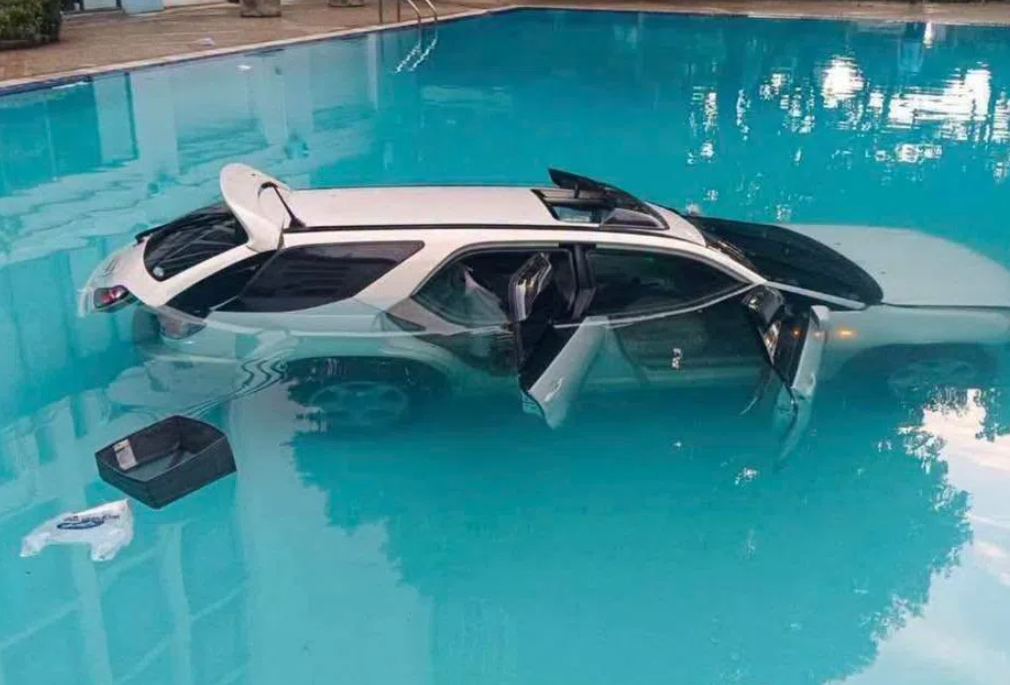
A dispute between a Bangkok mother and son over housing costs took a dramatic and destructive turn early Thursday morning when the frustrated 29-year-old drove his white Toyota Harrier directly into a swimming pool at Chulalongkorn University, one of Thailand's leading academic institutions. The incident at the prestigious campus in central Bangkok transformed what began as a household disagreement into a costly public spectacle, raising fresh questions about family financial pressures and generational entitlement in Thailand's urban middle class.
The collision occurred near the Sasapol Building when the man, unhappy about his mother's refusal to cover his condominium expenses, decided to take his grievances to the university campus. Thai police confirmed that security personnel stationed at the campus gates initially attempted to halt the vehicle as it approached the restricted area. Rather than complying with their signals, the driver accelerated, crashed through a barrier, and steered the SUV directly into the pool before dawn broke over the city. The dramatic manoeuvre was over in moments, leaving the sport utility vehicle nearly submerged with its doors agape and front section severely damaged.
Witnesses reported that the man successfully extricated himself from the sinking vehicle and swam to safety before emergency responders reached the scene. He sustained injuries from the crash and was transported to Charoenkrung Pracharak Hospital for medical assessment and treatment. Fortunately, no other individuals were present in or near the pool at the time, preventing what could have been a far more tragic outcome. University authorities and local emergency services attended to both the driver's condition and the recovery of the damaged automobile.
According to Thai media reports, the underlying conflict centred on a monthly rent burden of approximately 27,000 to 30,000 baht—roughly US$775—for his residential unit. The son had apparently expected his mother to assume this regular financial obligation, yet she declined to continue subsidising his accommodation. This refusal became the catalyst for Thursday's destructive outburst, though police are still investigating the precise chain of events and psychological factors that culminated in the pool incident. Investigators are examining not only how the crash occurred but also the driver's mental state at the time and his motivations for choosing such a public venue for his apparent protest.
The financial implications of his impulsive action quickly captured public attention across Thai social media platforms. Observers were quick to calculate that the driver's protest had likely transformed a manageable monthly disagreement into a liability many times larger. The SUV, which appeared relatively new in photographs, was almost certainly totalled by the impact and immersion in water. Beyond the vehicle loss, Chulalongkorn University would now require compensation for damage to university property and restoration of its recreational facilities. Legal proceedings and associated attorney fees would compound these costs exponentially, with conservative estimates suggesting the total financial fallout could exceed ten times the disputed monthly rent that sparked the conflict.
The episode resonates within a broader Thai context where housing affordability and intergenerational financial dependence have become increasingly contentious issues. Bangkok's real estate market, like many Southeast Asian capitals, has experienced significant price appreciation in recent years, placing rental accommodation beyond the reach of many young adults entering the workforce. Consequently, family financing of housing remains commonplace, creating dynamics where adult children continue to depend on parents for major expenses well into their professional lives. This arrangement can breed tension when parents question whether their adult offspring should be assuming greater financial responsibility for their own living costs.
Online responses to the incident predominantly lacked sympathy for the driver, with commenters viewing the situation as an unfortunate intersection of privilege, poor impulse control, and unrealistic expectations. Many social media users highlighted the seeming contradiction between the man's apparent affluence—evidenced by his relatively new SUV and condominium residence—and his expectation that his mother should fund his lifestyle. The incident became emblematic of broader concerns about entitlement among wealthy Thai youth, with observers questioning how someone with access to such material comforts could lack the emotional maturity to handle a reasonable parental boundary.
One particularly pointed social media comment encapsulated widespread sentiment: the observation that a 27,000 baht monthly rent, a nearly-new vehicle, and an adult male exhibiting acute financial dependence, severe anger management issues, and emotional immaturity comparable to a young child painted a picture of privilege disconnected from responsibility. This characterisation suggested that the driver's behaviour reflected not desperation born of poverty but rather the unchecked expectations of someone accustomed to having his demands met without consequence.
The Chulalongkorn University pool incident serves as a cautionary tale about the escalating costs of poor decision-making under emotional stress. What initially represented a family discussion about reasonable household expenses evolved into a situation involving property destruction, personal injury, legal investigation, and substantial financial liability. For Malaysian and broader Southeast Asian readers, the incident underscores how quickly personal conflicts can spiral beyond recovery and how crucial it becomes to develop conflict resolution skills and emotional regulation, particularly when financial disagreements arise within families managing housing costs in expensive urban centres.

