With nomination day set to commence across Johor tomorrow morning, the Election Commission has spent the final preparation hours conducting comprehensive checks and simulations at all designated candidate nomination centres to safeguard the integrity and efficiency of the process. A reconnaissance of multiple PPC locations throughout Johor Bahru found staff conducting only essential last-minute technical work, signalling that the bulk of groundwork has been completed well in advance of the critical morning deadline.
At the Perling state constituency nomination centre, situated within Dewan Jubli Intan Hall, returning officer Nazatul Shima Mohamad expressed full confidence in the setup, noting that physical layout arrangements and coordinated simulations involving all partner agencies had concluded successfully. She emphasised that the institution stands ready to extend assistance to prospective candidates whilst simultaneously calling on them to uphold their end of the bargain through punctuality, cooperation, and preparation of mandatory documentation including nomination deposits.
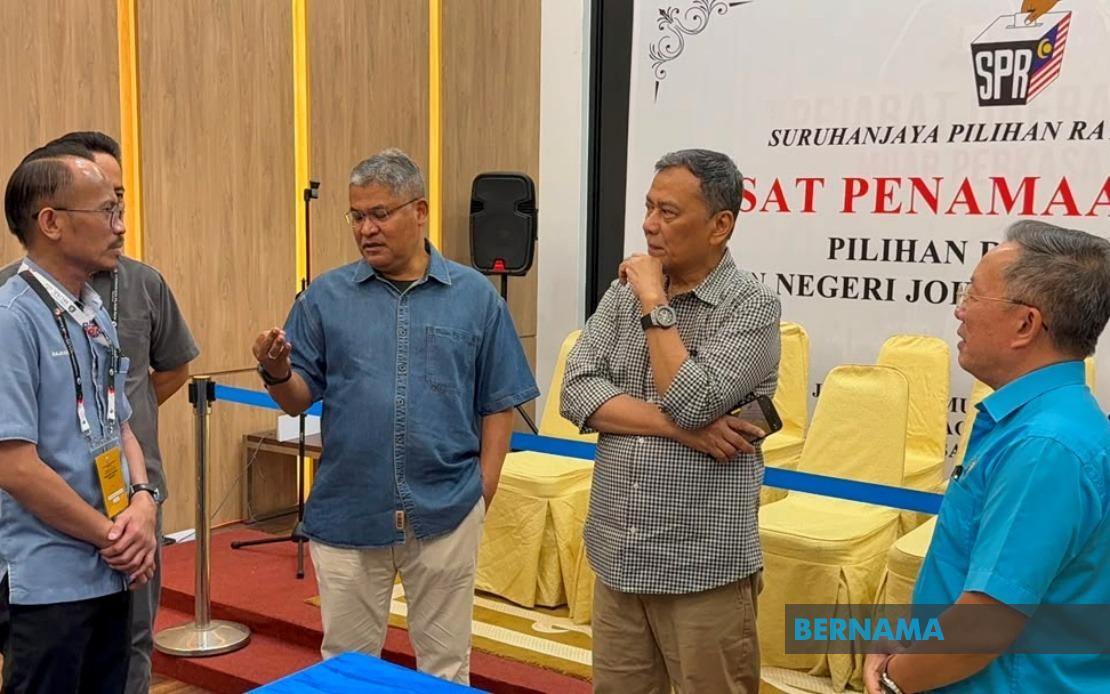
The Kota Iskandar nomination centre, administered from the Main Hall of Iskandar Puteri City Council in Medini, has undertaken comprehensive coordination with law enforcement agencies to prepare for what officials anticipate will be substantial gatherings of party supporters. These arrangements extend beyond the venue itself to encompass traffic management measures including strategic road closures along approach routes, establishment of 50-metre exclusion zones surrounding the nomination hall, deployment of temporary structures to organise supporters, and installation of physical barriers designed to prevent direct confrontation between rival party contingents.
Returning officer Shahrulizam Abdul Rashid articulated a measured acknowledgement of the political atmosphere surrounding the election, framing security preparations not as contentious impositions but rather as necessary scaffolding to facilitate orderly democratic participation. His public advisory to supporters emphasised the responsibility incumbent upon party workers to maintain decorum and resist provocative behaviour, underscoring that nomination day succeeds when all stakeholders prioritise process integrity over partisan theatre.
The logistical scale of tomorrow's undertaking is substantial, with the Election Commission operating 56 nomination centres operating simultaneously across the state. The nomination window itself spans merely one hour, from 9 to 10 in the morning, creating a tightly compressed timeframe that demands precision from both returning officers and the candidates themselves. This concentrated schedule necessitates the meticulous advance preparation now being confirmed, as bottlenecks or administrative confusion at any single centre could create cascading delays across the state.
The electoral franchise involved in this state election reflects Johor's demographic weight within Malaysia's political system. The 2,727,926 registered voters comprise approximately 2.7 million ordinary civilians eligible to cast ballots, supplemented by representation from military personnel and their spouses numbering over 12,000, and police officers and their spouses accounting for a similar figure. This composition ensures that whilst civilian participation remains dominant, the inclusion of uniformed service representatives reflects Malaysia's constitutional framework governing electoral participation.
The timeline leading to tomorrow's nomination day has been compressed by circumstances surrounding the dissolution of the Johor State Legislative Assembly on June 1st. This mid-year dissolution, rather than permitting an extended pre-election period, has condensed the campaign calendar considerably. The Election Commission has calibrated its schedule to permit early voting on July 7th, followed by the general polling day on July 11th, compressing what would normally be a more expansive electoral cycle into a matter of weeks.
For Malaysian observers monitoring this sixteenth iteration of the Johor state election, tomorrow's nomination process carries significance extending beyond mere procedural fulfillment. The transition from the dissolution of the prior assembly to the formal nomination of candidates represents the threshold between administrative dissolution and competitive democratic engagement. Tomorrow's process determines which individuals and parties will contest the July 11th polling day, effectively crystallising the political battlefield that has thus far existed in theoretical form.
The operational readiness expressed by returning officers across multiple nomination centres suggests that the Election Commission's advance planning has proceeded without major impediments. The confidence articulated by officials, tempered by appropriate acknowledgement of security considerations, indicates an institution that has absorbed lessons from previous electoral exercises and applied them systematically to tomorrow's operations. The emphasis on candidate preparation and supporter conduct suggests that election administrators view tomorrow not merely as a procedural formality but as a foundational moment establishing the tone for the entire campaign period.
For political parties across Johor's ideological spectrum, tomorrow morning represents the point at which electoral strategy transitions from internal deliberation into public candidacy. The mandatory deposit requirement serves as a mechanism to deter frivolous nominations whilst preserving the right of serious contenders to access the ballot. The requirement that candidates arrive early with complete documentation reflects administrative necessity but equally imposes discipline on participating parties to demonstrate organisational competence at the earliest stage of the electoral contest.

