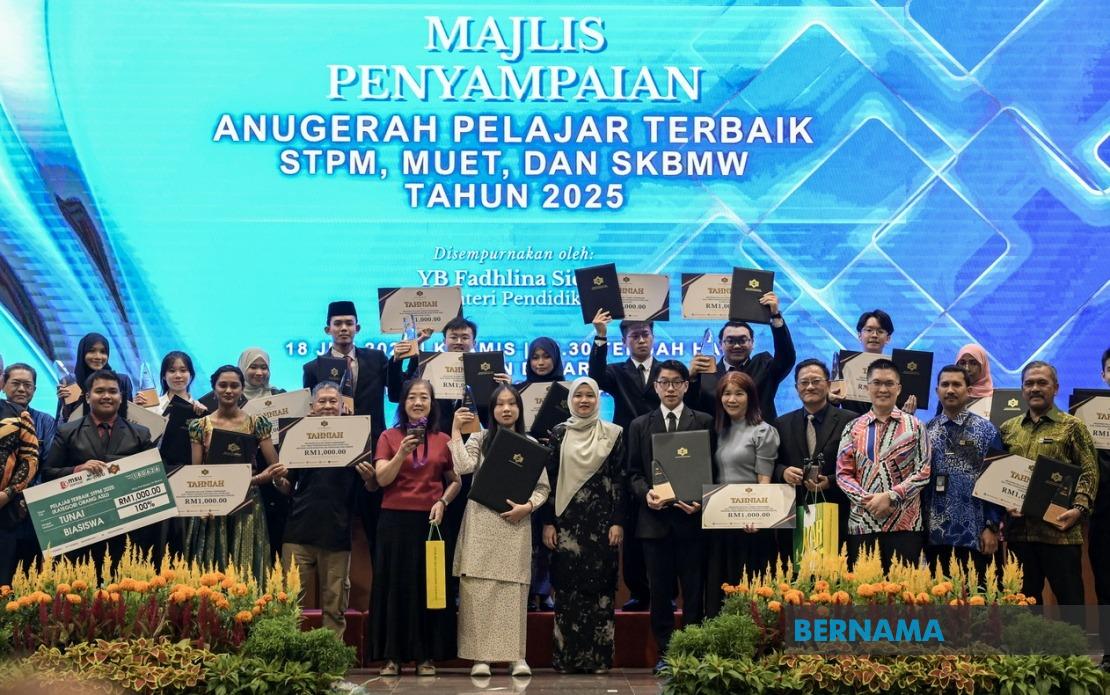
Eighteen of Malaysia's highest-performing STPM 2025 students have been selected to receive full tuition fee scholarships from the country's public universities. The initiative, announced by Education Minister Fadhlina Sidek at the presentation of the 2025 STPM Best Student Awards ceremony at the Malaysian Examinations Council building in Kuala Lumpur, represents a significant shift in how Malaysia's tertiary education system rewards academic merit within the Form Six pathway.
The scholarship scheme represents a concerted effort by the government and public universities to reinvigorate the traditional pre-university route, which has faced declining enrolment in recent years as students increasingly pursue the International Baccalaureate and other alternative qualifications. By directly rewarding excellence at the STPM level with undergraduate funding, the initiative seeks to restore prestige to Malaysia's national pre-university examination and demonstrate that high-achieving students who choose this pathway are valued and supported through their university studies.
Fadhlina emphasised that this represents a new departure for Malaysia's public universities, with each institution now committing to fund the top-performing STPM graduates entering their programmes. The minister expressed appreciation for the collaborative support demonstrated by the university sector, noting that institutional buy-in from these organisations was crucial to the scheme's launch. This collective approach suggests coordination between the Ministry of Education and the higher learning institutions to align incentives with broader policy objectives around strengthening the domestic pre-university ecosystem.
The government has framed this scholarship programme within a broader portfolio of measures designed to make Form Six more attractive to students considering their secondary-to-tertiary education pathway. Alongside this new initiative, the ministry is simultaneously expanding the physical footprint of Form Six Colleges across the country, upgrading classroom infrastructure with smartboards to enhance teaching quality, introducing early schooling support mechanisms, and distributing MADANI Book Vouchers to ease the financial burden on students. These complementary measures suggest a comprehensive strategy to address potential barriers—infrastructure, resources, financial accessibility, and academic support—that might otherwise dissuade capable students from choosing the STPM route.
The announcement arrives against the backdrop of improved national performance metrics for the 2025 STPM cohort. The national Cumulative Grade Point Average increased to 2.88 from 2.85 in the preceding year, indicating marginal but measurable improvement in overall student performance across the examination. While such gains may appear modest, they suggest that existing initiatives and systemic interventions are yielding results, and that renewed investment in the form of prestigious scholarships could accelerate this trajectory.
For Malaysian students considering their post-secondary options, this development carries implications beyond symbolic recognition. A fully funded university education eliminates a major financial barrier to pursuing higher learning, particularly for talented students from lower-income backgrounds who might otherwise be constrained by cost considerations. This addresses a persistent equity concern within Malaysia's education system, where financial circumstances have historically influenced university access despite academic merit. By targeting the very highest achievers, the scheme ensures that these scholarships reach students with demonstrated capability to succeed in degree-level work.
The structure also reflects a strategic calculation by public universities themselves. By competing to attract the most accomplished pre-university graduates, institutions enhance their institutional rankings and prestige, as student quality significantly influences how universities are evaluated domestically and internationally. This creates a virtuous cycle where scholarships become not merely an altruistic gesture but a calculated investment in institutional reputation and future research output. The fact that this occurred across multiple public universities simultaneously suggests either coordinated messaging or genuine competitive positioning among tertiary institutions.
Within the Southeast Asian context, Malaysia's move merits attention from neighbouring countries grappling with similar tensions between traditional and alternative pre-university pathways. Indonesia, Thailand, and the Philippines all operate national examination systems for secondary students, yet increasingly contend with competition from international qualifications. Malaysia's approach of using financial incentives to champion its national pathway could become a template other regional economies explore, particularly those concerned about losing high-achieving students to overseas qualification tracks.
The scholarship initiative also carries implications for future cohorts. If the 2025 programme establishes a durable precedent, annual cohorts of STPM graduates can anticipate comparable opportunities, potentially reinforcing institutional commitment to the pathway. Conversely, if the programme remains a one-time gesture, its impact on enrolment patterns may prove limited. The language employed by Fadhlina—describing this as beginning with the 2025 cohort—suggests intent toward continuity, though long-term funding commitment remains subject to budgetary considerations and political priorities.
For Malaysian employers and the broader economy, strengthening the STPM pathway has practical significance. The traditional Form Six-to-university pipeline has historically produced graduates with particular strengths in analytical reasoning and local educational context. Ensuring that Malaysia's highest-achieving pre-university students remain engaged with domestic institutions rather than pursuing overseas examinations helps retain intellectual talent and maintains coherence within the national education system. This becomes especially relevant as Malaysia competes regionally for skilled workforce development and attempts to reduce dependency on imported talent for knowledge-intensive sectors.
Deputy Education Minister Wong Kah Woh and officials from the Malaysian Examinations Council and Education Malaysia's directorate-general participated in the awards ceremony, signalling institutional coordination across education sector bodies. This multi-agency presence underscores that the scholarship initiative reflects broader policy consensus rather than isolated departmental action, lending credibility to the programme and suggesting adequate foundational support for implementation.
The government's positioning of this scheme as evidence of improving educational quality reflects broader governance messaging around development and national progress. However, the marginal improvement in national CGPA figures—from 2.85 to 2.88—warrants contextualisation. Incremental gains, while positive, suggest that systemic challenges affecting student achievement remain significant. Scholarships for the top 18 students represent recognition of excellence but address only a fraction of the broader cohort. Whether complementary support measures can replicate improvements across the wider student population remains an open question for policy implementation.
Looking forward, the success of this initiative will be measured not merely by the academic outcomes of the 18 scholarship recipients, but by whether it meaningfully influences enrolment decisions among high-achieving Form Four and Form Five students considering their pre-university options. If applications to Form Six surge and higher-calibre students elect the STPM pathway, the programme will have achieved its strategic objective of revitalising the ecosystem. Conversely, if the scholarships attract strong candidates already destined for public universities regardless, the innovation will have primarily redistributed resources among an unchanged cohort. Only subsequent enrolment trends and student choice data will reveal whether this initiative represents transformational change or incremental policy adjustment.