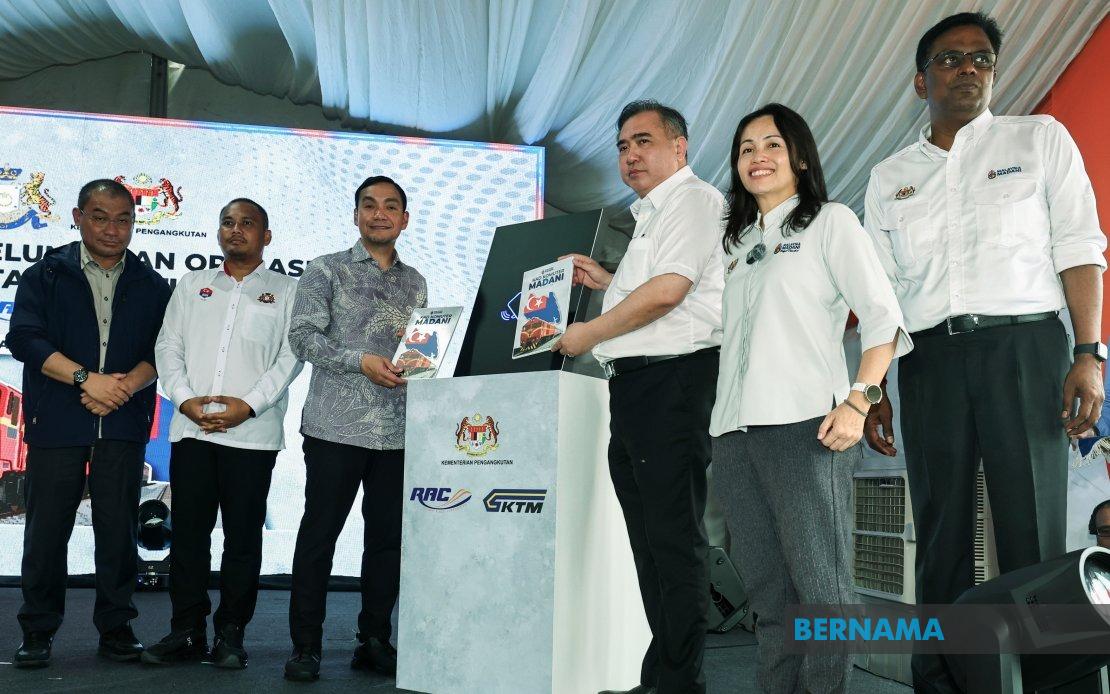
The Johor state government considers the Elevated Autonomous Rapid Transit (E-ART) system an indispensable component of Johor Bahru's transport infrastructure as the state prepares for the opening of the Johor Bahru-Singapore Rapid Transit System (RTS) Link next year. During the launch of the Southern Shuttle train service at KTM Kulai Station on June 16, Menteri Besar Datuk Seri Onn Hafiz Ghazi underscored that E-ART represents a critical long-term answer to the anticipated surge in traffic volumes that will accompany the new cross-border rail link's commencement of operations.
The introduction of the RTS Link is expected to substantially alter mobility patterns in Johor Bahru, as the high-speed rail connection will significantly increase passenger throughput between Malaysia and Singapore. The existing road network, already under considerable strain during peak hours, faces the prospect of severe congestion without adequate complementary infrastructure. Onn Hafiz acknowledged that while temporary and medium-term interventions are currently underway to address transport challenges, these measures alone cannot sustainably accommodate the projected volume of travellers who will utilise the new rail corridor.
Currently, authorities are deploying a series of interim solutions designed to manage traffic flow more efficiently. These initiatives include expanding Park & Ride facilities throughout Johor Bahru to encourage commuters to shift from personal vehicles to public transport, and implementing sophisticated traffic management systems at JB Sentral, the integrated transport hub serving the city. However, the Menteri Besar candidly stated that such measures provide only temporary relief and cannot serve as permanent answers to congestion challenges. These interventions, he suggested, constitute necessary stop-gap arrangements while waiting for the E-ART project to commence operations.
The scale of Johor Bahru's urban challenges underscores the urgency of comprehensive transport solutions. With approximately 1.8 million residents, Johor Bahru's population rivals that of Penang, placing it among Malaysia's most densely populated urban centres. Beyond domestic traffic considerations, the city functions as the nation's principal international gateway, with substantial cross-border movement connecting it to Singapore. This dual role—major population centre and crucial economic interchange—means that transport inefficiencies have cascading implications for both local residents and regional commerce.
Onn Hafiz emphasised that Johor Bahru requires an integrated, high-capacity public transport ecosystem capable of seamlessly connecting various transit modes. The E-ART project, as an elevated autonomous system, offers the potential to redistribute passenger flows away from congested surface roads and provide a rapid, reliable alternative transportation corridor. By operating above existing road networks, elevated transit avoids the capacity constraints that plague traditional bus and taxi services, while its autonomy addresses labour-related operational challenges. The system's design allows it to operate with minimal environmental disruption while maximising passenger throughput during peak demand periods.
The Transport Minister Anthony Loke and Deputy Communications Minister Teo Nie Ching, who also represents Kulai as its Member of Parliament, attended the Southern Shuttle launch event, signalling federal government commitment to enhancing Johor's transport infrastructure. This ministerial presence reflects the cross-party recognition that transport development in Johor carries significance extending beyond state boundaries, affecting national-level economic performance and regional stability. The federal government's involvement suggests that funding and policy coordination mechanisms are being mobilised to ensure priority implementation of critical projects.
Onn Hafiz articulated a broader political perspective, framing the E-ART initiative as an example of federal intervention that directly benefits ordinary citizens. He contended that swift implementation and successful delivery of such projects generate tangible improvements in daily quality of life, reducing commute times and enhancing overall livelihood conditions. This positioning reflects an understanding that infrastructure investments, when executed effectively, serve as visible demonstrations of government responsiveness to citizen needs. For residents experiencing prolonged traffic delays and mobility frustrations, the completion of E-ART represents a concrete manifestation of state and federal commitment to addressing long-standing grievances.
The Southern Shuttle train service launch itself represents incremental progress in Johor's railway expansion, connecting Kulai station to broader regional networks. This service expansion indicates that while E-ART remains under development, authorities continue advancing multiple transit solutions simultaneously. The layered approach—combining conventional rail services, Park & Ride facilities, traffic management upgrades, and planned autonomous transit systems—reflects recognition that singular solutions cannot adequately address the complexity of modern urban mobility. Each component addresses different passenger segments and trip patterns.
The timeline for E-ART implementation becomes increasingly critical given that the RTS Link is projected to commence operations within approximately twelve months. This compressed timeframe creates pressure on project managers and government agencies to accelerate planning, procurement, and construction phases. Any delays in E-ART development could result in a period when the RTS Link is operational but supporting infrastructure remains incomplete, potentially exacerbating rather than alleviating congestion pressures. The synchronisation of these major transport projects presents both opportunity and risk for Johor's urban development trajectory.
For Malaysian policymakers observing Johor's transport challenges, the E-ART initiative offers insights into managing urbanisation pressures in other growth centres. Cities such as George Town, Kuala Lumpur, and emerging urban clusters throughout Malaysia face similar congestion pressures driven by population concentration and cross-border economic activity. The successful implementation of E-ART could provide a replicable model for other state governments confronting comparable transport dilemmas. Southeast Asian urban planners also monitor Malaysia's infrastructure solutions, as rapid urbanisation across the region creates comparable mobility challenges requiring innovative responses.
Looking forward, the success of Johor Bahru's integrated transport strategy will depend on seamless coordination between multiple government agencies, private concessionaires, and community stakeholders. The E-ART project cannot function effectively in isolation; it must integrate smoothly with the RTS Link, existing railway networks, bus services, and taxi operations. Technical coordination challenges, fare integration mechanisms, and land-use planning considerations all require careful management. The vision articulated by Onn Hafiz—of a modern, efficient, interconnected mobility system—remains achievable but demands sustained political will, adequate funding, and professional project management throughout the implementation phase.