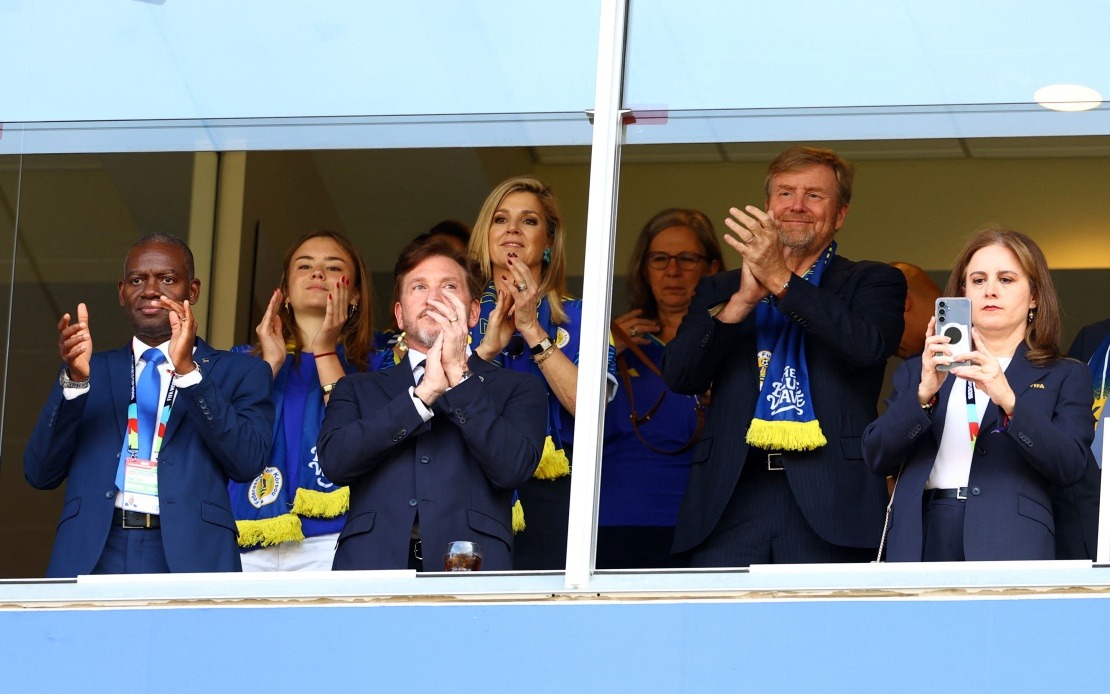
In a remarkable display of royal duty and sporting passion, King Willem-Alexander and Queen Máxima of the Netherlands undertook an ambitious World Cup itinerary across two American cities on Saturday, supporting both nations under their constitutional jurisdiction. The Dutch monarch and his consort traveled from Houston to Kansas City within hours, immersing themselves in the tournament atmosphere whilst wearing the national colours of each team they supported. This energetic schedule underscored the unique constitutional arrangement whereby the Dutch crown extends sovereign authority beyond the European mainland to Caribbean territories, creating an unusual situation where a reigning monarch could champion multiple nations competing simultaneously in international football's premier competition.
The royal couple's first engagement took them to Houston, where they witnessed the Netherlands deliver a commanding performance against Sweden, securing a decisive 5-1 victory. The dominant display represented a significant step forward in the Dutch team's tournament ambitions, positioning them favourably within their group standings ahead of subsequent fixtures. King Willem-Alexander and Queen Máxima dressed in the traditional orange colours synonymous with Dutch football, blending seamlessly with the passionate supporters surrounding them in the stadium. This opening victory provided the Netherlands with substantial momentum as they prepared for their remaining group-stage encounters, with the substantial goal margin demonstrating their attacking prowess and defensive solidity against a challenging Nordic opponent.
Having celebrated the Netherlands' impressive triumph, the royal couple quickly relocated to Kansas City for their second engagement of the day, where Curaçao faced Ecuador in a critical group match. The Caribbean nation's performance produced a surprising scoreless stalemate, a result that kept their knockout-stage aspirations alive despite the lack of goals. The Curaçao Football Association subsequently shared footage of the monarch and his wife enthusiastically joining team members in the dressing room, dancing and celebrating the hard-fought draw. The royals switched their supporting colours from Dutch orange to Curaçao's distinctive blue, demonstrating their commitment to honouring both constituent territories of the Kingdom of the Netherlands.
The constitutional dimension of this dual participation reflects an often-overlooked aspect of European monarchy. As King of the Netherlands, Willem-Alexander exercises sovereignty not merely over the European homeland but extends his authority to Caribbean jurisdictions including Curaçao, Aruba, and Sint Maarten, remnants of the Dutch colonial era that have evolved into autonomous constituent countries within a broader kingdom framework. This arrangement occasionally creates peculiar situations in international sport, where a single monarch represents multiple footballing nations competing simultaneously. The World Cup provided a window into this reality, allowing observers to appreciate how modern constitutional arrangements accommodate the sporting independence of constituent territories whilst maintaining overarching royal representation.
The king's own commentary on the experience highlighted the novelty and satisfaction of supporting multiple teams simultaneously. Willem-Alexander expressed delight at the prospect of cheering for both nations, acknowledging that the tournament offered him the unusual privilege of doubling his national interest. He further articulated his hopes that both the Netherlands and Curaçao would progress deeply into the competition, though such an outcome would require navigating challenging forthcoming fixtures. His remarks conveyed genuine enthusiasm rather than obligatory ceremonial sentiment, suggesting that the monarch embraced the unique circumstances with authentic sporting passion rather than treating the engagement as mere constitutional formality.
The Netherlands' path forward involved facing Tunisia in their final group encounter, a fixture looming large in their tournament narrative. Their commanding victory over Sweden had substantially improved their prospects of advancing to the knockout stages, establishing them as group contenders with momentum and confidence. The five-goal haul represented attacking football of the highest calibre, suggesting that the Dutch squad possessed the offensive capability to trouble any opponent in the tournament's knockout phases should they successfully navigate the group stage.
Curaçao's situation presented greater complexity and higher stakes, as their goalless draw against Ecuador left them requiring a victory against Ivory Coast to maintain realistic advancement hopes. The Caribbean team's resilience in securing a draw against a formidable South American opponent demonstrated their competitive credentials, yet their path to the knockout stages remained narrow and demanding. They would need to overcome a strong Ivory Coast outfit in circumstances where anything less than three points would likely prove insufficient for qualification. Despite these demanding circumstances, the presence of their royal head of state in Kansas City symbolized institutional support for the island nation's footballing ambition, a gesture that extended beyond the typical patriotic encouragement offered to competing national teams.
The royal couple's World Cup engagement extended beyond Saturday's double-header, as they had previously watched the Netherlands' opening fixture against Japan alongside Japanese imperial dignitaries. Emperor Naruhito and Empress Masako were conducting a state visit to the Netherlands when the match occurred, providing a remarkable convergence of constitutional monarchies united by international football. That encounter ended in a 2-2 draw, a result that ultimately proved significant when contextualized against the Netherlands' subsequent five-goal demolition of Sweden, suggesting the team had found their rhythm and tactical coherence as the competition progressed.
The logistics of attending both Houston and Kansas City matches within a single day demonstrated organisational sophistication and the personal commitment the royal couple invested in their sporting responsibilities. The journey between American cities, the necessary preparation for each match, and the attendance at post-match celebrations required meticulous coordination. Such dedication reflected not merely constitutional obligation but genuine engagement with football as a unifying cultural phenomenon. The decision to participate actively in dressing-room celebrations rather than remaining at executive level highlighted a more informal and relatable approach to royal duty, one that acknowledged the emotional intensity and community significance of international football beyond formal ceremonial considerations.
From a Malaysian and Southeast Asian perspective, the Dutch royal involvement in the World Cup illustrated how constitutional monarchies navigate their relationships with constituent territories and international sporting engagement. Malaysia's own constitutional framework, whereby the Yang di-Pertuan Agong serves as constitutional head of state, offers parallels in considering how national leadership represents diverse communities within broader political structures. The example of the Netherlands demonstrated that modern monarchy could embrace popular sporting culture whilst maintaining institutional dignity, a balance increasingly relevant to Southeast Asian monarchies managing contemporary governance and national identity questions. The World Cup provided a stage where constitutional arrangements typically invisible to international audiences became momentarily visible, revealing the intricate ways modern states organise their internal relationships and external representations.

