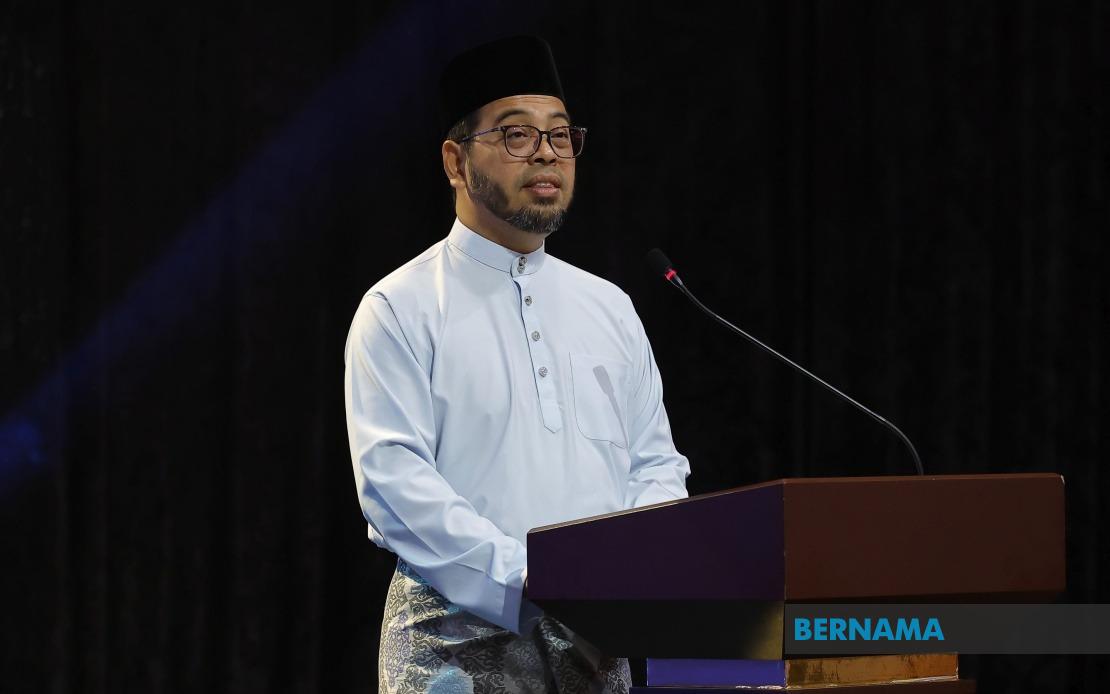
Religious Affairs Minister Dr Zulkifli Hasan has stressed that Malaysian Muslims must transcend lingering grievances and resolve their differences to forge a more resilient ummah capable of confronting an increasingly turbulent global landscape. Speaking at the national-level Maal Hijrah 1448H/2026M celebration held at Putra Mosque in Putrajaya on June 17, the Minister in the Prime Minister's Department articulated a vision of communal solidarity rooted in individual transformation, suggesting that lasting social progress emerges only when citizens undergo profound personal development spanning intellectual, moral, and spiritual dimensions.
The ceremony, which carried the theme "MADANI Dihayati, Ummah Diberkati", attracted senior political figures including Sultan Nazrin Shah of Perak and Deputy Prime Minister Datuk Seri Fadillah Yusof, underscoring the symbolic importance attributed to messaging around religious and community cohesion. This high-level participation reflects broader government efforts to position Islamic values and ummah unity as foundational to Malaysia's national resilience and identity, particularly as the country navigates complex domestic and international terrain.
Dr Zulkifli's remarks carried particular weight given the contemporary context in which Malaysian Muslims, like their counterparts throughout Southeast Asia, face mounting pressures from interconnected global phenomena. Economic uncertainty, supply chain vulnerabilities, and geopolitical instability have intensified the need for strong institutional and community bonds. The Minister argued explicitly that fragmentation within the Muslim community weakens Malaysia's capacity to withstand external shocks, whereas collective strength generates reciprocal benefits and protective mechanisms for all members. This framing positions ummah unity not merely as a religious imperative but as a pragmatic necessity for national survival and prosperity.
Central to his philosophical approach is a reconceptualization of the Islamic concept of hijrah, traditionally understood as the Prophet Muhammad's migration from Mecca to Medina. Dr Zulkifli reframed this notion as an ongoing spiritual and ethical journey rather than a singular historical event, arguing that contemporary hijrah involves continuous personal renunciation of destructive behaviours and deliberate cultivation of virtues that strengthen collective bonds. This interpretive move renders the ancient Islamic concept immediately relevant to modern Malaysian experience, enabling religious leaders to connect historical wisdom with pressing contemporary social challenges such as polarization, mistrust, and communal fragmentation.
The Minister emphasized that meaningful implementation of initiatives designed to elevate the dignity of Muslims and ensure Islamic values flourish in Malaysia depends fundamentally on strengthened communal cohesion. This strategic linking of policy effectiveness to ummah unity suggests an understanding that institutional measures, however well-intentioned, cannot succeed in a fractured social environment. Rather, top-down reforms require bottom-up support and cooperation rooted in shared commitment to collective welfare. For Malaysian policymakers, this positions religious and communal harmony as prerequisites rather than mere accompaniments to substantive policy achievement.
Significantly, Dr Zulkifli extended his message beyond the Muslim community, acknowledging that citizens of diverse beliefs and backgrounds share responsibility for maintaining peace, stability, and economic prosperity. This inclusive framing, while maintaining focus on Muslim unity, recognizes Malaysia's constitutional commitment to multireligious coexistence and suggests that communal strength among Muslims enhances rather than compromises broader national stability. The statement reflects an attempt to balance particular religious identity with pluralistic national identity, a perennial challenge in Malaysia's political landscape.
The ceremony also featured the presentation of prestigious National and International Tokoh Maal Hijrah awards, with International Islamic University Malaysia Rector Prof Emeritus Datuk Dr Osman Bakar receiving national recognition and Moroccan Islamic scholar Dr Ahmad Al-Raysuni honoured internationally. These selections indicate strategic choices about which Islamic figures and institutions the Malaysian government wishes to elevate and associate with its vision of ummah unity and Islamic leadership. The inclusion of an IIUM rector emphasizes the role of Islamic higher education in shaping religious discourse, while the recognition of a Moroccan scholar suggests Malaysia's positioning within broader Islamic intellectual currents beyond the Southeast Asian region.
For Malaysian readers, Dr Zulkifli's address carries implications extending into several domains. Domestically, the emphasis on transcending disputes and overcoming historical grievances may resonate with ongoing efforts to reduce political polarization and rebuild social trust following periods of considerable divisiveness. The framing of ummah unity as foundational to national resilience positions religious cohesion as a public good rather than sectarian concern, potentially justifying government investment in interfaith and intra-Muslim dialogue initiatives. Additionally, the explicit connection between communal solidarity and capacity to manage global economic challenges speaks to anxieties many Malaysians harbour regarding economic vulnerability and rising cost of living.
Regionally, Dr Zulkifli's articulation of ummah unity reflects broader patterns across Southeast Asian Muslim-majority nations, where religious nationalism and communal solidarity increasingly feature in official discourse. Malaysia's approach, which attempts to balance particular Islamic identity with plural governance, offers a distinct model compared to approaches adopted in neighbouring Indonesia or Brunei. The emphasis on intellectual, moral, and spiritual development as prerequisites for meaningful social transformation aligns with Islamic educational philosophies gaining currency throughout the region, suggesting transnational resonance for the Minister's message.
Moving forward, the effectiveness of such appeals depends substantially on whether they translate into concrete policy measures addressing grievances that fuel communal divisions. Disputes over religious authority, economic inequalities within Muslim communities, and questions of Islamic law application in plural contexts remain unresolved issues that symbolic calls for unity, however eloquently articulated, cannot automatically overcome. The government's commitment to supporting initiatives elevating Muslim dignity will face scrutiny regarding whether resources are equitably distributed and whether substantive progress occurs in areas such as Islamic education quality, economic inclusion, and religious freedom for Muslim minorities.