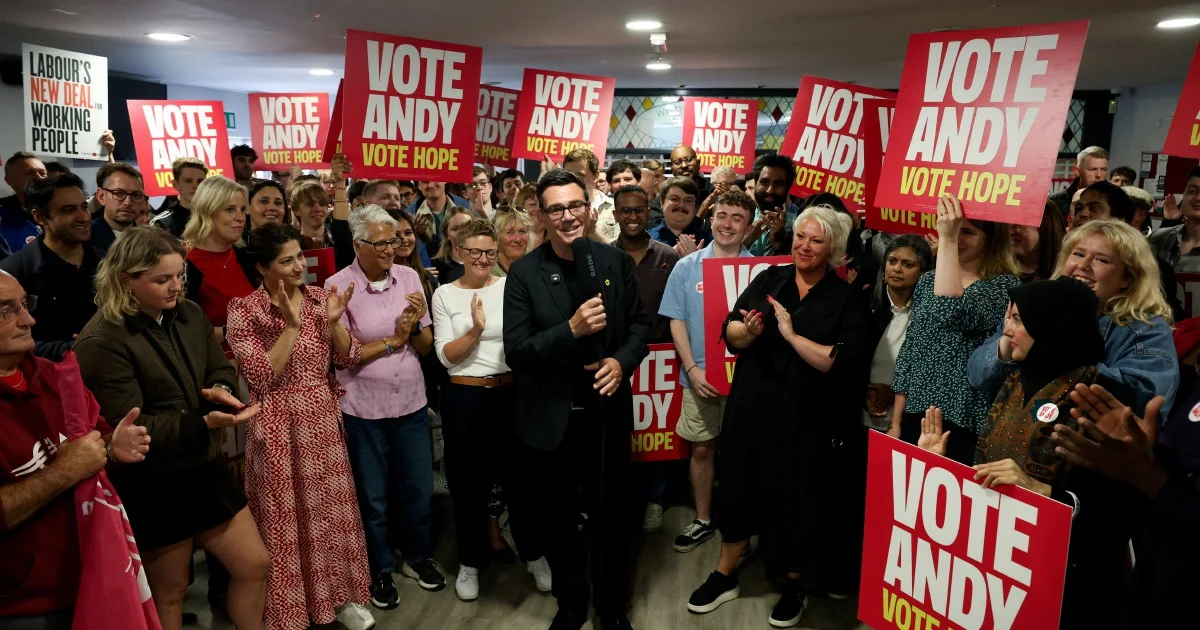
Andy Burnham's repositioning as a potential successor to Keir Starmer within Labour ranks faces a curious political tailwind: the fractious relationship between the United Kingdom's two main right-wing political movements. Ahead of Thursday's election in Makerfield, the seat critical to Burnham's ambitions to eventually challenge the current Prime Minister, analysts are examining how internal Conservative-Reform UK tensions could inadvertently strengthen the Labour contender's hand across the country.
The animosity between the Conservative Party and Reform UK, the populist upstart led by Nigel Farage, represents one of British politics' most consequential feuds. Rather than presenting a unified conservative counter-narrative to Starmer's government, the two parties have directed considerable rhetorical firepower at each other, creating strategic vulnerabilities neither can easily repair. This division runs deeper than typical election-season positioning; it reflects fundamental disagreements over direction, leadership legitimacy, and the future character of the British right.
For Burnham specifically, these dynamics create opportunities that transcend the Makerfield contest alone. The Manchester-based politician, previously a high-profile shadow health secretary and longtime mayor of Greater Manchester, has positioned himself as a serious alternative to Starmer within Labour's upper echelons. His challenge hinges partly on demonstrating broad appeal across constituencies that currently lean toward or could swing toward opposition parties. When right-wing voters fragment their support between Conservatives and Reform UK, Labour's threshold for victory in traditionally competitive seats drops substantially.
The Makerfield by-election itself carries particular significance for Burnham's narrative arc. A decisive victory here would burnish his credentials as an electoral asset capable of holding traditionally Labour-stronghold seats even during uncertain political periods. Should the Conservative and Reform UK split drain sufficient votes from potential challengers, Burnham's personal profile and campaigning effectiveness might appear secondary to the structural advantages handed to him by his opponents' dysfunction.
This dynamic has broader implications for British politics beyond a single constituency contest. The Conservative-Reform UK feud speaks to deeper fractures within right-wing ideology and strategy that have been widening since Farage's influence over Brexit accelerated traditional Conservative realignment. Where once the Tory party successfully contained populist pressure internally, the emergence of Reform UK as a competitive force has forced those conversations outward and into openly hostile territory. The mutual delegitimisation between these camps leaves little room for the kind of electoral cooperation or tacit voter coordination that might otherwise concentrate conservative strength.
For Malaysian and Southeast Asian observers, the Makerfield situation illuminates how fractured opposition movements can inadvertently strengthen incumbent governing parties. Britain's experience demonstrates that even well-established conservative political traditions can fragment when internal consensus erodes and populist alternatives gain traction. The Conservative Party's decades of electoral dominance could not insulate it against organisational challenges when core constituencies felt inadequately represented by conventional leadership.
Burnham's potential trajectory also reflects how individual politicians can benefit from circumstances largely beyond their control. His reputation as a pragmatic, regionally-grounded Labour figure may enhance his appeal during periods of national uncertainty, yet the actual mechanics of his advance toward possible party leadership candidacy depend significantly on whether the right-wing split persists. Should Conservative-Reform UK tensions ease or resolve through merger or realignment, the political topography would shift dramatically in ways that transcend Burnham's personal attributes.
The Makerfield by-election thus functions as both a specific electoral test and a barometer of deeper structural tensions within British conservatism. A Burnham victory achieved despite genuine competitiveness from right-wing opposition would suggest that fragmentation, rather than reinvigorated Conservative messaging, drove the outcome. Conversely, a strong combined showing from Conservative and Reform UK candidates, even resulting in a Labour win, would indicate that populist and traditional right-wing movements retain substantial voter appeal when measured on a unified basis.
Looking beyond Thursday's contest, the implications for Burnham's longer-term political ambitions remain contingent. His path to serious Prime Ministerial contention requires sustained parliamentary strength for Labour, growing public confidence in his alternative vision for government, and continued weakness among opposition forces. The right-wing feud currently works in his favour, but political circumstances shift rapidly. Should the Conservative Party recover cohesion or Reform UK fade as a competitive force, Burnham would need to overcome headier electoral challenges through demonstrable policy innovation and public persuasion rather than relying on opponent dysfunction.
The broader lesson from this moment in British politics concerns how electoral systems interact with party fragmentation to produce unexpected winners. While Andy Burnham's ambitions for higher office rest ultimately on his own political acumen and Labour's performance in government, the immediate advantage he draws from Conservative-Reform UK infighting reminds observers that political fortune depends on multiple moving parts. For Burnham, the right-wing feud remains a tactical asset—valuable now, but potentially ephemeral.