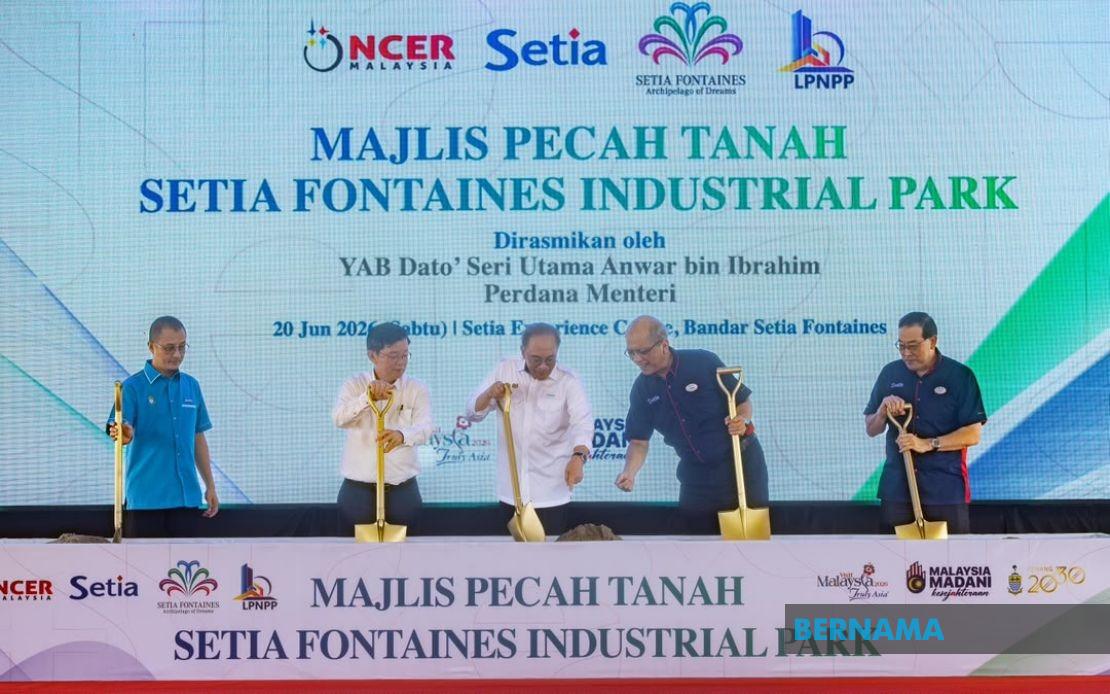
Prime Minister Datuk Seri Anwar Ibrahim has issued a pointed directive to both government-linked entities and the private sector: economic expansion must translate into tangible opportunities for middle- and lower-income Malaysians, or risk deepening the nation's fault lines of inequality. Speaking at the groundbreaking ceremony for Setia Fontaines Industrial Park in Bandar Setia Fontaines on June 20, Anwar underscored a fundamental challenge facing Malaysia's development agenda—ensuring that rapid growth and surging investment do not inadvertently concentrate wealth and opportunity among privileged segments while marginalising those struggling economically.
The Prime Minister's remarks signal growing concern within government circles that Malaysia's development trajectory, while impressive in headline figures, risks becoming hollowed out if ordinary Malaysians cannot access its benefits. Anwar's emphasis reflects a recognition that sustained economic stability and social cohesion depend on broad-based prosperity rather than statistics that mask widening disparities. His call represents a recalibration of how Malaysia measures development success, moving beyond GDP growth rates and investment inflows toward qualitative measures of inclusive participation.
In articulating the expectation to major economic players, Anwar specifically named Malaysia's most influential wealth-creation engines. Khazanah Nasional Berhad, Permodalan Nasional Berhad, and the Employees Provident Fund—sovereign wealth vehicles managing hundreds of billions in ringgit—received explicit notice that project approvals carry an implicit obligation to create pathways for economically disadvantaged Malaysians. This framing transforms development approvals from technical decisions into social contracts, where institutional investors and private enterprises are expected to balance returns with equity considerations.
The structural risk Anwar identified addresses a persistent Malaysian challenge: projects frequently generate employment and economic activity, yet the benefits concentrate among those already positioned to capture them. Middle-income wage earners and lower-income workers often find themselves sidelined by skills mismatches, capital barriers, or lack of connections. Without deliberate design incorporating inclusive elements, industrial parks and major developments can paradoxically worsen inequality by creating new wealth streams while leaving the broader population behind.
The Setia Fontaines Industrial Park development illustrates the practical dimension of this principle. Located in Bandar Setia Fontaines, the project represents a strategic effort to rebalance Seberang Perai's economic geography, ensuring that prosperity extends beyond the island and southern regions. By intentionally situating industrial development to serve a broader geographic constituency, the government signals recognition that concentration of investment creates corresponding concentration of opportunity—a dynamic that fuels resentment and social tension if perceived as structurally unfair.
Anwar positioned the industrial park as a catalyst for upgrading Malaysia's manufacturing capabilities, transitioning away from back-end assembly operations toward technology-intensive sectors that typically command higher wages and stronger career trajectories. This sectoral shift matters considerably for lower-income workers, as it theoretically expands access to better-remunerated employment than traditional manufacturing offered. However, such advancement requires the workforce to possess appropriate capabilities, introducing a critical vulnerability in Malaysia's development model.
Educational alignment emerged as central to Anwar's vision for inclusive development. He stressed that collaboration among industry, technical and vocational education institutions, and universities—naming Universiti Sains Malaysia as an example—must intensify to equip workers with genuinely market-relevant skills. This framing acknowledges a painful reality: Malaysian educational outputs frequently mismatch industry requirements, leaving employers unable to fill skilled positions while jobseekers remain unemployed despite apparent labour demand. Bridging this gap requires genuine partnership transcending traditional boundaries between academics and commerce.
The technological acceleration Anwar highlighted creates both opportunity and urgency. Industrial standards evolve rapidly, meaning training and education programmes risk obsolescence within months if not continuously refreshed through industry engagement. This dynamic particularly disadvantages workers entering the market with minimal foundational skills, as they face constant retraining demands. Ensuring accessible, ongoing skill development becomes essential infrastructure for inclusive development—yet Malaysia's vocational training system frequently suffers from undersourcing and reputation challenges.
Anwar's insistence that economic growth be measured by distribution of benefits rather than aggregate statistics challenges conventional development discourse dominated by foreign direct investment statistics and manufacturing output figures. This represents a subtle but significant rhetorical shift in Malaysian governance, acknowledging that headline economic indicators can mask hollow growth that fails to improve ordinary living standards. For regional observers, particularly those in ASEAN economies grappling with similar inequality challenges, Malaysia's leadership articulating this concern carries analytical weight.
The Prime Minister's framing also carries implicit criticism of development models prioritising investor convenience and returns over distributional outcomes. By requiring beneficiaries of government approval to demonstrate commitment to inclusive opportunity creation, he establishes accountability mechanisms previously absent from Malaysia's project evaluation frameworks. This could reshape how government evaluates private sector proposals, introducing social equity criteria alongside financial viability assessments.
Implementing Anwar's vision faces substantial practical obstacles. Government-linked entities and private companies frequently argue that imposing distributional requirements raises costs and reduces competitiveness. Training local workforces demands investment that immediate profit calculations may not justify. Creating accessible pathways for lower-income groups requires deliberate design that may complicate otherwise straightforward project execution. Yet Anwar's framing suggests these are non-negotiable considerations rather than optional extras.
For Malaysia's broader development trajectory, Anwar's intervention signals determination to address inequality through integrating inclusive growth principles into project design rather than attempting redistribution post-hoc. This preventive approach acknowledges that wealth concentration during development becomes increasingly difficult to reverse through taxation or transfer programmes. By insisting beneficiaries of large-scale projects contribute to inclusive opportunity creation upfront, the government seeks to ensure equity becomes embedded in Malaysia's economic expansion rather than relegated to charitable add-ons.
The Setia Fontaines groundbreaking thus represents more than industrial infrastructure development. It embodies an evolving Malaysian conception of what development genuinely means and whom it should benefit. Whether this rhetoric translates into substantive outcomes remains to be observed, but Anwar's explicit expectations may influence how subsequent industrial parks, infrastructure projects, and investment approvals are designed and evaluated across Malaysia and potentially throughout Southeast Asia.

