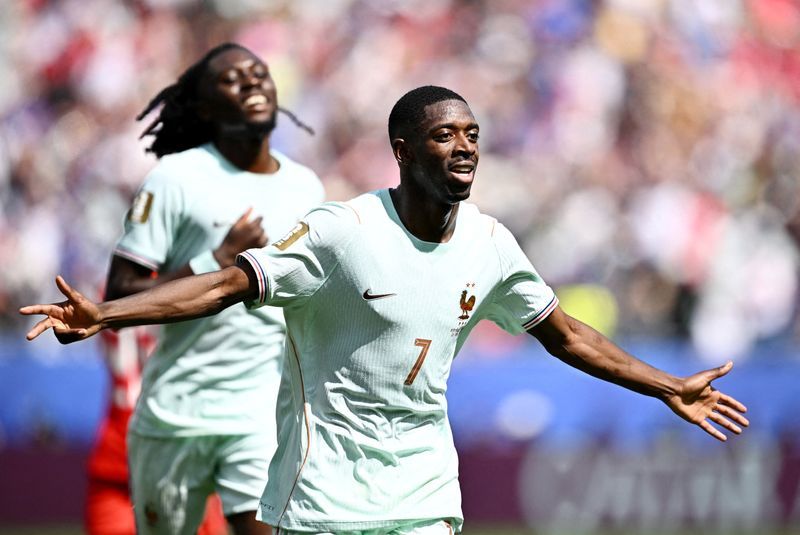
France consolidated their status as World Cup heavyweights with a clinical 4-1 dismantling of Norway in Foxborough, Massachusetts on Friday, with winger Ousmane Dembele's electrifying first-half performance overshadowing the entire contest. The Paris St-Germain attacker etched his name into the tournament's annals by becoming only the third French player to score a hat-trick at a World Cup, matching the exclusive company of Just Fontaine and Kylian Mbappe, while achieving the feat in the second-fastest time in the competition's history.
Despite both sides having already secured passage to the knockout rounds before kickoff, France maintained their intensity and competitive hunger, driven partly by the resolve to deliver a symbolic victory for absent manager Didier Deschamps, who returned home to the United States to attend his mother's funeral. The squad's commitment to the contest underscored the strength of character within the defending runners-up and 2018 champions, who recognised that topping Group I carried tangible advantages beyond mere pride. The tournament's sprawling North American itinerary meant that group winners faced a considerably more manageable travel schedule through the knockout stages, transforming what might ordinarily be a dead-rubber fixture into a strategically meaningful encounter.
France's task proved considerably simplified by the pragmatic but ultimately costly rotation enforced by Norway head coach Stale Solbakken, who opted to rest virtually his entire starting eleven save for a solitary player. The absence of captain Martin Odegaard and Erling Haaland, the prolific striker tipped as a genuine threat for the Golden Boot award, left the Scandinavian backline bereft of both defensive stability and attacking bite. This decision essentially handed the initiative entirely to Didier Deschamps' side, who had shown early in the tournament that they possessed sufficient quality to punish any diminished opposition.
The dominance was evident from the opening seconds, when Kylian Mbappe nearly broke the deadlock with an audacious angled effort that cannoned off the crossbar after barely twenty seconds of action. The PSG forward, himself a contender for the tournament's top scorer prize, demonstrated the incisive quality that has defined France's attacking play throughout their World Cup campaign. Within moments, Mbappe's creative brilliance manifested itself as he threaded a perfectly weighted cross-field pass to Dembele, who executed a clinical finish by cutting past his marker before dispatching a precise angled shot beyond goalkeeper Egil Selvik.
Dembele's second goal arrived in the twentieth minute, again courtesy of Mbappe's playmaking prowess, as the winger found space and executed a dipping finish that left Selvik stranded. The combination of Mbappe's creativity and Dembele's positioning and finishing proved utterly irresistible, and when Norway briefly offered respite through Thelo Aasgaard's goal, the response was swift and emphatic. Just twelve minutes after conceding, Dembele completed his remarkable hat-trick by curling a low shot into the bottom corner, achieving the feat in twenty-five minutes—the second-fastest in World Cup history, behind only Austria's Erich Probst who accomplished the milestone in 1954 against Czechoslovakia after twenty-four minutes.
Norway's second-half revival proved fleeting and ultimately unconvincing. Jorgen Strand Larsen squandered a penalty that might have galvanised the Scandinavian challenge, with Mike Maignan producing a crucial save to deny the centre-forward. Winger Oscar Bobb subsequently tested the French goalkeeper again, hinting at underlying fragility in France's defensive structure that might prove exploitable against more capable opposition. Nevertheless, France's superiority was too pronounced to be seriously threatened, and substitute Desire Doue's injury-time header from Bradley Barcola's cross merely added gloss to an already dominant performance.
The ramifications of France's victory extend beyond the scoreline. By finishing atop Group I, France are positioned to face Sweden in the Round of 16, a notably favourable draw that reflects both their superior performance across the group stage and the geographical advantages accruing to group winners navigating the North American tournament format. Conversely, Norway's second-place finish condemns them to a meeting with Ivory Coast, a considerably more formidable prospect that typifies the penalty imposed upon group runners-up in the tournament's current structure.
For Malaysian and Southeast Asian observers, this encounter illustrated the gulf separating genuine World Cup contenders from periphery nations. France's capacity to maintain standards despite resting opportunities, and to execute gameplan with clinical precision against inferior opposition, demonstrates the hallmarks separating champions from pretenders. The tournament continues to validate the predictive value of seeding and historical pedigree, even as it unfolds across unfamiliar territory in North America, offering lessons relevant to the region's own aspirational football development programmes.

