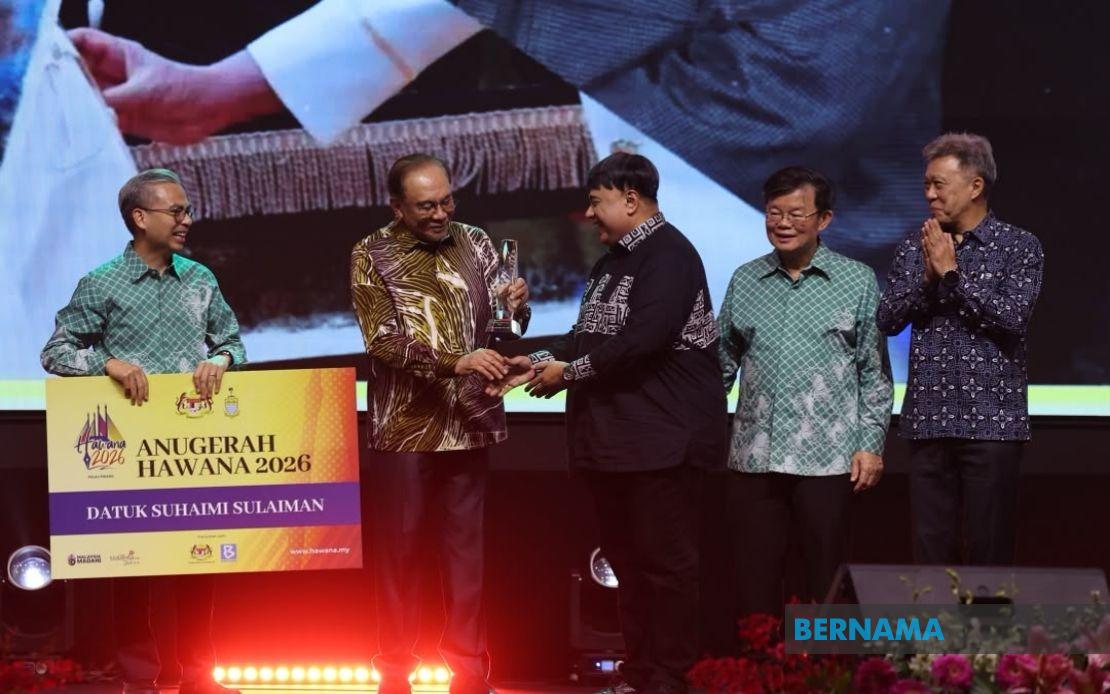
Datuk Suhaimi Sulaiman, a veteran broadcaster and journalist who has spent more than three decades shaping Malaysia's media landscape, has been recognised with the National Journalists' Day (HAWANA) 2026 Award. The prestigious accolade was presented to him on June 20 at the HAWANA 2026 Grand Finale, held at PICCA @ Arena Butterworth Convention Centre in Butterworth, Penang, marking a significant acknowledgement of his enduring influence on the nation's journalism profession.
The award ceremony underscored the high regard in which Suhaimi is held within Malaysia's media establishment. Prime Minister Datuk Seri Anwar Ibrahim personally presented the honour, flanked by a distinguished gathering that included Penang Chief Minister Chow Kon Yeow, Communications Minister Datuk Fahmi Fadzil, and Malaysian National News Agency (Bernama) chairman Datuk Seri Wong Chun Wai. The presence of such senior government figures reflected not merely protocol but genuine recognition of Suhaimi's stature as a towering figure in Malaysian broadcasting and news management.
Suhaimi's career trajectory places him among the most influential media leaders in Malaysia's post-independence era. His tenure as director-general of Broadcasting Malaysia (RTM), the country's premier state broadcaster, positioned him at the helm during formative periods of Malaysian television and radio development. Throughout his professional journey, he has navigated the complexities of public service broadcasting while maintaining editorial standards and journalistic integrity—a balance increasingly difficult in polarised media environments.
In responding to the accolade, Suhaimi articulated a perspective that resonates deeply with contemporary challenges facing the journalism profession globally and in Southeast Asia. Rather than treating the award as a capstone to his career, he framed it as motivation for continued engagement with the industry's evolving dynamics. His acknowledgement of artificial intelligence as a transformative force reshaping media operations demonstrates acute awareness of the technological disruptions confronting newsrooms across the region.
The emergence of AI as a dominant theme in Suhaimi's remarks carries particular significance for Malaysian media practitioners. The industry faces mounting pressure to adopt automation for routine news production, content curation, and audience analytics, while simultaneously grappling with concerns about job displacement, algorithmic bias, and the potential erosion of investigative journalism's economic foundation. Suhaimi's emphasis on continuous learning and knowledge acquisition in this context positions him as an elder statesman advocating for thoughtful adaptation rather than passive absorption of technological change.
For Malaysian journalists and media professionals, Suhaimi's recognition via HAWANA 2026 carries symbolic weight that extends beyond individual honour. The award itself, administered by Bernama, represents the journalism establishment's commitment to celebrating excellence and institutional memory within the profession. In an era when trust in media institutions faces erosion globally and regionally, honouring figures who have dedicated their careers to upholding journalistic standards sends an important signal about the profession's values and aspirations.
Suhaimi's three-decade trajectory also reflects Malaysia's broader media evolution. He entered the profession during an era of limited broadcast channels and tightly controlled state media, progressed through the introduction of commercial competition and cable television expansion, and now confronts a digital-first, platform-driven information ecosystem. His accumulated experience across these transformative periods positions him as a living bridge between institutional journalism and emerging media paradigms—a role increasingly valuable as the industry searches for sustainable business models and credibility frameworks.
The HAWANA award ceremony itself serves as an annual gathering point for Malaysia's journalism community, reinforcing professional identity and collective commitment to ethical standards. Such ceremonial recognition of individual excellence helps counterbalance the fragmentation and atomisation characterising modern media production, where freelancers and gig workers increasingly outnumber permanent staff. By celebrating Suhaimi's contributions, the gathering implicitly reaffirms the value of institutional journalism and long-term professional commitment.
Suhaimi's emphasis on learning rather than closure when accepting the award reflects maturity about the journalism profession's inherent incompleteness. Unlike fields with stabilised knowledge bases, journalism continuously confronts novel challenges—from technological disruption to audience behavioural change to geopolitical developments affecting editorial independence. His framing of the award as motivating continued knowledge acquisition rather than marking professional culmination models the adaptive mindset increasingly essential for media practitioners across Southeast Asia.
The timing of this recognition occurs within a broader context of media industry restructuring across Malaysia and the region. Newsrooms have contracted, digital transition has disrupted traditional revenue models, and the proliferation of unverified information sources has complicated journalism's gatekeeping role. Against this challenging backdrop, Suhaimi's three decades of sustained contribution to professional standards and institutional integrity become especially noteworthy. His career demonstrates that committed journalism leadership can persist and maintain influence across multiple technological cycles and business model transformations.
Looking forward, Suhaimi's positioning as continuing advocate for thoughtful AI adoption and professional development could influence how Malaysian media organisations approach digital transformation. Rather than treating technology primarily as a cost-cutting mechanism, his emphasis on human learning alongside technological implementation suggests frameworks prioritising journalism's ultimate purpose—serving public understanding and democratic discourse—over mere operational efficiency.
The HAWANA 2026 Award also highlights the journalism establishment's recognition that sustained institutional memory and cross-generational knowledge transfer represent critical resources for the profession's evolution. As newsrooms become leaner and turnover accelerates, mentoring relationships and deliberate preservation of professional wisdom become increasingly valuable. Suhaimi's continued engagement with the industry, rather than full retirement, ensures that accumulated insights from three decades of broadcasting leadership remain accessible to emerging practitioners navigating unfamiliar technological and commercial terrain.

