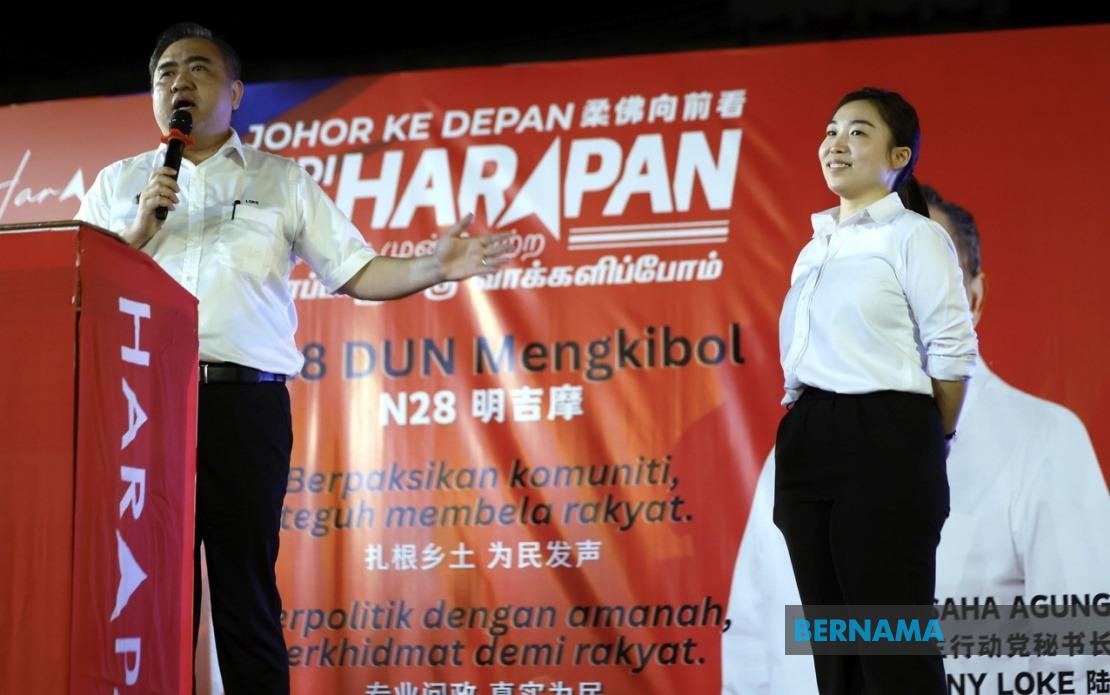
The Democratic Action Party has signalled its commitment to expanding female representation in the upcoming Johor state election by nominating 33-year-old lawyer Chu Poh Yee to contest the Mengkibol seat. The announcement, made at a candidate declaration event in Kluang on June 18, marks a strategic transition in the constituency, which has been represented by the incumbent assemblyman for two consecutive terms. The move reflects broader efforts within the party to inject fresh talent into state-level politics whilst maintaining continuity through careful succession planning.
Party secretary-general Anthony Loke explained that the selection of Chu represents part of a deliberate party strategy to elevate women candidates to competitive seats. Rather than treating female nominations as token gestures, DAP has positioned Chu in a seat currently held by the party, suggesting confidence in her ability to retain the constituency for the coalition. Loke highlighted her professional credentials, noting her strong educational background, multilingual capabilities, and genuine community connections within the Mengkibol district. These qualifications address a persistent question in Malaysian electoral politics about whether female candidates receive the same level of substantive preparation and support as their male counterparts.
The transition of the current assemblyman Chew Chong Sin represents a calculated move up the political ladder. Having completed two terms representing Mengkibol at state level, Chew is being groomed for parliamentary representation. Specifically, he will be nominated for the Labis parliamentary seat following an announcement by incumbent MP Pang Hok Liong that he will not contest the next general election. This succession reflects how established parties manage talent progression, identifying capable legislators early and positioning them for advancement to federal politics. The arrangement demonstrates a coordinated approach within the Pakatan Harapan coalition, where state and federal candidacies are being synchronised to optimise the coalition's overall electoral prospects.
Chu's background in legal practice, particularly her experience assisting elected representatives with legal aid cases, provides a foundation directly relevant to constituency service work. In Malaysian politics, assemblypersons routinely handle legal aid requests from constituents, navigating the bureaucracy of criminal justice, civil claims, and family law matters. A lawyer with demonstrated expertise in these areas brings practical value to the position beyond typical political credentials. Her institutional knowledge of how the legal system operates and her existing relationships within the legal community could enhance her effectiveness in addressing constituent grievances, an increasingly important factor in electoral competition as voters prioritise service quality over party loyalty.
The broader context of DAP's candidate selection for Johor reveals a party operating from a position of relative strength in the state. The party is fielding candidates across 17 state seats, comprising ten currently held constituencies, four previously lost seats the party intends to reclaim, and three additional aspirational seats. This range of targets suggests DAP remains competitive across multiple districts despite demographic and political shifts in Johor over recent years. The party's ability to field candidates in such breadth, combined with a process that apparently vetted each nominee through democratic procedures, indicates organisational capacity that many regional parties lack.
The sequencing of candidate announcements reflects careful coordination within the Pakatan Harapan coalition at both state and federal levels. Four additional candidates for the seats of Tiram, Johor Jaya, Senai, and Bukit Permai were scheduled for announcement the Saturday following Chu's unveiling. The remaining candidates were set to be announced jointly with other coalition partners the following Monday by the Prime Minister, suggesting that the coalition has negotiated seat allocations across its component parties and that final approval rested at the highest political level. This choreography is typical of coalition management in Malaysian politics, where public announcements must be coordinated to avoid internal tensions or rival parties exploiting divisions.
For Malaysian voters, the selection of candidates like Chu reflects evolving expectations about political representation. The presence of a female lawyer contesting from a secure party seat normalises women's participation in elected politics beyond symbolic appointments. Johor remains a bellwether state for Malaysian politics, and the outcomes of this election will influence whether female representation becomes institutionalised across the country's political landscape or remains a sporadic gesture towards inclusivity. The voters of Mengkibol, in effect, will participate in a broader national conversation about gender parity in political leadership through their local ballot.
The timing of these announcements, in the lead-up to a state election that simultaneously precedes federal polling, shapes the political narrative in Johor during a period of heightened electoral competition. For DAP specifically, the emphasis on diverse candidacies—younger, professional, female—signals an attempt to project modernity and inclusivity as organisational values. This messaging carries particular weight in urban and semi-urban constituencies where voters increasingly prioritise competence and representation quality over longstanding party loyalty or communal voting patterns.
The repositioning of Chew Chong Sin also deserves attention as a case study in how Malaysian political parties manage internal succession and ambition. Two terms as state assemblyman appears to be increasingly recognised as an appropriate tenure before seeking advancement to the federal tier, particularly in competitive states where fresh candidates might energise electoral performance. This timing aligns with global political trends where younger politicians are expected to move between electoral levels rather than cement themselves in single constituencies, yet it remains relatively novel within Malaysian practice where incumbents historically maintained seats across multiple electoral cycles.
Looking ahead, the selection of Chu and the broader slate of DAP candidates will test whether the party's stated commitment to diversity translates into improved electoral performance. If Chu successfully retains Mengkibol and other newly nominated candidates expand DAP's representation in Johor, the party will have demonstrated that candidate selection based on merit and community ties outweighs traditional factors such as factional connections or inherited political position. Conversely, any losses could be interpreted as evidence that voters remain unpersuaded by efforts to rebrand party identities through candidate selection alone, particularly if broader coalitional or economic concerns dominate voting behaviour. The election results will thus provide empirical data for assessing whether Malaysian voters have shifted their evaluation criteria for political representatives.

